
UNODC Security Council Periodic Report, July 2026
- Records OHCHR reporting at least 2,310 deaths, 1,106 injuries and 99 kidnappings between January and early June.
- Cites Human Rights Watch counting at least 1,243 people killed, and IOM documenting 5,291 displaced persons.
- Documents individual interdictions: three firearms with magazines and 1,800 rounds of 9 mm ammunition, and separately 10,659 rounds of ammunition, six drones and communication equipment seized by customs at Gonaives.
- Records more than 1,000 tactical uniforms intercepted, which is a supply-chain detail rather than a weapons seizure.
- The eleventh UNODC report to the Security Council, covering January to July 2026.
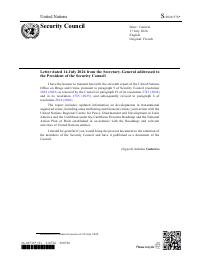
Transmitted to the President of the Security Council by the Secretary-General on July 14, 2026 and issued as S/2026/578 on July 17, this is the eleventh report of the UN Office on Drugs and Crime under paragraph 9 of resolution 2692 (2023), renewed by paragraph 19 of resolution 2743 (2024) and by resolution 2785 (2025), and revised by paragraph 6 of resolution 2814 (2026). It covers January to July 2026 across eight sections. Gangs consolidated and expanded territorially in Artibonite and areas adjacent to Port-au-Prince, with pressure beginning to reach corridors towards the south-east; activity intensified from April, which the report links to the drawdown of the Multinational Security Support Mission after the April 15, 2026 transition deadline and to gangs exploiting the handover to the Gang Suppression Force.
On arms, the United States-Haiti firearms corridor through maritime cargo channels remains the clearest documented external supply line. On drugs, joint operations by the Bureau de lutte contre le trafic de stupéfiants and the Haitian Coast Guard produced cocaine seizures around Les Cayes in April and May. A section on scarcity argues that dependence on imported fuel and food makes distribution networks and the Varreux terminal points of leverage over the State, humanitarian actors and the economy. On financial crime, the report notes the April 2025 decree establishing two specialized judicial poles for complex financial crimes and for mass crimes including sexual violence, and Haiti's first national money-laundering and terrorist-financing risk assessment presented on March 11, 2026, while cautioning that such reforms need time to produce judicial outcomes.
Closing sections cover migrant smuggling and trafficking in persons, and the regional exposure of neighboring states and the wider Caribbean through displacement, route diffusion, illicit financial flows and higher shipping, insurance and compliance costs.
How to cite
United Nations Office on Drugs and Crime (UNODC), UNODC Security Council Periodic Report, July 2026, https://docs.un.org/en/S/2026/578