
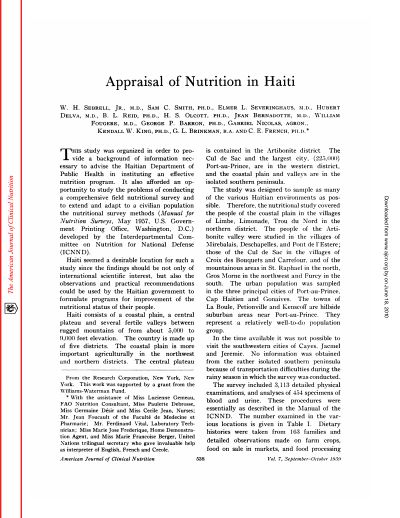
Appraisal of Nutrition in Haiti
- The survey concludes that the Haitian peasant suffers from multiple nutritional deficiencies.
- Insufficient calories and protein are named as the most important, shown by underweight, poor muscular development and short stature.
- Kwashiorkor was present in young children in all degrees of severity.
- Serum vitamin A levels were low, and the survey found signs of riboflavin deficiency, small goiters and moderate anemia.
- The authors recommend iodated salt, enriched white flour, dried skim milk for children and a nutrition division in the Department of Public Health.
The authors, led by W. H. Sebrell, describe a nutrition survey of Haiti that used the techniques of the Interdepartmental Committee on Nutrition for National Defense, adapted to a civilian population. The study included an appraisal of food habits and vital statistics, as well as clinical examinations of about 3,000 persons in a number of villages and cities, and biochemical determinations on blood and urine from about 15 percent of those examined.
They conclude that the Haitian peasant suffers from multiple nutritional deficiencies, the most important being insufficient calories and protein, shown by underweight, poor muscular development, short stature and a high total serum protein with relatively low serum albumin. Kwashiorkor was present in young children in all degrees of severity. The survey also found signs of vitamin A and riboflavin deficiency, small goiters and moderate anemia. The paper recommends creating a nutrition division in the Department of Public Health, distributing dried skim milk and vitamin A capsules through hospitals and dispensaries, adding iodate to salt, enriching white wheat flour, and encouraging parboiled rice.
How to cite
American Journal of Clinical Nutrition, 1959, Appraisal of Nutrition in Haiti, accessed via HaitiDocs, https://www.haitidocs.org/doc/sebrell-1959-appraisal-nutrition-haiti
- Rights holder
- American Journal of Clinical Nutrition