
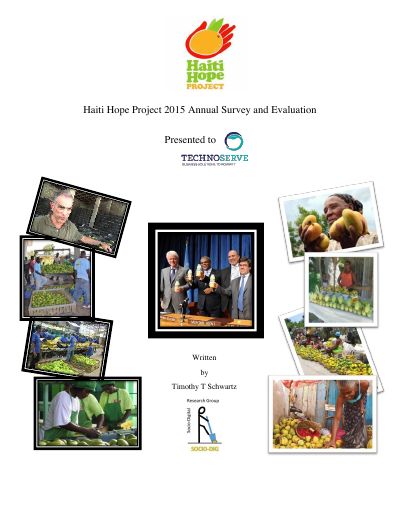
Haiti Hope Project 2015 Annual Survey and Evaluation
- Haiti Hope signed up and trained 25,125 producers, formed 262 producer business groups and loaned 3.2 million USD to 9,352 farmers.
- Counting only participants who attended trainings, adopted best practices and sold at least once reduces the figure from 25,125 to 4,116.
- The project had no detectable impact on volumes produced.
- Farm-gate prices in gourdes rose 42% over the life of the project, but in US dollars the average change disappears.
- Local market prices per dozen are consistently 20% to 40% higher than farm-gate prices paid in the export market chain.
Timothy T. Schwartz evaluates Haiti Hope, a $10 million mango project sponsored by the Coca-Cola Company, the Multilateral Investment Fund, USAID and the Soros Foundation, whose objective was to raise the income of 25,000 mango farmers. The report has three parts: methodology and results, analysis of prices, volumes, income and adoption of best practices, and an assessment of the assumptions behind the project and the interests of producers, intermediaries, exporters and NGOs.
The project signed up and trained 25,125 producers, formed 262 producer business groups and registered 6,122 producer plots. The report finds that counting only those who attended trainings, adopted practices and sold at least once reduces participation to 4,116, that there was no detectable impact on volumes, and that price gains in gourdes disappear in US dollars. It concludes that the project was limited by assumptions about the domestic value of mangos, producers' interest in the export market and the commitment of the export cartel.
How to cite
Timothy T. Schwartz, Haiti Hope Project 2015 Annual Survey and Evaluation, accessed via HaitiDocs, https://www.haitidocs.org/doc/schwartz-2015-haiti-hope-project-annual-survey-evaluation
- Rights holder
- Timothy T. Schwartz