
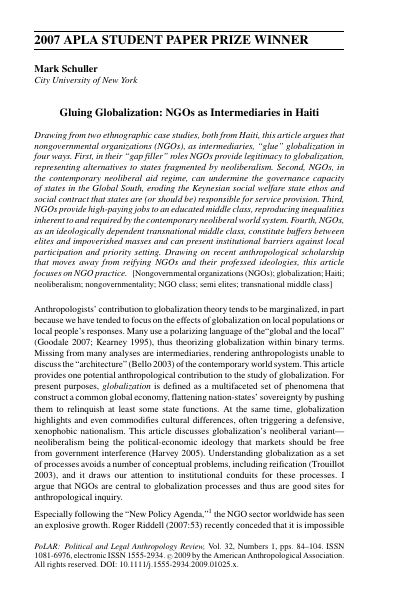
Gluing Globalization: NGOs as Intermediaries in Haiti
- The article argues that NGOs act as gap fillers that give legitimacy to globalization by standing in for states fragmented by neoliberalism.
- It argues that NGOs in the contemporary neoliberal aid regime can undermine the governance capacity of states in the Global South.
- It argues that NGOs provide high-paying jobs to an educated middle class and reproduce inequalities of the world system.
- It argues that NGOs form a buffer between elites and impoverished masses and can create institutional barriers to local participation and priority setting.
- It reports that a full 90 percent of the Haitian government budget was financed externally in the mid-1990s.
The article by Mark Schuller won the 2007 APLA student paper prize and appeared in PoLAR in 2009. Drawing on two ethnographic case studies in Haiti, it argues that NGOs act as intermediaries who glue globalization in four ways: they fill gaps left by states fragmented by neoliberalism, they can weaken state governance capacity, they provide high-paying jobs to an educated middle class, and they form a buffer between elites and impoverished masses that can limit local participation and priority setting.
The text places this in the history of external financing of the Haitian state in the 1990s. It cites a share of 90 percent of the government budget financed externally in the mid-1990s, and it reports inequality figures for Haiti.
How to cite
PoLAR: Political and Legal Anthropology Review, 2009, Gluing Globalization: NGOs as Intermediaries in Haiti, https://doi.org/10.1111/j.1555-2934.2009.01025.x
- Rights holder
- PoLAR: Political and Legal Anthropology Review