
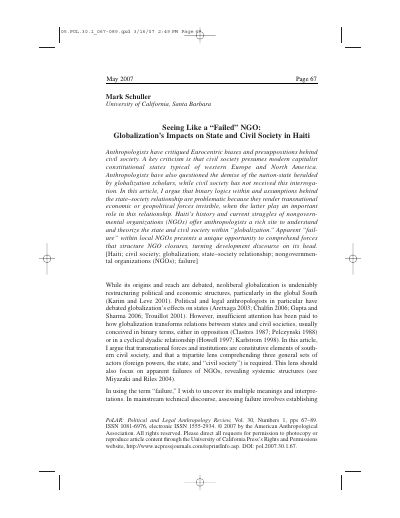
Seeing Like a "Failed" NGO: Globalization's Impacts on State and Civil Society in Haiti
- The author argues that binary logics within the state and society relationship render transnational economic or geopolitical forces invisible.
- Haiti's history and the struggles of NGOs offer a site to theorize the state and civil society within globalization.
- Apparent failure within local NGOs offers a way to understand the forces that structure NGO closures.
- The article cites the 1825 recognition of Haitian independence by France with a 150 million franc indemnity.
Mark Schuller argues that assumptions behind the state and society relationship are problematic because they make transnational economic and geopolitical forces invisible. He uses Haiti's history and the struggles of nongovernmental organizations to examine the state and civil society within globalization. He treats apparent failure within local NGOs as a way to understand the forces that structure NGO closures, reversing the usual development discourse. The article reviews Haitian history including the 1825 indemnity of 150 million francs paid to France, the Duvalier era and the aid regime.
How to cite
PoLAR: Political and Legal Anthropology Review, 2007, Seeing Like a "Failed" NGO: Globalization's Impacts on State and Civil Society in Haiti, accessed via HaitiDocs, https://www.haitidocs.org/doc/schuller-2007-seeing-like-a-failed-ngo
- Rights holder
- PoLAR: Political and Legal Anthropology Review