
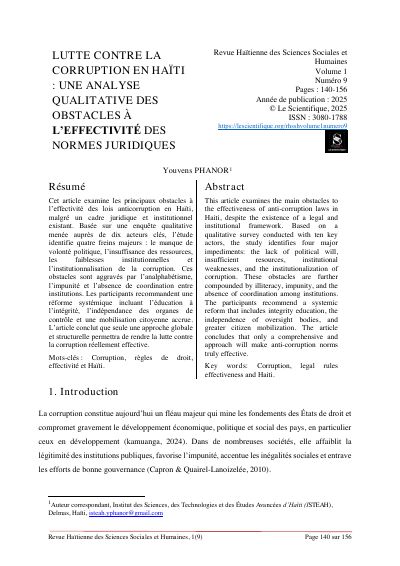
Fighting Corruption in Haiti: A Qualitative Analysis of the Obstacles to the Effectiveness of Legal Norms
- Haiti has anti-corruption laws and institutions, including the ULCC, the UCREF and the CSCCA, and has signed the anti-corruption conventions of the United Nations and the Inter-American system, yet corruption remains endemic.
- Ten participants from the ULCC, the UCREF and the judiciary identified four obstacles: lack of political will, insufficient resources, institutional weaknesses and the institutionalization of corruption.
- Participants see a consensus that lack of political will is the main brake, with laws adopted under pressure from international donors and no commitment to apply them.
- The ULCC and the UCREF depend on the executive for funding and for the appointment of their heads, and executive interference in investigations is reported.
- Participants recommend integrity education, budgetary and statutory autonomy for the ULCC and the UCREF, a specialized prosecutor's office for economic crimes, systematic sanctions including asset confiscation, translation of the laws into Creole and a ten-year national strategy.
- The author lists two limits: the UCREF director could not be met, and other anti-corruption institutions were not covered.
The article, published in the Revue Haïtienne des Sciences Sociales et Humaines (volume 1, number 9, 2025), asks why Haiti's anti-corruption laws and institutions, among them the ULCC, the UCREF and the CSCCA, produce few concrete effects. It uses a qualitative, phenomenological approach with ten participants drawn from the ULCC, the UCREF and the judiciary, interviewed in semi-structured sessions of 30 to 40 minutes and analyzed with QDA Miner.
The participants identify four obstacles: lack of political will, insufficient resources, institutional weaknesses and the institutionalization of corruption. Illiteracy, impunity and weak coordination between institutions make them worse. The recommended reforms are education in integrity, independence for the oversight bodies, a specialized prosecutor's office for economic crimes, systematic sanctions and a ten-year national strategy involving civil society. The author notes two limits: the director of the UCREF could not be interviewed, and access to some regions was restricted by crime.
How to cite
Le Scientifique, 2025, Fighting Corruption in Haiti: A Qualitative Analysis of the Obstacles to the Effectiveness of Legal Norms, https://lescientifique.org/wp-content/uploads/2025/08/Lutte-contre-la-corruption-en-Haiti-une-analyse-qualitative-des-obstacles-a-leffectivite-des-normes-juridiques.pdf
- Rights holder
- Le Scientifique