
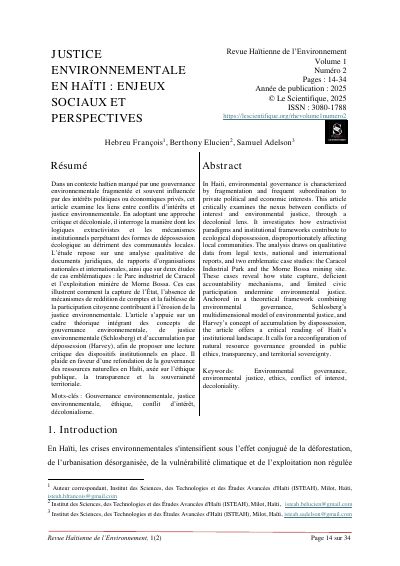
Environmental Justice in Haiti: Social Stakes and Outlook
- Environmental governance in Haiti is fragmented and often influenced by private political and economic interests.
- The study draws on legal texts, national and international reports, and two case studies: the Caracol Industrial Park and the Morne Bossa mining site.
- State capture, missing accountability mechanisms and weak citizen participation erode environmental justice.
- Local communities are largely excluded from decisions, which produces inequalities of recognition, redistribution and participation.
- Community mobilizations show a popular political ecology that proposes alternatives based on ecological sovereignty and collective management of common goods.
- The authors call for transparent and inclusive mechanisms, better accountability and stronger local capacity.
The article examines how conflicts of interest between public, private and international actors weaken environmental governance in Haiti. It combines a qualitative review of legal texts and reports from national and international organizations with two case studies, and draws on Schlosberg's model of environmental justice and Harvey's concept of accumulation by dispossession.
The authors find that state capture, missing accountability mechanisms and weak citizen participation exclude local communities from decisions and produce inequalities of recognition, redistribution and participation. They call for natural resource governance based on public ethics, transparency and territorial sovereignty, with inclusive mechanisms and stronger local capacity.
How to cite
Le Scientifique, 2025, Environmental Justice in Haiti: Social Stakes and Outlook, https://lescientifique.org/wp-content/uploads/2025/09/JUSTICE-ENVIRONNEMENTALE-EN-HAITI-ENJEUX-SOCIAUX-ET-PERSPECTIVES.pdf
- Rights holder
- Le Scientifique