
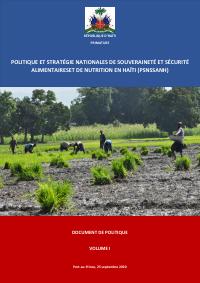
National Food Sovereignty, Food Security and Nutrition Policy and Strategy (PSNSSANH), Volume I: Policy
- Rests on four strategic decisions, the first of which is to rebalance away from policies favoring international trade toward food sovereignty, and names current trade policy, the tariff profile and budget policy as sources of poverty, hunger and malnutrition.
- Translates into 35 measures and 25 national programs across 11 ministries and 12 agencies, with a new office, ONASAN, to be created by legal text as the implementing structure.
- Records rice self-sufficiency at about 17 percent and 58 percent for food crops overall, against 8 percent of rice imported in 1985, the year before structural reform of agricultural markets, and 83 percent of rice consumed imported now.
- Reports agriculture receiving 1.1 to 1.6 percent of the general budget and under 0.2 percent of private credit.
- Projects agricultural GDP growth of 6.7 percent a year to 2030 creating 3 million lasting jobs, against 87,000 from 10 percent annual growth in manufacturing GDP, and food-crop self-sufficiency rising to 88 percent.
- Carries the DRAFT marking on its final page, so it should be cited as a policy document rather than as an adopted instrument.
Volume I of Haiti's national policy on food sovereignty, food security and nutrition, issued by the Prime Minister's office on 25 September 2020 after several years of consultation. The final page is marked DRAFT, which is worth knowing before citing it as an adopted policy.
The policy's premise is that Haiti's growth is held down by an agriculture in retreat since the 1980s and by eroding human capital, and that the current trade policy, tariff profile and budget policy are themselves sources of poverty, hunger and malnutrition. It rests on four strategic decisions: rebalancing away from policies favoring international trade toward food sovereignty, making family farming and agro-industry the motor of recovery, investing in social safety nets and basic services, and building the national capacity for a food-security program budget under the LEELF law. It is organized in four axes, political, operational, institutional and cross-cutting, and translates into 35 measures and 25 national programs to be carried out by 11 ministries and 12 agencies, with a new agency, ONASAN, to be created by a legal text as the implementing structure.
The diagnosis is where the numbers are. Rice self-sufficiency is about 17 percent and 58 percent for food crops overall, against only 8 percent of rice imported in 1985, the year before structural reform of agricultural markets; 83 percent of rice consumed is now imported. The 2012 poverty survey found 59 percent of Haitians poor and 24 percent in extreme poverty, some 6.3 million unable to meet basic needs and 2.5 million not eating enough, with more than 80 percent of the poor in rural areas. The richest 20 percent hold more than 64 percent of national wealth and the poorest 20 percent barely 1 percent. Agriculture receives 1.1 to 1.6 percent of the general budget and under 0.2 percent of private credit. Against that, the policy's own scenario has agricultural GDP growing 6.7 percent a year to 2030, creating 3 million lasting jobs, where 10 percent annual growth in manufacturing GDP would create 87,000, and raises food-crop self-sufficiency to 88 percent.
How to cite
Office of the Prime Minister of Haiti, 2020, National Food Sovereignty, Food Security and Nutrition Policy and Strategy (PSNSSANH), Volume I: Policy, http://agriculture.gouv.ht/wp-content/uploads/2026/07/PSNSSANH_Volume-1-2-decembrebre-2020.pdf