
Islands Energy Snapshot: Haiti (Energy Transition Initiative)
Summary — A four-page energy profile of Haiti in the Energy Transition Initiative's island series.
Key Findings
- Places Haiti's electricity cost above the Caribbean regional average of US$0.33 per kilowatt-hour.
- Records a target of 50 percent electrification by 2020.
- Part of an island energy series, so Haiti is presented comparably to its neighbors.
Full Description
A four-page energy profile of Haiti in the Energy Transition Initiative's island series. Short, but it places Haiti's electricity tariff against the Caribbean regional average, which is the comparison that frames every argument about the sector's viability.
Full Document Text
Extracted text from the original document for search indexing.
Islands
Energy Snapshot
Haiti
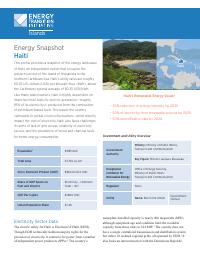
This profile provides a snapshot of the energy landscape
Haiti
of Haiti, an independent nation that occupies the
western portion of the island of Hispaniola in the
northern Caribbean Sea. Haiti’s utility rates are roughly
$0.35 U.S. dollars (USD) per kilowatt-hour (kWh), above
the Caribbean regional average of $0.33 USD/kWh.
Like many island nations, Haiti is highly dependent on Haiti’s Renewable Energy Goals:3
imported fossil fuels for electric generation—roughly
85% of its electricity is produced from the combustion • 30% reduction in energy intensity by 2030
of petroleum-based fuels. This leaves the country
• 50% of electricity from renewable sources by 2020
vulnerable to global oil price fluctuations, which directly
impact the cost of electricity. Haiti also faces challenges • 50% electrification rate by 2020.
in terms of lack of grid access, reliability of electricity
service, and the prevalence of wood and charcoal fuels
for home energy consumption. Government and Utility Overview
Ministry: Ministry of Public Works,
Government Transport and Communication
Population 1
9,997,000
Authority
Key Figure: Minister Jacques Rousseau
Total Area 27,750 sq. km
Designated Office of Energy Security,
Gross Domestic Product (GDP) $18.54 billion USD Institution for Ministry of Public Work,
Renewable Energy Transport and Communication
Share of GDP Spent on Electricity – Unknown
Fuel and Imports Total – 4%2 Regulator None
GDP Per Capita $1,800 USD Government-
Utility Name: Electricité d’Haïti
Owned
Urban Population Share 57.4%
nameplate installed capacity is nearly 400 megawatts (MW),
Electricity Sector Data although equipment age and condition limit the available
The electric utility for Haiti is Electricité d’Haïti (EDH). capacity from those units to 244 MW.4 The country does not
Though EDH technically holds monopoly rights for the have a single centralized transmission and distribution system
provision of electricity, it contracts for power from a number but rather 10 isolated regional grids, all operated by EDH.5 It
of independent power producers (IPPs).4 The country’s also lacks an interconnection with the Dominican Republic,
Electricity Sector Overview
Total Installed
244 MW
Capacity (2011)7 Energy Consumption by Sector (2011)
Peak Demand 250–500 MW (est.) Residential 11%
Total Generation Losses 66% Commercial &
875 gigawatt-hours Public Agencies 8%
(2011)
Commercial, Large 15%
Renewable Share
15%
(2011)
Energy Generation Mix (2011)
Transmission &
Distribution Losses 66%
(2011)
Hydroelectric Petroleum
15% 85%
Electrification Rate
25%
(2010)
Residential $0.28
Commercial $0.37 Existing Policy and Regulatory Framework3
Average
Electricity Tariffs Industrial $0.39
Renewable Energy
(USD/kWh)8
Feed-in Tariff
Public Authorities $0.37
Net Metering/Billing
Public Lighting $0.37
Interconnection Standards
Renewables Portfolio Standard/Quota
its neighbor to the east with which it shares the island of Tax Credits
Hispaniola. Several studies have suggested that such a link
Tax Reduction/Exemption
would be technically feasible, although political and energy
security concerns in Haiti have forestalled that option.4,5 Public Loans/Grants
The electricity sector in Haiti faces numerous challenges. Green Public Procurement
First, it has a very high rate of losses, with almost two-thirds
Energy Efficiency
of the electricity produced failing to reach a paying customer.
Roughly 70% of those system losses, or 46% of all energy Energy Efficiency Standards
produced, are due to non-technical factors including energy
Tax Credits
theft and the inability of EDH to effectively bill customers
and collect payment.4 Second, Haiti has one of the lowest Tax Reduction/Exemption
electrification rates in the world, with 12.5% of the popula-
Public Demonstration
tion using an official grid connection and an equal number
connecting illegally for a total electrification rate of 25%.4 Restrictions on Incandescent Bulbs
In the past, illegal connections and artificially low rates
charged to official customers have driven EDH to require an Appliance Labeling Standards
annual operating subsidy of $170 million from the Haitian Targets
government.6 Additionally, those customers may only receive
electricity between 5 and 15 hours per day.4 Renewable Energy
Energy Efficiency
In Place In Development
Renewable Energy Status and Potential4,10
Wind Hydropower Geothermal Ocean Biomass Solar
Potential: High
Potential: High Installed Capacity: Potential: Unknown Potential: Unknown Potential: Low Potential: High
Installed Capacity: 0 40 MW Installed Capacity: 0 Installed Capacity: 0 Installed Capacity: 1 MW Installed Capacity: 0
Clean Energy Policy Environment Energy Efficiency and
Haiti’s clean energy policy environment has yet to be defined. Renewable Energy Projects
Responsibility for energy policy and implementation is To date, Haiti’s renewable energy development has been lim-
fragmented between many government bodies that have ited to a number of small hydroelectric installations. Despite
direct or indirect influence on the energy sector. This diffu- having a total installed hydroelectric capacity of 62 MW, the
sion of responsibilities stems in part from the lack of a single operational capacity is only 40 MW due to out-of-service
agency wholly focused on energy issues. Among the agencies turbines or reduced water flow rates due to accumulation of
responsible for energy policy are the Ministry of Public silt.4 There have been a number of small-scale solar projects,
Works, Transport, and Communications, and the Bureau of including the distribution of home solar lights and an off-
Mines and Energy. Since 2006, these two agencies have been grid solar system at a teaching hospital near Port-au-Prince.9
working with EDH to develop a national energy policy, with However, there has not yet been any significant adoption
the most recent draft released in 2012. However, as of this of grid-tied solar systems, whether at the customer or
publication it still has not been implemented.3 utility scale.
The current draft of the proposed national energy policy also
sets several energy goals for Haiti to be achieved by the year Opportunities for Clean
2020, including reducing energy intensity of the economy by Energy Transformation
30% and increasing the portion of electricity generated from Haiti faces many challenges in its transition toward clean
renewable sources to 50%.3 Recognizing the widespread energy, such as its aging electrical infrastructure, lack of clear
deforestation caused by household reliance on wood and governance in the energy sector, and the poverty faced by
charcoal fuels and the overall lack of access to electricity, the many of its citizens. However, these obstacles also suggest
draft would seek to raise the electrification rate to 50% by that the impact of increased adoption of clean energy will be
2020.3 To enable greater adoption of renewable energy, the felt far beyond the electricity system. For example, instead
draft national energy plan also calls for the completion of simply replacing diesel electricity generation with wind
of nationwide wind, solar, and hydroelectric resource or solar, Haiti could displace the combustion of wood and
assessment maps.4 charcoal fuels that make up 77% of primary energy use in
Haiti and the cooking fuel in 93% of households.4 This
shift would create huge benefits in term of respiratory
health, public safety, economic productivity, and
environmental preservation.
Energy Transition Initiative
This energy snapshot was prepared to support the Energy Transition
Initiative, which leverages the experiences of islands, states, and cities that
have established a long-term vision for energy transformation and are
successfully implementing energy efficiency and renewable energy projects
to achieve established clean energy goals.
Through the initiative, the U.S. Department of Energy and its partners
provide government entities and other stakeholders with a proven
framework, objective guidance, and technical tools and resources for
transitioning to a clean energy system/economy that relies on local
resources to substantially reduce reliance on fossil fuels.
1
All information in this table is from the CIA World Factbook, unless otherwise 6
http://www.usaid.gov/haiti/energy.
noted; https://www.cia.gov/library/publications/the-world-factbook/geos/ha.html.
7
All information in this table is from the Haiti Sustainable Energy Roadmap,
2
http://stat.wto.org/StatisticalProgram/WSDBStatProgramHome.aspx?Language=E. unless otherwise noted; http://www.worldwatch.org/system/files/Haiti-Roadmap-
English_0.pdf.
3
http://www.bme.gouv.ht/energie/Declaration%20de%20politique%20
energetique_ebauche9.pdf. 8
http://www.edh.ht/tarif.php.
4
http://www.worldwatch.org/system/files/Haiti-Roadmap-English_0.pdf. 9
http://www.theguardian.com/global-development/2013/dec/17/haiti-solar-power-
sustainable-electricity-solution.
5
http://www-wds.worldbank.org/external/default/WDSContentServer/WDSP/IB/
2011/02/27/000356161_20110227233101/Rendered/PDF/594590ESW0WHIT1 10
http://www.worldwatch.org/system/files/nPhase%201%20C-SERMS%20
icity0Supply0Options.pdf. Summary%20for%20Policymakers%20(1).pdf.
Page 1 photo from IStock 886989; page 4 photo from iStock 29878236
Prepared by the National Renewable Energy Laboratory (NREL), a national
laboratory of the U.S. Department of Energy, Office of Energy Efficiency and
Renewable Energy; NREL is operated by the Alliance for Sustainable Energy, LLC.
Islands DOE/GO-102015-4657 • June 2015
How to cite
National Renewable Energy Laboratory (NREL), 2015, Islands Energy Snapshot: Haiti (Energy Transition Initiative), accessed via HaitiDocs, https://www.haitidocs.org/doc/nrel-2015-islands-energy-snapshot-haiti