
Planning Scheme for Martissant
- The zone is a concerted development area of Port-au-Prince split into four neighborhoods and treated as a representative sample of the city.
- The seafront neighborhood, more than 40 ha, is proposed as a mixed residential district of about 3,000 housing units in place of the La Joie settlement of about 2,500 houses.
- Pilot housing operations are set at Dantès (200 units short term, 400 long term) and Ti Bois (350 short term, 500 long term).
- A survey of 205 households in La Joie found that 70 percent of the buildings have no road access for vehicles and that a quarter of the homes have no toilet at all.
- Builders usually charge US$200 to 250 per square meter without seismic standards, and applying the standards roughly doubles the price to US$500.
- Haitian law has no instrument for such a scheme, so the report proposes adoption by order of the Prime Minister and an interim steering unit that would prefigure an urban agency.
The scheme for Martissant and a companion scheme for Baillergeau came from an international tender of the public works ministry, which delegated project ownership to the Fondation Connaissance et Liberté (FOKAL) and obtained financing from the Agence Française de Développement. The report calls it the first exercise of its kind. It is not a reconstruction plan but a neighborhood outlook built through a participatory process, meant as a reference framework for about twenty years. The study ran in three phases, from the framing phase approved by the steering committee of July 2011 to the final scheme at the end of February 2012.
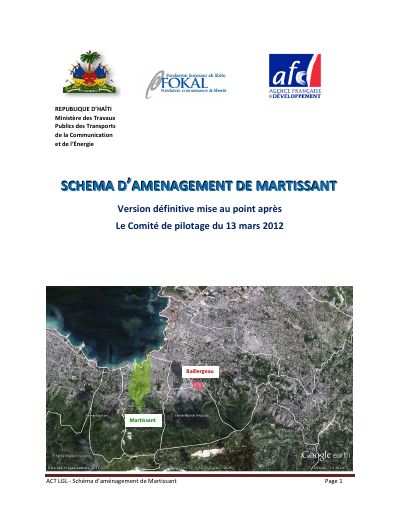
The concerted development zone (ZAC) was created by presidential decree in 2007 around the Martissant Park, in the third communal section of Port-au-Prince, Morne l'Hôpital, which had 220,484 inhabitants at the 2003 census. The report splits it into four neighborhoods from the coast to the quarries of Morne l'Hôpital: a seafront district proposed as a city reconciled with the sea (more than 40 ha, where the La Joie settlement has about 2,500 houses), the historic heart, the Hauts de Martissant and the hills for peri-urban farming and leisure. It lists flood, landslide, earthquake and soil liquefaction risks, polluted water, and unplanned building.
The proposals are grouped in three axes: risk prevention and environment, public space and a new housing policy, and quality of life through jobs, education, health, social facilities and safety. They include pilot housing operations at Dantès (200 units in the short term, 400 in the long term) and Ti Bois (350 and 500), road and ravine works, and about 3,000 new housing units in the seafront district. Each action has a sheet, with cost estimates in US dollars for many of them. The last part sets out how to give the scheme a legal status through an order of the Prime Minister, an interim steering unit that would prefigure an urban agency, and the roles of the municipality, the operators, land action and participation.
How to cite
Ministry of Public Works, Transport and Communications (MTPTC); Fondation Connaissance et Liberté (FOKAL), 2012, Planning Scheme for Martissant, accessed via HaitiDocs, https://www.haitidocs.org/doc/mtptce-2012-schema-amenagement-martissant
- Rights holder
- Ministère des Travaux Publics, Transports et Communications (MTPTC)|Fondation Connaissance et Liberté (FOKAL)