
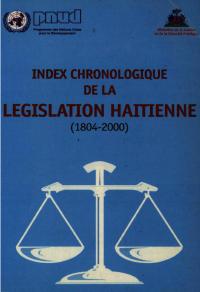
Chronological Index of Haitian Legislation (1804-2000)
- Indexes Haitian legislation from 1804 to 2000 by branch of law rather than in a single date sequence, opening with the Act of Independence and moving through public international law, Haitian public law, civil, commercial and penal law to a miscellaneous chapter.
- Gives each entry its Moniteur citation, the issue number and date of publication alongside the instrument's own date, which is the reference chain needed to find the text itself and what most Haitian legal sources lack.
- States on its own rights page that it is a research essay not claiming to be exhaustive, so it should be used as a finding aid rather than as an authoritative register.
- Subdivides administrative law finely, into central public administration, organic laws, administrative districts and territorial collectivities, administrative property law, public hygiene legislation and administrative police, which is where much of the operative regulation sits.
- Carries the international layer in three parts, universal instruments, regional instruments and bilateral agreements, with entries including treaties and accords with the United States, France, Japan, Spain, Germany and Belgium.
- Closes with a miscellaneous chapter covering judicial institutions and the liberal professions, industry and investment, general regulations, maritime law and aviation law, the areas that fall outside the standard codes.
- Was produced by the justice ministry with UNDP support and carries an ISBN, so it is a state publication rather than a private compilation.
A chronological index of Haitian legislation from 1804 to 2000, compiled by the Ministry of Justice and Public Security with UNDP support and published in Port-au-Prince in September 2001. It carries an ISBN and states plainly on its rights page that it is a research essay that does not claim to be exhaustive, which is the right way to read it.
Its organizing principle is branch of law rather than date within a single sequence. It opens with the Act of Independence, then public international law divided into universal instruments, regional instruments and bilateral agreements, then Haitian public law with constitutional, electoral and administrative law, the last subdivided into central public administration, organic laws, administrative districts and territorial collectivities, administrative property law, public hygiene legislation and administrative police. Education and culture law, tax law, customs law and fundamental rights follow, and later chapters cover civil, commercial and penal law with a final miscellaneous chapter taking in judicial institutions, the liberal professions, industry and investment, general regulations, maritime law and aviation law.
What makes it useful two decades on is the citation attached to each entry: the instrument, its date, and the number and date of the Moniteur issue in which it appeared. That is the reference chain a researcher needs to find the text itself, and it is exactly what is missing from most Haitian legal sources. The entries run from nineteenth-century acts through mid-century mining and commercial agreements to accords with the United States, France, Japan, Spain, Germany and Belgium.
How to cite
Ministry of Justice and Public Security (MJSP), 2001, Chronological Index of Haitian Legislation (1804-2000), https://andyreiter.com/wp-content/uploads/military-justice/ht/Government%20Documents/Haiti%20-%202001%20-%20Chronological%20Index%20of%20Haitian%20Legislation%20(1804-2000)%20%5BFrench%5D.pdf