
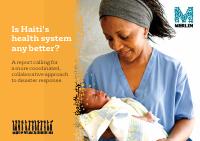
Is Haiti's Health System Any Better?
- Argues that the international health response, while welcome and vital, failed to support the existing health capacity, and calls for support to national health workers so that fragile countries can respond to a growing threat of disasters.
- Records a health sector chronically underfunded before the earthquake at less than 5 percent of the national government budget, with only 40 percent of the population served by any kind of health service and most workers and facilities concentrated in urban areas.
- States that Haiti had the lowest ratio of nurses to physicians of any country in the Americas, which is a workforce composition problem and not only a shortage.
- Sets the event at magnitude 7.0 with an estimated 230,000 killed and more than 1.5 million left homeless, nearly 70 percent of buildings falling and over 60 percent of hospitals destroyed in the worst affected areas, at a cost to the health sector of almost 200 million US dollars.
- Records the ministry's own estimate that Haiti needed an additional 100 doctors, 1,000 nurses and 2,200 support staff.
- Notes the cholera epidemic arriving on top of the earthquake, a previously eradicated disease that had killed over 1,880 Haitians by December with local health workers lacking the experience to respond.
- Places the case in a wider pattern, with 2008 the first year more people lived in cities than in rural areas and roughly two-thirds of the world's population, about 6 billion people, projected to be urban by 2050, and names Kathmandu as another city at risk.
A report by Merlin, then a UK medical relief charity, published a year after the January 2010 earthquake as part of its Hands Up for Health Workers campaign. Its argument is that the international response, while vital, failed to support the health capacity that already existed, and that this is the lesson to act on rather than a detail of one operation.
It sets out what the system was before the disaster: a health sector chronically underfunded at less than 5 percent of the national government budget, only 40 percent of the population served by any kind of health service, most workers and facilities concentrated in urban areas, and the lowest ratio of nurses to physicians of any country in the Americas. Then the scale of the event, a magnitude 7.0 earthquake that killed an estimated 230,000 people and left more than 1.5 million homeless, with nearly 70 percent of buildings falling in the worst affected areas, over 60 percent of hospitals destroyed there, and a cost to the health sector of almost 200 million US dollars.
The report's own recommendations follow from that: humanitarian assessments based on a comprehensive analysis of national health worker capacity, international responses that complement and support existing local and national capacity, and health playing a leading role in disaster risk reduction. It sets Haiti's experience against rapid urbanization, noting that 2008 was the first year in which more people lived in cities than in rural areas, and names Kathmandu as another city at risk. The text of this copy is degraded by the scan of a magazine layout, so it should be read for its figures and argument rather than quoted verbatim.
How to cite
Merlin, 2010, Is Haiti's Health System Any Better?, accessed via HaitiDocs, https://www.haitidocs.org/doc/merlin-2010-is-haiti-health-system-any-better