
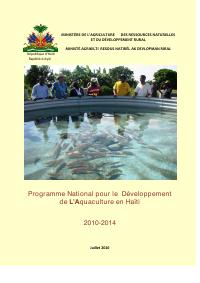
National Programme for the Development of Aquaculture in Haiti
- Fish consumption is the number that frames the program: 3.5 kg per person a year in Haiti against about 37.5 kg in Jamaica, a tenfold gap with a neighbor at similar latitude.
- Self-sufficiency fell rather than rose. National production from maritime and inland fishing covered 30 percent of national needs in 1998 (FAO, 1999) and less than 23 percent by 2006, of which inland fishing and aquaculture together supplied only 3.2 percent.
- The resource base is larger than the sector's output suggests. Inland waters total about 22,700 hectares, 69 percent of it in three bodies: Lake Azuéi or Étang Saumâtre at 11,300 hectares, the Péligre reservoir at 2,750 and the Miragoâne ponds at 1,130, plus 31 more or less permanent watercourses covering about 6,820 hectares, some 71 small water bodies totaling about 2,770 hectares, and 90 hectares of hillside retention ponds.
- Stocking had almost stopped before the program. Between 2000 and 2008 the country received only three stocking operations, about 200,000 fingerlings in total, against a planned program introducing more than 400,000, which is the immediate constraint the program addresses.
- The production targets are staged and steep: natural production to rise from 600 to 1,200 tonnes by the end of 2010 and from 1,200 to 3,000 tonnes a year between 2011 and 2013, with aquaculture production up by about 4,000 tonnes a year. Against a current aquaculture output of about 200 tonnes a year, a quarter of terrestrial production, that is an order-of-magnitude increase.
- Feed is identified as the binding cost, not stock or technique. Fish feed containing 18 to 21 percent protein cost between 20 and 25 US dollars, while cultivated species need 24 to 50 percent protein depending on type and system, so local firms cannot supply the higher protein requirement. Feed production is accordingly one of the program's seven intervention axes.
- The social argument is stated in prices, not adjectives: informal-sector daily earnings are put near 4 US dollars while more than 71 percent of the population earns less than 2 dollars, which is the context for treating inland fishing as socially important regardless of its tonnage.
- Costing is partial and says so. The value-chain study and the rehabilitation of the Damien fish farm carry 25,000,000 gourdes of financing already mobilized and 1,852,593.68 US dollars listed as funds still to be sought, with MARNDR as contracting authority.
- Monitoring is assigned to DPAQ with a recommendation for an independent evaluation cell, an evaluation during 2010 and a final evaluation six months before the 2013 deadline. A Water Bodies Management Unit is to be set up inside DPAQ.
- The program's own record of the sub-sector's history is candid: development has been sawtoothed and dependent on the national context, with 87 floating cages in production and average output of about 157 tonnes in 2007.
Produced from the October 2008 exercise in which MARNDR convened some fifty livestock, veterinary and agronomy professionals - from the Faculty of Agronomy and Veterinary Medicine, specialized NGOs, private operators and producer organizations - to draft policy for the animal production and fisheries sub-sectors across seven themes. This volume covers aquaculture: the state of the sub-sector, its constraints and the ministry's program for developing it over 2010-2014. It is a direct companion to the MARNDR programs on maritime fisheries, milk, and livestock for environmental rehabilitation, all issued in the same format and from the same process.
How to cite
Government of Haiti; Ministry of Agriculture, Natural Resources and Rural Development (MARNDR), 2010, National Programme for the Development of Aquaculture in Haiti, https://agripubhaiti.org/wp-content/uploads/2025/03/Aquaculture_-_MARNDR_2010.pdf