
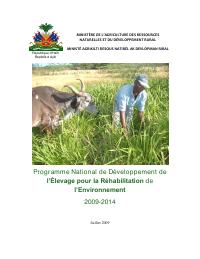
National Livestock Development Programme for Environmental Rehabilitation
- The program treats livestock as a land-restoration instrument, and its two objectives are stated together for that reason: double the annual income of 14,000 farm holdings in seven priority watersheds, and restore and secure 28,000 carreaux of land in those same watersheds using agroforestry techniques over five years.
- The income target is specific and doubles from a stated base: from 30,000 to 60,000 gourdes a year per holding, through agro-silvo-pastoral activity. The program estimates the investment needed for a holding to reach 60,000 gourdes a year from livestock at about 100,000 gourdes, offered under three scenarios to at least 25 percent of holders.
- The seven watersheds are named, which makes the program auditable: Mapou, Fond Verrettes, Gonaïves, Arcahaie, Port-au-Prince, Les Cayes and Léogâne. Intervention is targeted at slopes of 10 to 40 percent, within a wider land-use logic that separates technical support on slopes of 0 to 10 percent from treatment of slopes above 40 percent.
- Land tenure is addressed directly rather than assumed. Activities include work on property titles and payment of the first year's rent for 25 percent of the holdings, plus a credit fund capitalized at 10,000 gourdes per woman.
- The cost is stated as 2.8 billion gourdes for the seven watersheds over five years, which sets the implied cost against 14,000 holdings and at least 70,000 people involved.
- The demand side is part of the design. The program looks to state institutions concerned with restoration, the school-canteen program, the police, the prisons administration, universities, high schools and ministries, to source local meat, milk, honey and eggs, which makes public procurement the intended market.
- The program states its own insufficiency, which is unusual in a sector plan. Its success is said to depend on a complementary program run by other ministries, Social Affairs, Public Works and Education, addressed to watershed inhabitants, so livestock alone is not presented as the answer.
- The document also records that Haiti is self-sufficient in and an exporter of goat meat, at 75,000 head, which is the one product line where the sub-sector is not import-dependent.
- The drafting history matters for reading it: the program comes from the October 2008 policy exercise, was validated in national forums between February and October 2009, and was revised after the 12 January 2010 earthquake to fit the National Agricultural Investment Plan and the Action Plan for the Recovery and Development of Haiti. It carries a foreword by Dr Michel Chancy, Secretary of State for Animal Production.
Produced from the October 2008 exercise in which MARNDR convened some fifty livestock, veterinary and agronomy professionals - from the Faculty of Agronomy and Veterinary Medicine, specialized NGOs, private operators and producer organizations - to draft policy for the animal production and fisheries sub-sectors across seven themes. This volume takes the fourth of those themes - smallholder livestock in agro-ecological systems as a route to environmental rehabilitation - and turns it into a program for 2009-2014. It is dated July 2009, a year earlier than the aquaculture, fisheries and milk volumes, and frames livestock as an instrument of land and vegetation recovery rather than only of production, which distinguishes it from the other sub-sector programs.
How to cite
Government of Haiti; Ministry of Agriculture, Natural Resources and Rural Development (MARNDR), 2009, National Livestock Development Programme for Environmental Rehabilitation, https://agripubhaiti.org/wp-content/uploads/2025/03/Elevage-environnement-MARNDR.pdf