
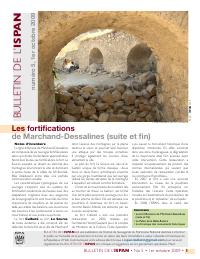
Bulletin of the ISPAN, No. 5: The Fortifications of Marchand-Dessalines, Concluded
Summary: Inventory notes closing the Marchand-Dessalines survey: six fortified works on an approximate north-south line, all but fort La Source sited on the summits commanding the upper town.
Key Findings
- The bulletin describes the Marchand-Dessalines defensive line as six fortified works set roughly north-south, with visual communication among them and designs inspired by Vauban-style bastioned fortification adapted to the terrain.
- Fort Culbute, also called Fort La Source, defended the eastern entrance of Marchand and protected the water sources that supplied the city.
- Fort Decide covered about 800 square meters and overlooked Marchand-Dessalines and the Artibonite valley.
- Fort Innocent was in very poor condition, with enclosure walls about 6 m high on average and 10 m in places, and central building walls about 1.50 m thick.
- Fort Madame was the largest Marchand-Dessalines fortification by size at 2,200 square meters, while Fort Doko was the smallest at 350 square meters with a 13 m by 13 m central courtyard.
- ISPAN adopted an official identification manual for cultural-value immovable properties on 25 September 2009 and planned to begin updating Jacmel historic-center building records on 15 October 2009.
Full Description
Inventory notes closing the Marchand-Dessalines survey: six fortified works on an approximate north-south line, all but fort La Source sited on the summits commanding the upper town. One issue of the Bulletin de l'ISPAN, the monthly bulletin of Haiti's Institut de Sauvegarde du Patrimoine National, which ran from June 2009 to at least November 2011 and documented one monument, site or historic center per issue.
How to cite
Institute for the Protection of National Heritage (ISPAN), 2009, Bulletin of the ISPAN, No. 5: The Fortifications of Marchand-Dessalines, Concluded, https://www.haiti.org/