
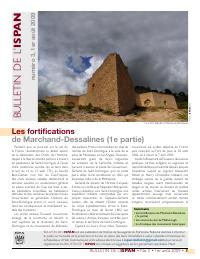
Bulletin of the ISPAN, No. 3: The Fortifications of Marchand-Dessalines, Part One
Summary: The first of two issues on the defensive line Dessalines built around his capital, opening with fort Décidé and placing the works in the revolutionary sequence that ran from the night ceremony of 1791 to independence.
Key Findings
- The bulletin links the post-independence fortification system to Dessalines's 9 April 1804 ordinance requiring departmental commanders to build fortifications on the highest interior mountains.
- The article says Marchand-Dessalines became the inland capital at Habitation Laville, behind the Artibonite valley and at the foot of the Cahos mountains.
- The first part lists the fortifications around Marchand-Dessalines, including Fort Fin-du-Monde, Fort Doko, Fort Innocent, Fort Madame and Fort Culbute.
- The issue reproduces ISPAN's prototype identification sheet for historic monuments, using Sans-Souci Palace as the example.
- The Sans-Souci identification prototype describes the palace as built in 1811-1813, completed in 1813, pillaged after the king's death in 1820, partly destroyed by the 1842 earthquake, listed as World Heritage in 1982 and National Heritage in 1995.
- ISPAN reported a planned Jeremie photographic exhibition of about forty color panels for the Saint-Louis patronal feast on 29 August.
Full Description
The first of two issues on the defensive line Dessalines built around his capital, opening with fort Décidé and placing the works in the revolutionary sequence that ran from the night ceremony of 1791 to independence. One issue of the Bulletin de l'ISPAN, the monthly bulletin of Haiti's Institut de Sauvegarde du Patrimoine National, which ran from June 2009 to at least November 2011 and documented one monument, site or historic center per issue.
How to cite
Institute for the Protection of National Heritage (ISPAN), 2009, Bulletin of the ISPAN, No. 3: The Fortifications of Marchand-Dessalines, Part One, https://www.haiti.org/