
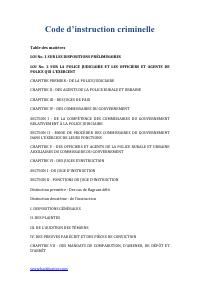
Code of Criminal Procedure of Haiti
- 472 articles; Article 472 makes the code enforceable from January 1, 1836.
- Public action ends with the death of the accused, and civil action may be pursued together with it.
- Judicial police duties were rewritten by the decree of November 10, 1962 at Articles 8 and 9.
- Investigating judges are covered by Articles 44 and following, amended by the law of July 12, 1920.
- Time limits: three years for correctional offenses, two years for police penalties, one year for police contraventions.
- Civil awards in final judgments follow the Civil Code rules on prescription.
The code has 472 articles. Its first provisions say that the action to apply penalties belongs only to the officials charged with it by law, that public action ends with the death of the accused, and that civil action may be brought at the same time and before the same judges. Further parts cover the judicial police and the officers who exercise it, government commissioners, investigating judges and their orders, and referral of accused persons to the criminal court. They also cover the dean's direction of jurors and the duty of citizens to sit on juries. The closing articles set time limits: three years for correctional offenses and one year for police contraventions. Article 472 repeals contrary laws and makes the code enforceable from January 1, 1836. Later amendments are flagged in the text, including laws of July 12, 1920 and March 29, 1928, a decree-law of May 19, 1937 and a decree of November 10, 1962.
How to cite
Ministry of Justice and Public Security (MJSP), 2008, Code of Criminal Procedure of Haiti, accessed via HaitiDocs, https://www.haitidocs.org/doc/hti-code-instruction-criminelle