
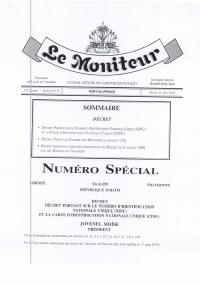
Decree on the Unique National Identification Number (NINU) and the Unique National Identity Card (CINU) (Le Moniteur, 175th year, Special No. 9, 16 June 2020)
- Creates the NINU, a unique identifier to be inserted in every civil registry act from birth, and the CINU card built on it.
- Cites the need to replace the varied identity documents citizens hold with one standardized system.
- Fixes the number of ministries at eighteen.
- Money transfer houses must pay beneficiaries in the form, currency and rate set by the central bank, with a fine of up to 3 percent of equity for a violation and possible loss of authorization for a repeat.
- Sub-agents of transfer houses are limited to receiving funds and paying them out.
Le Moniteur Special No. 9 of June 16, 2020 (175th year) prints three decrees signed by President Jovenel Moïse. The first creates the unique national identification number (NINU) and the unique national identification card (CINU): the recitals say the state must identify citizens from birth, that citizens hold different identity documents that need standardizing, and that a unique identifier should appear in every civil registry act. The second sets the number of ministries at eighteen. The third, signed June 5, 2020, amends the July 6, 1989 decree on money transfer houses and gives the central bank authority over payout currency and rate.
From the document
Text extracted from the original document. It may contain character recognition errors.
How to cite
Legislative Body of Haiti, Decree on the Unique National Identification Number (NINU) and the Unique National Identity Card (CINU) (Le Moniteur, 175th year, Special No. 9, 16 June 2020), accessed via HaitiDocs, https://www.haitidocs.org/doc/hti-2020-decret-ninu-cinu
- Rights holder
- Corps Législatif d'Haïti