
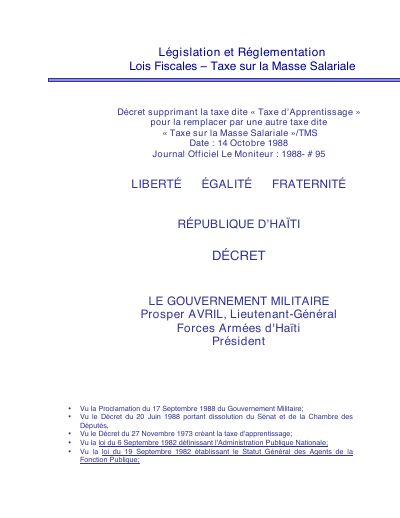
Decree of 14 October 1988 Instituting the Payroll Tax (TMS)
- Article 1 abolishes the apprenticeship tax created by the decree of 17 September 1973.
- Article 2 sets the payroll tax at 2 percent of salaries, emoluments and other remuneration.
- Article 3 places the tax exclusively on the employer. It is a labour cost, and the employee has nothing deducted.
- Article 4 exempts embassies and consulates, international organisations, and NGOs holding a contractual exemption.
- Article 5 requires a monthly declaration to the DGI between the 1st and the 10th.
- The article 4 exemption removes a large part of Haiti's formal NGO and international-organisation employment from the base.
The decree of 14 October 1988, published in Le Moniteur No. 95 of 1988, replacing the apprenticeship tax with a payroll tax.
Article 1 abolishes the apprenticeship tax created by the decree of 17 September 1973. Article 2 institutes the Taxe sur la Masse Salariale at 2 percent of salaries, emoluments and other remuneration paid to the staff of public and private enterprises and of the public administration generally. Article 3 places the tax exclusively on the employer. It is a labour cost, and the employee has nothing deducted. Article 4 exempts embassies and consulates, international organisations, and non-governmental organisations bound to the state by a contract that expressly provides for exemption from duties and taxes. Article 5 requires every liable taxpayer to file a declaration with the DGI between the 1st and the 10th of each month, giving the enterprise's tax identification number and the details of the staff concerned.
For an economist the exemption in article 4 is the operative detail: it removes from the payroll-tax base a large part of the formal employment that NGOs and international organisations account for in Haiti.
How to cite
Presidency of the Republic of Haiti (PRH), Decree of 14 October 1988 Instituting the Payroll Tax (TMS), https://www.mef.gouv.ht/
- Rights holder
- Government of Haiti