
Political Agreement for a Peaceful and Orderly Transition
- The agreement sets three priorities for the transition: security, constitutional and institutional reforms, and elections.
- The Presidential Council has nine members, seven voting and two observers, and its members may not run in the next elections.
- The Council's mandate ends on February 7, 2026 and cannot be extended.
- The Council names the Provisional Electoral Council within 60 days of the installation of the government.
- A 15-member Organ for Control of Government Action oversees the executive.
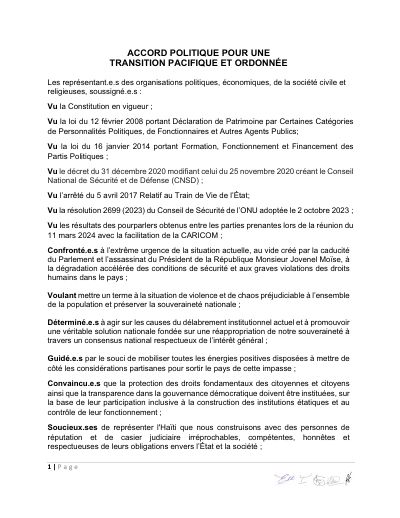
The agreement sets the vision of the transition as the reconciliation of the State with the Nation, the return to constitutional order and the defense of Haiti's interests, with three priorities: security, constitutional and institutional reforms, and elections. It creates three governing bodies: the Presidential Council, the government and the Organ for Control of Government Action (OCAG).
The Presidential Council has nine members, seven voting and two observers, whose names and designating parties are listed, and its members may not run in the next elections. Its mandate ends on February 7, 2026 and cannot be extended. The Council names the Provisional Electoral Council within 60 days of the installation of the government. The prime minister, who must have a non-partisan profile and may not run, is named by the Council from a list of at most 15 candidates. The OCAG has 15 members, including two designated by the diaspora. Members must file police and tax certificates and an asset declaration within 30 days of installation. The text is signed in Port-au-Prince on April 3, 2024, although the preamble states that the parties met on April 4.
How to cite
Parties signataires de l'Accord politique du 3 avril 2024, Political Agreement for a Peaceful and Orderly Transition, accessed via HaitiDocs, https://www.haitidocs.org/doc/ht-accord-2024-04-transition-pacifique-ordonnee
- Rights holder
- Parties signataires de l'Accord politique du 3 avril 2024