Full Description
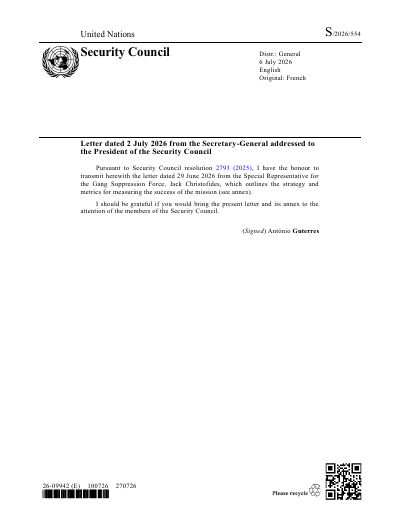
Issued as S/2026/554 on 6 July 2026, this is the letter of 2 July 2026 from Secretary-General António Guterres to the President of the Security Council transmitting the letter of 29 June 2026 from Special Representative Jack Christofides, with the strategy and metrics report enclosed. It is the document resolution 2793 (2025) requested when it authorised the Force.
Three strategic objectives are drawn from paragraph 1 of resolution 2793: gang control over territory is removed; critical infrastructure is secure, measured on operations conducted independently or jointly with the Haitian National Police and the Haitian Armed Forces; and Haitian authorities have the ability to contain gang violence, which covers improving the capabilities of Haitian security and defence forces and the space the Force's operations create for the Government, the UN system and partners to pursue medium- and long-term stabilization.
The measurement design matters as much as the objectives. The baseline is the situation in the mission area as at 31 May 2026, chosen as the zero point because operations began on 1 June 2026, and the next comprehensive report will present the situation as at 31 August 2027, with interim updates through the Special Representative's briefings. The Force's indicators are deliberately narrower than the Haiti benchmark framework presented by the Secretary-General in S/2026/31: the Force measures where its own operations have taken place, while the country framework also covers national operations without Force participation and other government-led programmes. Objective 1 is measured territorially, with a map of gang-controlled territory as at 31 May 2026, supplemented by counts of weapons and ammunition confiscated or surrendered and gang members arrested, with the document itself noting the high replacement ratio that limits what those counts prove. Objective 2 is described as strategically decisive because control of critical infrastructure shapes perceptions of state legitimacy. Objective 3 rests on joint planning and joint conduct of operations, learning by doing, complementing bilateral training programmes.
The end state is defined for 30 September 2028: gangs' ability to threaten the Haitian State degraded, and minimum security conditions established, meaning organized armed groups without freedom of movement and with very limited or no territorial control, degraded gang information operations, secure key infrastructure and supply routes, and civilian access to essential services and humanitarian aid without persistent threat of violence. The report states explicitly that this end state is not the complete stabilization of Haiti.
Full Document Text
Extracted text from the original document for search indexing.
S/2026/554
United Nations
Security Council
Distr.: General
6 July 2026
English
Original: French
Letter dated 2 July 2026 from the Secretary-General addressed to
the President of the Security Council
Pursuant to Security Council resolution 2793 (2025), I have the honour to
transmit herewith the letter dated 29 June 2026 from the Special Representative for
the Gang Suppression Force, Jack Christofides, which outlines the strategy and
metrics for measuring the success of the mission (see annex).
I should be grateful if you would bring the present letter and its annex to the
attention of the members of the Security Council.
(Signed) António Guterres
26-09942 (E)
100726
*2609942*
270726
�S/2026/554
Annex
[Original: English]
I have the honour to submit herewith the report of the Gang Suppression Force
on the strategy and metrics for measuring the success of the mission, as requested by
the Security Council in its resolution 2793 (2025) (see enclosure).
The report has been prepared following consultations with the Government of
Haiti, the United Nations system and other relevant stakeholders. It sets out the
strategic framework that will guide the implementation of the mandate of the Gang
Suppression Force. It identifies three core objectives: the removal of gang control
over territory; the securing of critical infrastructure; and the strengthening of the
capacity of Haitian authorities to contain gang violence.
The benchmarks and metrics outlined in the report are intended to measure the
impact of Gang Suppression Force operations, both independently and in coordination
with the Haitian National Police and the Haitian Armed Forces. The baseline for the
Gang Suppression Force framework reflects the situation in the mission area as at
31 May 2026, immediately prior to the commencement of Gang Suppression Force
operations on 1 June 2026.
The report further defines the desired end state of the Gang Suppression Force
mandate implementation by 30 September 2028, namely the degradation of the ability
of armed organized gangs to threaten the Haitian State and the establishment of
minimum security conditions necessary for sustained international stabilization
efforts and the gradual rebuilding of Haitian security institutions with international
support.
(Signed) Jack Christofides
Special Representative
2/7
26-09942
�S/2026/554
Enclosure
[Original: English]
In its resolution 2793 (2025), the Security Council requested the Special
Representative to develop a strategy and metrics for measuring the success of the
mission and concrete time-bound objectives, with benchmarks towards an end state.
Pursuant to the Council’s request, the Gang Suppression Force consulted with
the Government of Haiti, the United Nations system and other relevant stakeholders.
These consultations informed the structure of the mission’s strategy, the formulation
of three strategic objectives, and the scope of the metrics and benchmarks defined to
measure progress.
Three strategic objectives
The three strategic objectives at the core of the strategy are based on the
mandated activities identified in paragraph 1 of resolution 2793 (2025):
• Objective 1: Gang control over territory is removed.
• Objective 2: Critical infrastructure is secure, focusing on the impact of
operations of the Gang Suppression Force to be conducted independently or
jointly with the Haitian National Police and the Haitian Armed Forces, in line
with subparagraphs (a) and (b).
• Objective 3: Haitian authorities have the ability to contain gang violence,
reflecting the understanding that the deployment of the Gang Suppression Force
presents an opportunity for the Government of Haiti, the United Nations system
and international partners to progress with medium- and long-term stabilization
(subparagraphs (d), (e) and (f)). This includes improving the capabilities of the
Haitian security and defence forces to fight and prevent gang violence
(subparagraph (c)).
In all its work, the Gang Suppression Force is committed to a policy of strict
accountability for serious misconduct, including sexual exploitation and abuse, so as
to gain and maintain the trust of the Haitian population.
Measuring the impact of operations
The metrics and benchmarks used in this mission strategy are defined to measure
the overall success of Gang Suppression Force operations. They complement the Haiti
benchmark framework with indicators requested by the Security Council in
paragraph 24 of its resolution 2793 (2025) and presented by the Secretary-General in
his report of 15 January 2026 (S/2026/31). While the Gang Suppression Force
indicators will focus on areas where Force operations have taken place, the Haiti
benchmark framework considers a broader approach, encompassing operations by the
national security and defence forces without Force partic ipation, as well as other
government-led stabilization programmes.
The data used as a baseline reflect the situation in the mission area as at 31 May
2026. 1 The next comprehensive report will present the situation as at 31 August 2027. 2
__________________
1
The Gang Suppression Force started operations on 1 June 2026; 31 May 2026 was chosen as a
baseline to establish the “zero” point against which all progress is measured.
2
Regular updates will be provided by the Special Representative through his briefings to the
Council.
26-09942
3/7
�S/2026/554
Strategic objective 1: Gang control over territory is dismantled (or has decreased)
At the core of the Gang Suppression Force strategy is a territorial approach in
which operations focus on removing gang control over territory to help restore the
State’s monopoly on the use of force.
The Gang Suppression Force intends to regain control of territory through
intelligence-led operations conducted either independently or jointly with the Haitian
National Police and/or the Haitian Armed Forces. The map of Haiti below shows
territory under gang control as at 31 May 2026, prior to the first Force operations on
1 June 2026.
Source: Maps data: Google © 2026 Airbus. Imagery date: 25 June 2026, open source.
Note: The boundaries and names shown and the designations used on this map do not imply official endorsement
or acceptance by the United Nations.
In the forthcoming report of the Special Representative to the Council, a map
displaying territory under the control of the State will illustrate the evolution of the
security situation following Gang Suppression Force operations.
To capture the factors that could account for its success, the Gang Suppression
Force will collect the data in figure I to measure its impact on the security situation
in a given territory.
4/7
26-09942
�S/2026/554
Figure I
Strategic objective 1: Gang control over territory is dismantled
Abbreviations: FOBs, forward operating bases; GSF, Gang Suppression Force; HAF, Haitian Armed Forces; HNP, Haitian
National Police.
In addition, the Gang Suppression Force will track data on the number of
weapons and ammunition confiscated or surrendered, and gang members arrested,
while annotating the inherent advantages and limitations of this method of data
collection, as it is known for a high ratio of replacement.
Strategic objective 2: Critical infrastructure is secure
The second objective will require coordinated efforts with the Haitian
authorities to secure critical infrastructure in target areas. In many ways, this objective
will be strategically decisive because the ability to control critical infrastructure
shapes perceptions of state legitimacy and may become one of the clearest indicators
of success in the eyes of Haitians. Figure II displays the benchmarks and metrics that
will be used to measure whether the Gang Suppression Force is reaching this
objective.
26-09942
5/7
�S/2026/554
Figure II
Strategic objective 2: Critical infrastructure is secure
Abbreviations: FAA, United States Federal Aviation Administration; GSF, Gang Suppression Force; HNP, Haitian National Police.
Strategic objective 3: Haitian authorities have the ability to contain gang violence
This objective focuses on making the impact of Gang Suppression Force
operations sustainable, first by improving the operational and planning capabilities of
the Haitian security and defence forces. This will be done through the joint planning
and conduct of operations by the Gang Suppression Force, the Haitian National Police
and the Haitian Armed Forces (“learning by doing”). It will be complementary to the
training programmes for Haitian security and defence forces provided by bilateral
partners.
Second, the momentum created through Gang Suppression Force operations
presents an opportunity for the Government and its partners to fight gang violence,
hold elections, provide humanitarian aid and address the illicit trafficking of arms and
related materials. Coordinating the planning of Force operations with the work of the
United Nations system and the leadership of the Government is therefore key to
stabilizing the security situation and creating a safe environment for the civilian
population affected by gang violence, especially children.
6/7
26-09942
�S/2026/554
Figure III
Strategic objective 3: Haitian authorities have the ability to contain gang violence
Abbreviations: BINUH, United Nations Integrated Office in Haiti; GSF, Gang Suppression Force.
End state
In line with the objectives and benchmarks identified above, the desired end
state of the Gang Suppression Force mandate implementation is defined as follows:
by 30 September 2028, the Gang Suppression Force will have degraded armed,
organized gang ability that threatens the Haitian State and established the minimum
security conditions necessary for sustained international stabilization efforts and the
gradual rebuilding of Haitian security institutions with international support.
Minimum security conditions are defined as those in which organized armed groups
are unable to operate with freedom of movement and maintain very limited or no
territorial control; gang information operations have been degraded; key
infrastructure and supply routes are secure; and civilian populations can access
essential services and humanitarian aid without persistent threat of violence.
Reaching this end state is not intended to signify the complete stabilization of
Haiti, but rather the attainment of minimum security conditions necessary to reverse
current trends, restore public confidence and create the political and operational space
required for longer-term recovery and international engagement. The current context
presents a limited but important window of opportunity to achieve these conditions.
26-09942
7/7
�