
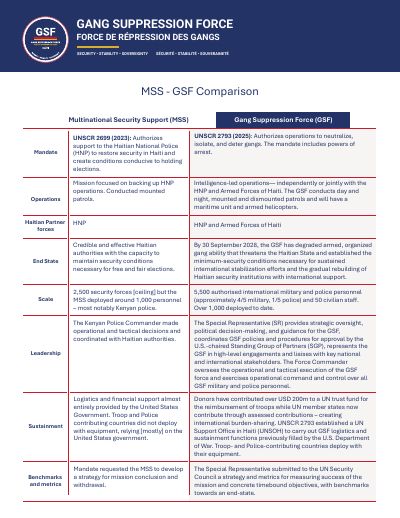
From MSS to GSF: comparison of the Multinational Security Support mission and the Gang Suppression Force
- The MSS had a ceiling of 2,500 and deployed around 1,000; the GSF is authorised at 5,500 international military and police personnel, roughly four fifths military, plus 50 civilian staff, with over 1,000 deployed at the time of publication.
- The mandate changed from supporting the Haitian National Police to authorising operations to neutralize, isolate and deter gangs, including powers of arrest.
- Financing moved from almost entirely United States support to assessed contributions plus a UN trust fund that has received over USD 200 million, with UNSOH taking over logistics and sustainment.
- Contributing countries now deploy with their own equipment, where under the MSS they relied mostly on the United States Government.
- Command is split: the Special Representative holds strategic and political direction and coordinates policies for approval by the United States-chaired Standing Group of Partners, while the Force Commander holds operational command and control.
A single-page bilingual comparison table published by the Gang Suppression Force. It is the mission's own account of what changed when it replaced the Multinational Security Support mission, and it is more precise than the narrative statements on several points that matter for reading the mission's capacity.
On mandate, resolution 2699 (2023) authorised support to the Haitian National Police to restore security and create conditions for elections; resolution 2793 (2025) authorises operations to neutralize, isolate and deter gangs, and the mandate includes powers of arrest. On operations, the MSS backed up HNP operations and conducted mounted patrols; the GSF conducts intelligence-led operations independently or jointly with the HNP and the Haitian Armed Forces, day and night, mounted and dismounted, and will have a maritime unit and armed helicopters. Partner forces widen from the HNP alone to the HNP and the Armed Forces of Haiti.
On scale, the MSS had a ceiling of 2,500 but deployed around 1,000 personnel, most notably Kenyan police; the GSF is authorised at 5,500 international military and police personnel, roughly four fifths military and one fifth police, plus 50 civilian staff, with over 1,000 deployed at the time of writing. Leadership moves from the Kenyan Police Commander making operational and tactical decisions to a split between a Special Representative holding strategic oversight and political decision-making, coordinating policies for approval by the United States-chaired Standing Group of Partners, and a Force Commander exercising operational command and control over all military and police personnel. On sustainment, MSS logistics and finance came almost entirely from the United States Government and contributing countries deployed without equipment; under the GSF, donors have contributed over USD 200 million to a UN trust fund for troop reimbursement, Member States now contribute through assessed contributions, resolution 2793 established the UN Support Office in Haiti to carry out logistics and sustainment, and contributing countries deploy with their own equipment. The end state also changes: from credible Haitian authorities able to hold free and fair elections, to the 30 September 2028 degradation target set out in S/2026/554.
Full Document Text
Extracted text from the original document for search indexing.
How to cite
Gang Suppression Force (GSF), 2026, From MSS to GSF: comparison of the Multinational Security Support mission and the Gang Suppression Force, https://gangsuppressionforce.org/docs/gsf-mss-comparison-en.pdf
- Rights holder
- Gang Suppression Force (GSF)