
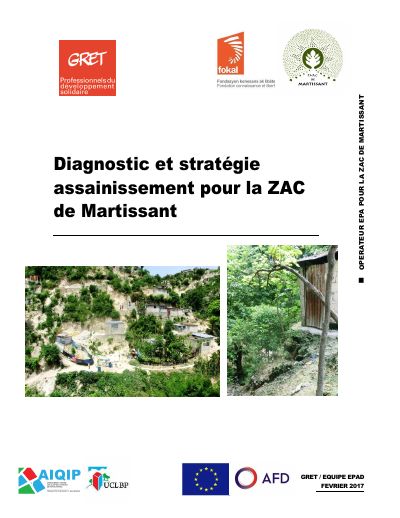
Diagnosis and Sanitation Strategy for the Martissant ZAC
- The study is part of the water and sanitation operator mission entrusted to the GRET by FOKAL in April 2016, financed by the AFD and the EU under the project ownership of the UCLBP.
- On the seafront the water table is at the surface, and test holes dug to 80 centimeters reached sea water from 40 centimeters.
- In zone 2, around 90 percent of homes have access to sanitation, mostly pit latrines, but only 3 percent of households have modern flush toilets and sludge emptying is a problem.
- In zone 1, sharing a toilet with a neighbor can cost 1,000 gourdes a month.
- A waste collection operator collected through subcontractors about 70 tonnes of waste in 2016, or about 233 cubic meters.
- The strategy is built zone by zone, with hygienic sanitation and training of local masons and manual emptiers in equipped sub-neighborhoods and protection of water sources in zone 3.
The study is task 1 of the mission that FOKAL gave the GRET in April 2016 as water and sanitation operator for the ZAC of Martissant, financed by the Agence Française de Développement and the European Union under the project ownership of the UCLBP (programme AIQIP). It follows the four zones of the 2012 planning scheme. Because of limited time and the size of the zone, it uses field visits, a bibliographic review, focus groups of 12 to 20 people in each zone and soil infiltration tests, instead of a face-to-face household survey, so its figures are estimates from the groups.
The soil is mostly silty sand with pockets of reworked soil. On the seafront, built on a polder of waste and coarse material, the water table is at the surface: workers digging test holes reached sea water at 40 centimeters. The study draws a sanitation zoning that links each zone to suitable technologies, and then reviews practices zone by zone. Zone 1, by the sea, is relatively equipped with latrines but the collection and removal of sludge are very insufficient, since emptying is rare because of the soil. Zone 2, the old heart, has a high rate of toilets, with around 90 percent of homes having access but problems with emptying that lead to poor practices. Zone 3 is poorly equipped and varied, with land scarcity and precarity as obstacles, and zone 4, between urban and rural, has very few toilets because of limited funds.
The strategies are given zone by zone: adapted technical solutions and hygienic sanitation on the seafront; training local masons to build toilets and pits properly and supporting manual emptiers in the equipped sub-neighborhoods; protecting water sources in zone 3, including sealed pits and a study of a mini sanitation network at Baigne; and developing a local sanitation chain in zone 4. General proposals follow for the whole ZAC.
How to cite
Groupe de recherche et d'échanges technologiques (GRET), 2017, Diagnosis and Sanitation Strategy for the Martissant ZAC, accessed via HaitiDocs, https://www.haitidocs.org/doc/gret-2017-zac-martissant-strategie-assainissement
- Rights holder
- Groupe de recherche et d'échanges technologiques (GRET)