
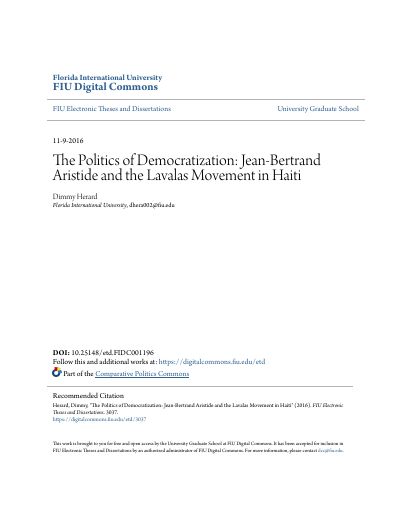
The Politics of Democratization: Jean-Bertrand Aristide and the Lavalas Movement in Haiti
- The Duvalier dictatorship ended in 1986, and Lavalas emerged from the grassroots organizations of Haiti's poor majority.
- Lavalas placed emphasis on popular mobilization to challenge Haiti's legacy of authoritarianism.
- The political parties and U.S. democracy promoters emphasized negotiation and compromise with Haiti's antidemocratic forces.
- The study traces four critical junctures between 1986 and 1991, ending with Aristide's overthrow on September 29, 1991.
- Lavalas sought to guarantee the right of all Haitians to participate directly in governing and to share national resources more equitably.
Defended on November 9, 2016 at Florida International University, this dissertation asks whether Mouvement Lavalas held a particular conception of democracy that explains its antagonistic relationship with the political parties and with U.S. democracy promoters. It uses process-tracing on primary and secondary sources from 1986 to 1991, with emphasis on four junctures: the Conseil National du Gouvernement, the government of Leslie Manigat, the military regimes of Henri Namphy and Prosper Avril, and Aristide's 8 months in power before the overthrow of September 29, 1991.
The study concludes that Lavalas emphasized popular mobilization to challenge the legacy of authoritarianism, while the political parties and U.S. democracy promoters emphasized negotiation and compromise with antidemocratic forces. It situates Lavalas in the long struggle of the poor majority to expand politics beyond procedural democracy toward what the author calls popular democracy.
How to cite
Florida International University (FIU), 2016, The Politics of Democratization: Jean-Bertrand Aristide and the Lavalas Movement in Haiti, https://digitalcommons.fiu.edu/etd/3037
- Rights holder
- Florida International University (FIU)