Full Description
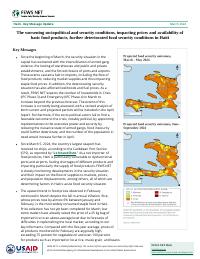
This Key Message Update covers March 2024, the month Haiti's security crisis broke into a supply crisis. From the beginning of March the security situation in the capital worsened sharply with intensified armed gang violence, the looting of warehouses and of public and private establishments, and the forced closure of ports and airports. Those events halted imports, including food, reducing market supplies and pushing up staple prices, while also damaging livelihoods and raising fuel prices. FEWS NET therefore expected the number of households in Crisis (IPC Phase 3) and Emergency (IPC Phase 4) in March to increase beyond the previous forecast, and stated that the extent was still being assessed, with a revised analysis of both current and projected periods to appear in the April report.
It warned that if socio-political actors failed to resolve the crisis, by appointing representatives to the executive and by reducing the reach of armed gangs, food insecurity could deteriorate further and the population in need grow again in April. Since 5 March 2024 the country's largest seaport had received no ships, according to the Caribbean Port Service reported by Le Nouvelliste; as a net food importer Haiti is particularly exposed to dysfunctional ports and airports. The upward trend in food prices seen in February continued into March despite falling annual inflation.
Rice, the most widely consumed staple, had already risen almost 6 percent between January and February, and although March price collection was incomplete, traders had raised the price of a 25 kg bag of imported rice above average in anticipation of restocking difficulties. Against the five-year average, February prices of all monitored products were atypically high, exceeding 75 percent for vegetable oil and 100 percent for imported and local rice, maize grain and beans. Below-average rainfall with irregular spatial and temporal distribution over the preceding three months, combined with inadequate support for decapitalised farmers and high input costs, delayed and reduced soil preparation and sowing for the spring season.
Full Document Text
Extracted text from the original document for search indexing.
Haiti - Key Message Update
March 2024
The worsening sociopolitical and security conditions, impacting prices and availability of
basic food products, further deteriorated food security conditions in Haiti
Key Messages
Since the beginning of March, the security situation in the
capital has worsened with the intensification of armed gang
violence, the looting of warehouses and public and private
establishments, and the forced closure of ports and airports.
These events caused a halt to imports, including the flow of
food products, reducing market supplies and thus impacting
staple food prices. In addition, the deteriorating security
situation has also affected livelihoods and fuel prices. As a
result, FEWS NET expects the number of households in Crisis
(IPC Phase 3) and Emergency (IPC Phase 4) in March to
increase beyond the previous forecast. The extent of this
increase is currently being assessed, with a revised analysis of
both current and projected periods will be included in the April
report. Furthermore, if the socio-political actors fail to find a
favorable outcome to the crisis, notably political, by appointing
representatives to the executive power and security by
reducing the nuisance state of armed gangs, food insecurity
could further deteriorate, and the number of the population in
need would increase further in April.
Since March 5, 2024, the country's largest seaport has
received no ships, according to the Caribbean Port Service
(CPS), as reported by "Le Nouvelliste." As a net importer of
food products, Haiti is particularly vulnerable to dysfunctional
ports and airports, fueling shortages of different products and
impacting particularly the supply of food products. FEWS NET
is closely monitoring developments in the security situation
and their impact on the flow of supplies to markets, prices,
and population displacements, among others, all of which are
determining factors in Haiti's acute food security situation.
The upward trend in food prices observed in February
continued in March despite the fall in annual inflation. Rice,
whose prices rose by almost 6% between January and
February, is the most widely consumed staple food in Haiti.
Price collection has not yet been completed for March, but
some traders have already raised the price of a 25 kg bag of
imported rice to an above-average level due to forecasts of
difficulties in replenishing the local market, according to our
key informants. Compared with the five-year average, prices of
all products monitored for February are atypically high,
exceeding 75 percent for vegetable oil and even 100 percent
for products such as imported or local rice, maize grain, and beans.
FEWS NET is a USAID-funded activity. The content of this report does not necessarily reflect the view
of the United States Agency for International Development or the United States Government.
FEWS NET Haiti
haiti@fews.net
fews.net/latin-america-and-caribbean/haiti
�Key Message Update
March 2024
Finally, below-average rainfall, with irregular spatial and temporal distribution, has been recorded over the past
three months. This irregularity in the spatiotemporal distribution of the rains, combined with the inadequacy or
absence of assistance to already decapitalized farmers, as well as the high cost of agricultural inputs, has led to
delays and a reduction compared with normal in soil preparation and sowing activities for this year's spring
cropping season.
Recommended citation: FEWS NET. Haiti Key Message Update March 2024: The worsening sociopolitical and security
conditions, impacting prices and availability of basic food products, further deteriorated food security conditions in Haiti,
2024.
*
FEWS NET's classifications are IPC-compatible. IPC-compatible analysis follows key IPC protocols but does not necessarily reflect the consensus of national food security partners. As of IPC
3.0, the IPC no longer assesses the impact of food assistance on classification and thus no longer maps the (!). However, FEWS NET continues to produce food security maps inclusive of the
(!) as well as maps compatible with IPC 3.0/3.1, which include the mapping of food security assistance bags. FEWS NET and the IPC use different methods to estimate the total Population in
Need of humanitarian food assistance and assess the risk of Famine. Learn more at www.fews.net/about.
About Key Message Update
This Key Message Update provides a high-level analysis of current acute food insecurity conditions and any changes to FEWS NET's latest projection of acute food insecurity outcomes
in the specified geography. Learn more here.
Famine Early Warning Systems Network
2
�