EN FR HT
République d'Haïti
Bibliothèque de documents
Rechercher & télécharger Résumés IA Libre & ouvert
(2024-03) Mise à jour des messages clés : L'aggravation de la crise sociopolitique et sécuritaire, en pesant sur les prix et la disponibilité des produits alimentaires de base, a encore détérioré la sécurité alimentaire en Haïti

(2024-03) Mise à jour des messages clés : L'aggravation de la crise sociopolitique et sécuritaire, en pesant sur les prix et la disponibilité des produits alimentaires de base, a encore détérioré la sécurité alimentaire en Haïti

FEWS NET 2024 2 pages
Resume — Mars 2024 marque une rupture. L'intensification de la violence des gangs, le pillage d'entrepôts et la fermeture forcée des ports et aéroports ont interrompu les importations, réduisant l'approvisionnement des marchés dans un pays importateur net de produits alimentaires. Le principal port maritime du pays n'a reçu aucun navire depuis le 5 mars, selon le Caribbean Port Service rapporté par Le Nouvelliste. FEWS NET s'attendait à ce que le nombre de ménages en Crise (Phase 3 de l'IPC) et en Urgence (Phase 4 de l'IPC) dépasse ses prévisions antérieures, l'analyse révisée étant reportée au rapport d'avril. En février, les prix de tous les produits suivis étaient anormalement élevés par rapport à la moyenne quinquennale, dépassant 75 pour cent pour l'huile végétale et 100 pour cent pour le riz, le maïs en grain et le haricot.
Constats Cles
Description Complete
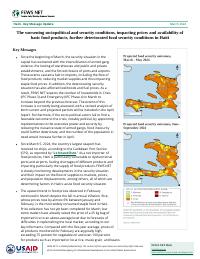
Cette mise à jour des messages clés porte sur mars 2024, le mois où la crise sécuritaire haïtienne est devenue une crise d'approvisionnement. Depuis le début du mois, la situation sécuritaire dans la capitale s'est fortement dégradée avec l'intensification de la violence des gangs armés, le pillage d'entrepôts et d'établissements publics et privés, et la fermeture forcée des ports et aéroports. Ces événements ont interrompu les importations, y compris alimentaires, réduisant l'approvisionnement des marchés et faisant monter les prix des denrées de base, tout en dégradant les moyens d'existence et en renchérissant le carburant. FEWS NET s'attendait donc à ce que le nombre de ménages en Crise (Phase 3 de l'IPC) et en Urgence (Phase 4 de l'IPC) en mars dépasse la prévision précédente, précisant que l'ampleur restait à évaluer et qu'une analyse révisée des périodes courante et projetée figurerait dans le rapport d'avril. Il avertissait que si les acteurs sociopolitiques ne parvenaient pas à dénouer la crise, en désignant des représentants au pouvoir exécutif et en réduisant la capacité de nuisance des gangs armés, l'insécurité alimentaire pourrait encore se détériorer et la population dans le besoin augmenter en avril. Depuis le 5 mars 2024, le principal port maritime du pays n'avait reçu aucun navire, selon le Caribbean Port Service rapporté par Le Nouvelliste ; importateur net de produits alimentaires, Haïti est particulièrement exposée au dysfonctionnement des ports et aéroports. La tendance haussière des prix alimentaires observée en février s'est poursuivie en mars malgré le recul de l'inflation annuelle. Le riz, denrée de base la plus consommée, avait déjà augmenté de près de 6 pour cent entre janvier et février et, bien que la collecte des prix de mars fût incomplète, des commerçants avaient porté le prix du sac de 25 kg de riz importé au-dessus de la moyenne en prévision de difficultés de réapprovisionnement. Par rapport à la moyenne quinquennale, les prix de février de tous les produits suivis étaient anormalement élevés, dépassant 75 pour cent pour l'huile végétale et 100 pour cent pour le riz importé et local, le maïs en grain et le haricot. Des précipitations inférieures à la moyenne, mal réparties dans l'espace et le temps au cours des trois mois précédents, conjuguées à l'insuffisance de l'appui aux agriculteurs décapitalisés et au coût élevé des intrants, ont retardé et réduit la préparation des sols et les semis de la campagne de printemps.
Geographie
NationalDépartement de l'Ouest
Periode Couverte
2024-03 — 2024-03
Mots-cles
series:fewsnet-hti-foodsec|key message update|IPC|acute food insecurity|port closure|imports|rice prices|spring campaign
Entites
FEWS NET|IPC|Caribbean Port Service|Le Nouvelliste
Texte Integral du Document

Texte extrait du document original pour l'indexation.

Haiti - Key Message Update March 2024 The worsening sociopolitical and security conditions, impacting prices and availability of basic food products, further deteriorated food security conditions in Haiti Key Messages Since the beginning of March, the security situation in the capital has worsened with the intensification of armed gang violence, the looting of warehouses and public and private establishments, and the forced closure of ports and airports. These events caused a halt to imports, including the flow of food products, reducing market supplies and thus impacting staple food prices. In addition, the deteriorating security situation has also affected livelihoods and fuel prices. As a result, FEWS NET expects the number of households in Crisis (IPC Phase 3) and Emergency (IPC Phase 4) in March to increase beyond the previous forecast. The extent of this increase is currently being assessed, with a revised analysis of both current and projected periods will be included in the April report. Furthermore, if the socio-political actors fail to find a favorable outcome to the crisis, notably political, by appointing representatives to the executive power and security by reducing the nuisance state of armed gangs, food insecurity could further deteriorate, and the number of the population in need would increase further in April. Since March 5, 2024, the country's largest seaport has received no ships, according to the Caribbean Port Service (CPS), as reported by "Le Nouvelliste." As a net importer of food products, Haiti is particularly vulnerable to dysfunctional ports and airports, fueling shortages of different products and impacting particularly the supply of food products. FEWS NET is closely monitoring developments in the security situation and their impact on the flow of supplies to markets, prices, and population displacements, among others, all of which are determining factors in Haiti's acute food security situation. The upward trend in food prices observed in February continued in March despite the fall in annual inflation. Rice, whose prices rose by almost 6% between January and February, is the most widely consumed staple food in Haiti. Price collection has not yet been completed for March, but some traders have already raised the price of a 25 kg bag of imported rice to an above-average level due to forecasts of difficulties in replenishing the local market, according to our key informants. Compared with the five-year average, prices of all products monitored for February are atypically high, exceeding 75 percent for vegetable oil and even 100 percent for products such as imported or local rice, maize grain, and beans. FEWS NET is a USAID-funded activity. The content of this report does not necessarily reflect the view of the United States Agency for International Development or the United States Government. FEWS NET Haiti haiti@fews.net fews.net/latin-america-and-caribbean/haiti Key Message Update March 2024 Finally, below-average rainfall, with irregular spatial and temporal distribution, has been recorded over the past three months. This irregularity in the spatiotemporal distribution of the rains, combined with the inadequacy or absence of assistance to already decapitalized farmers, as well as the high cost of agricultural inputs, has led to delays and a reduction compared with normal in soil preparation and sowing activities for this year's spring cropping season. Recommended citation: FEWS NET. Haiti Key Message Update March 2024: The worsening sociopolitical and security conditions, impacting prices and availability of basic food products, further deteriorated food security conditions in Haiti, 2024. * FEWS NET's classifications are IPC-compatible. IPC-compatible analysis follows key IPC protocols but does not necessarily reflect the consensus of national food security partners. As of IPC 3.0, the IPC no longer assesses the impact of food assistance on classification and thus no longer maps the (!). However, FEWS NET continues to produce food security maps inclusive of the (!) as well as maps compatible with IPC 3.0/3.1, which include the mapping of food security assistance bags. FEWS NET and the IPC use different methods to estimate the total Population in Need of humanitarian food assistance and assess the risk of Famine. Learn more at www.fews.net/about. About Key Message Update This Key Message Update provides a high-level analysis of current acute food insecurity conditions and any changes to FEWS NET's latest projection of acute food insecurity outcomes in the specified geography. Learn more here. Famine Early Warning Systems Network 2