
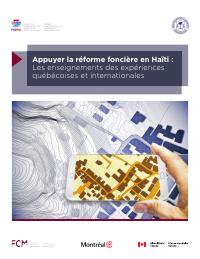
Supporting Land Reform in Haiti: Lessons from Quebec and International Experiences
- Land reform should begin with core registry and cadastre functions before expanding into broader land-information ambitions.
- International experience suggests that reform objectives must fit institutional, human and financial capacity.
- Cadastre and land-registry modernization can support rights security, local taxation and territorial governance when sequenced realistically.
- The Haitian reform requires a shared vision among government, land professionals and users.
Prepared for the Project for the Computerization of the Land Registry in Haiti, this note places Haiti's land reform after the 2010 earthquake in a broader debate on land information systems, cadastral modernization, rights security and local taxation. It warns against oversized reform objectives and technology-first approaches that exceed institutional capacity, using experiences from Quebec, Rwanda and other countries to frame what a sequenced Haitian reform can realistically do.
The document is valuable for HaitiDocs because it links the CIAT/ONACA/DGI reform agenda to practical implementation questions: the basic functions a land system must perform, how cadastre and registry modernization should support territorial governance, and what public institutions and land professionals need in order to secure rights and support development.
How to cite
Fédération canadienne des municipalités (FCM); Ville de Montréal; Global Affairs Canada; Projet d'informatisation du registre foncier en Haïti (PIRFH), 2019, Supporting Land Reform in Haiti: Lessons from Quebec and International Experiences, http://www.foncier-developpement.fr/wp-content/uploads/Appuyer-la-réforme-foncière-en-Haïti-FINAL-190909-1.pdf