
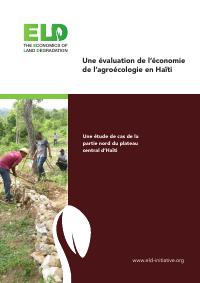
An Economic Assessment of Agroecology in Haiti: A Case Study from the Northern Part of Haiti's Central Plateau
- Agroecological model farmers earn net crop-and-tree income of USD 1,231-1,596 per hectare, nearly double the USD 616-806 earned by conventional farmers, despite higher production costs.
- Regression analysis shows the income gap is driven by agroecological practices, quality-seed and weeding-labor spending, not by farmer education, support networks, or plot distance.
- Intercropping is the main productivity driver: increasing from 2 to 6 intercropped species raises expected gross crop income from about USD 700 to USD 1,680 per hectare.
- Satellite NDVI data validate the survey results, with model plots showing 4.3 percent higher monthly vegetation values despite receiving 3.5 mm less rain per month.
- 98 percent of model farmers intend both to continue agroecological farming and to expand the area under it.
Produced by Altus Impact with the Haitian NGO Partenariat pour le Developpement Local (PDL) and Groundswell International under the Economics of Land Degradation (ELD) Initiative, this study builds and applies a farm-level valuation tool combining household-survey land-use budgets with focus groups and satellite validation. The setting is the northern Central Plateau basin (communal sections of Bois Neuf, Sans Souci, and La Belle-Mère in the communes of Saint-Raphaël, Mombin-Crochu, and Pignon), where PDL has supported peasant associations since 2009; 330 farmers, both agroecological 'model' farmers and conventional farmers, were surveyed in June-July 2021.
Model farmers earn gross crop-and-tree income above USD 1,600 per hectare on their main plot versus roughly USD 900 for conventional farmers, and after deducting input and labor costs their net income (USD 1,231-1,596/ha) is close to double the conventional benchmark (USD 616-806/ha). Production-function regressions show the gap is not explained by education, support networks, or plot distance but by spending on quality seed and weeding labor and by agroecological practice itself; intercropping is the strongest driver, with raising intercropping from 2 to 6 crops lifting expected gross crop income from about USD 700 to USD 1,680 per hectare.
NDVI satellite data corroborate higher land productivity (monthly values 4.3 percent higher on model plots despite less rainfall), and 98 percent of model farmers intend to continue and expand the approach. The study recommends blended-finance solutions, payments for ecosystem services, secure land tenure, and public-private-NGO partnerships to scale agroecology.
How to cite
Economics of Land Degradation Initiative (ELD), 2023, An Economic Assessment of Agroecology in Haiti: A Case Study from the Northern Part of Haiti's Central Plateau, https://www.eld-initiative.org/fileadmin/ELD_Filter_Tool/Case_Study_Haiti_2023/Haiti_2023_Agroecology_ELD_Report_FR.pdf