
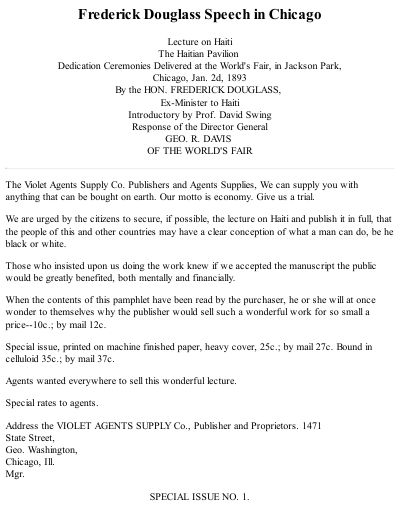
Lecture on Haiti: The Haitian Pavilion Dedication Ceremonies, World's Fair, Chicago, January 2, 1893
- Douglass calls Haiti the only self-made Black republic and the first place in the New World where Black people asserted their right to be free and won it.
- He names recurring revolutions as Haiti's greatest calamity, attributes them to an educated and ambitious few, and says allies in the United States stirred up strife for profit.
- He says Haiti refused to cede the Mole Saint-Nicolas to the United States and that the refusal involved neither insult nor broken faith.
- After diligent inquiry he never met anyone who had seen human sacrifice in Haiti, and he says the people are not as lazy as they are represented.
- He reports marked improvement over twenty years, citing a telegraph cable Haiti paid for itself and five hundred schools added in two years of President Hyppolite's administration.
- He says France sent 50,000 veteran troops to Haiti in 1802 and 1803 and that Haiti has kept its independence since 1804.
Frederick Douglass, who had served as United States Minister to Haiti, delivered this lecture in Chicago on January 2, 1893. The Violet Agents' Supply Co. printed it as a pamphlet with an introduction by David Swing and a preface dated April 1893. Douglass presents Haiti as the only self-made Black republic, describes its scenery and its trade with the United States, and says Haiti was entitled to refuse the Mole Saint-Nicolas to the United States. He names recurring revolutions as the country's main affliction, attributes them to an educated and ambitious few and to allies in the United States who profit from arming factions, and says he would work to abolish the right of asylum in foreign legations.
He answers the charges of laziness, voodoo and human sacrifice made by Mr. Froude and others, reports that he never met anyone who had seen a sacrifice, and finds Port-au-Prince much improved compared with twenty years earlier. He defends President Hyppolite and recounts the Haitian Revolution, including the French expedition of 1802 and 1803 and the capture of Toussaint Louverture. The pamphlet also reproduces his remarks at the dedication of the Haitian Pavilion at the World's Columbian Exposition, held on the anniversary of Haitian independence.
How to cite
Frederick Douglass, Lecture on Haiti: The Haitian Pavilion Dedication Ceremonies, World's Fair, Chicago, January 2, 1893, accessed via HaitiDocs, https://www.haitidocs.org/doc/douglass-1893-lecture-on-haiti-chicago
- Rights holder
- Frederick Douglass