
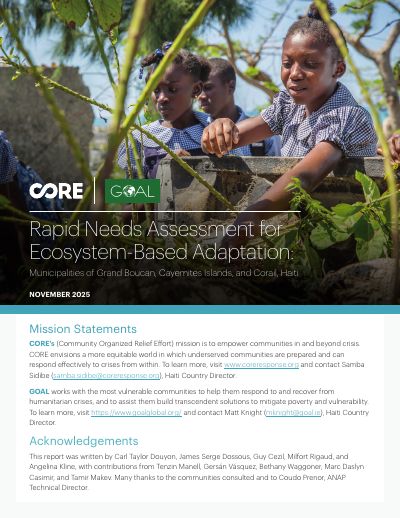
Rapid Needs Assessment for Ecosystem-Based Adaptation: Municipalities of Grand Boucan, Cayemites Islands, and Corail, Haiti
- The assessment covers Grand Boucan, the Cayemites Islands and Corail, in the 874.474 square kilometer Baradères-Cayemites Marine and Coastal Protected Area.
- 188 participants were consulted: 171 in six focus groups, 56 of them women, and 17 key informants.
- Coastal erosion, overfishing, loss of coral reefs and mangroves, and charcoal production are degrading marine, coastal and terrestrial ecosystems.
- Fishing is the main source of income and over 90 percent of men reportedly fish, but fishers lack gear, preservation structures, training and strong associations.
- The Cayemites Islands have no health center, court or police station.
- Women work in food production, trade and artisanal work, with limited access to training and finance.
- Priority needs include training and gear for sustainable and deep-sea fishing, updated fishing rules with zoning, savings and loan associations, cooperatives and support for women entrepreneurs.
In November 2024, CORE (Community Organized Relief Effort) and GOAL conducted a joint rapid needs assessment in three municipalities of the Baradères-Cayemites Marine and Coastal Protected Area: Grand Boucan, the Cayemites Islands and Corail. The protected area covers 874.474 square kilometers, 49 percent terrestrial and 51 percent marine, and straddles the Nippes and Grand'Anse departments. The report, dated November 2025, aims to inform programming on ecosystem restoration and resilient livelihoods. It consulted 188 participants: 171 in six focus groups (115 men and 56 women) and 17 key informants, among them fishers, traders, farmers, local authorities and community leaders.
The report gives estimated populations of 5,815 for Grand Boucan, 5,231 for the Cayemites Islands (an independent municipality since 2017) and 23,203 for Corail, from IHSI projections for 2015. Basic services are largely absent: the Cayemites Islands have no health center, court or police station, and neither Grand Boucan nor the Cayemites has a public market. Fishing is the most common source of income, and the report states that over 90 percent of men fish. Fishers report declining catches, small-mesh nets, dynamite fishing, little capacity to preserve fish and weak associations. Farmers report an eight-month drought from September to April 2022-2023, slash-and-burn clearing and free-roaming livestock. Many households turn to charcoal production, which adds pressure on forests and mangroves.
The report concludes that environmental degradation is accelerating, that livelihoods in fisheries and agriculture are at risk, that women are central to livelihoods but face structural barriers, and that local climate response efforts exist but remain under-resourced. Recommendations include training in sustainable and deep-sea fishing, appropriate gear, preservation and storage structures, enforcement of updated fishing regulations with zoning, savings and loan associations, cooperatives, crop diversification, beekeeping, ecotourism and support for women entrepreneurs.
How to cite
Community Organized Relief Effort (CORE), 2025, Rapid Needs Assessment for Ecosystem-Based Adaptation: Municipalities of Grand Boucan, Cayemites Islands, and Corail, Haiti, https://reliefweb.int/attachments/29c08e37-6d1e-4a0c-8498-3219ee3f3730/Haiti_RapidNeedsAssessmentReport_102725_HiRes.pdf
- Rights holder
- Community Organized Relief Effort (CORE)