
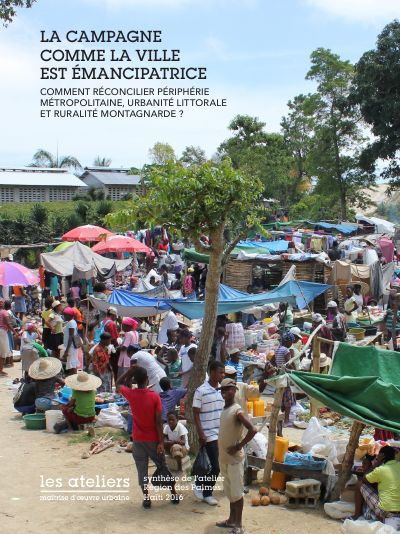
The Countryside, Like the City, Is Emancipatory: How to Reconcile Metropolitan Periphery, Coastal Urbanity and Mountain Rurality? Workshop Synthesis, Région des Palmes, Haiti 2016
- The workshop drew more than 120 applications and gathered 24 volunteers, eight Haitian professionals and sixteen from eight countries, in four teams between February 26 and March 12, 2016.
- The four team messages are to open the mornes, to turn toward the sea, to build a new countryside and to live together by improving crossroads, roads and river deltas.
- The booklet states seven major challenges, from water and watersheds to the economic positioning of the Palmes within the Port-au-Prince metropolitan area.
- It recommends a fine network of paths, coastal shipping between Miragoâne and Port-au-Prince and village links in the mornes as alternatives to National Road 2.
- It proposes a hierarchy of towns and villages, with Léogâne, Grand-Goâve and Petit-Goâve as historic anchors and new centers in the mornes such as Tomb Gato and Fiche.
- The jury of March 11, 2016 stressed the sea and the mornes as resources absent from earlier Haitian urban plans.
The workshop drew more than 120 applications and gathered 24 volunteers, eight Haitian professionals and sixteen from eight countries, in four teams. The booklet was written by the workshop pilot, Marion Talagrand, with two co-pilots, and has three chapters: the hypothesis that the countryside, like the city, can be a desirable horizon; the four messages of the teams; and a cross-team synthesis addressed to the public authorities. The messages are 'Moun mon' (open the mornes), 'Sarasimbi' (the sea asserts itself), 'Byen kare' (a new countryside, built as a mosaic of built, wooded and farmed plots) and 'Nou tout anndan' (living together, by improving the crossroads of National Road 2, the roads to the mornes and the river deltas).
The synthesis lists seven major challenges for the territory, from water and watersheds to the economic positioning of the Palmes within the Port-au-Prince metropolitan area. It proposes a fine network of paths, coastal shipping between Miragoâne and Port-au-Prince and village-to-village links as alternatives to National Road 2, and a hierarchy of towns and villages with Léogâne, Grand-Goâve and Petit-Goâve as historic anchors and new centers in the mornes. Targeted actions include opening the Petit-Goâve port to the town, restoring the 100 m strip at a Gressier beach, restoration projects on coastal rivers starting with the Grand-Goâve river, and pilot farm frames in the Léogâne and Grand-Goâve plains.
The jury met on March 11, 2016 under Michèle Oriol of the CIAT and Pierre-André Périssol of Les Ateliers. Its members stressed the sea and the mornes as resources absent from earlier Haitian urban plans, and the booklet records that the CMRP-DATIP was analyzing the ideas in order to seek financing.
How to cite
Interministerial Committee for Territorial Planning (CIAT); Communauté des Municipalités de la Région des Palmes (CMRP); Les Ateliers, The Countryside, Like the City, Is Emancipatory: How to Reconcile Metropolitan Periphery, Coastal Urbanity and Mountain Rurality? Workshop Synthesis, Région des Palmes, Haiti 2016, https://ateliers.org/en/workshops/161/
- Rights holder
- Comité Interministériel d'Aménagement du Territoire (CIAT)|Communauté des Municipalités de la Région des Palmes (CMRP)|Les Ateliers