
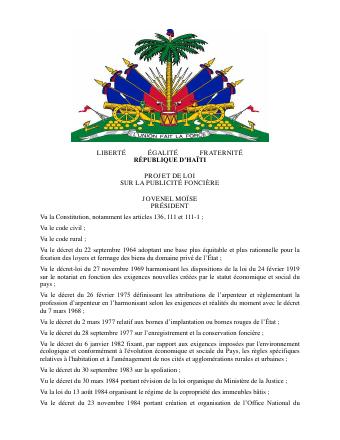
Draft Law on Land Publicity (Land Registration)
- Supplies the registration half of land security: a public record of rights, made enforceable against third parties.
- Without it a purchaser cannot verify title and a lender cannot rely on a mortgage, whatever the cadastre shows.
- The preamble's reference to the 1964 state-domain leasing decree signals the unclear public/private boundary it must handle.
- Prepared under the CIAT with the cadastre, notarial and surveyor instruments and transmitted to Parliament with them.
A cadastre alone does not create land security. Knowing where a parcel lies and what it measures is of limited use if there is no reliable public record of who holds which right over it and no rule making that record enforceable against a competing claimant. This draft law supplies that half. Land publicity, in the civil-law tradition it belongs to, is the system by which transactions and rights over immovable property are entered into a public register and thereby made opposable to third parties; without it, a purchaser cannot know whether the seller's title is good, and a lender cannot rely on a mortgage. Its preamble situates it against the civil code, the rural code and the 1964 decree on the leasing of state private-domain property, which signals the particular Haitian problem it must handle: much of what is transacted touches land whose relationship to the state domain is itself unclear. It was prepared under the CIAT alongside the cadastre and notarial drafts and the surveyors law, and transmitted to Parliament with them.
How to cite
Government of Haiti; Interministerial Committee for Territorial Planning (CIAT), 2019, Draft Law on Land Publicity (Land Registration), http://ciat.gouv.ht/sites/default/files/articles/files/AVANT-PROJET%20DE%20LOI%20SUR%20LA%20PUBLICITE%20FONCIERE.pdf