
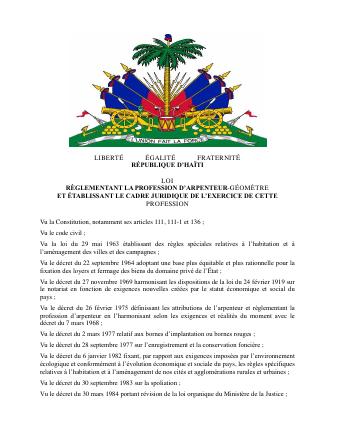
Law Regulating the Surveyor Profession and Establishing its Legal Framework
- The surveyor produces the boundary evidence a cadastre rests on, so the profession's standard caps the quality of any land record.
- Titled LOI, not PROJET DE LOI, unlike the other three instruments, suggesting it advanced further.
- The preamble ties surveying to the 1963 law on housing and town and country development, not to a purely technical trade.
- Part of the four-instrument CIAT land-law package sent to Parliament.
A land record is only as reliable as the measurement behind it. In Haiti the arpenteur is the practitioner who goes to the parcel, establishes its boundaries and produces the document on which a claim then rests, so the standard of that profession sets a ceiling on the quality of any cadastre built above it. This instrument regulates the profession and establishes the legal framework for its exercise. Notably, it is titled LOI rather than PROJET DE LOI, unlike the cadastre, land publicity and notarial texts alongside it, which suggests it reached a further stage than the other three. Its preamble reaches back to the law of May 29, 1963 establishing special rules on housing and the development of towns and countryside, and to the 1964 decree on state private-domain leasing, tying the surveyor's work directly to urban development law rather than treating it as a purely technical trade.
How to cite
Government of Haiti; Interministerial Committee for Territorial Planning (CIAT), 2019, Law Regulating the Surveyor Profession and Establishing its Legal Framework, http://ciat.gouv.ht/sites/default/files/articles/files/LOI%20%20ARPENTEUR-G%C3%89OM%C3%88TRE.pdf