Full Document Text
Extracted text from the original document for search indexing.
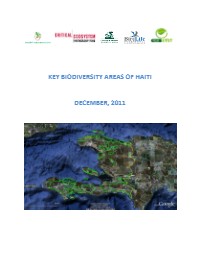
KEY BIODIVERSITY AREAS OF HAITI
DECEMBER, 2011
ii
ACKNOWLEGEMENTS
The assistance of several organizations and their staff were instrumental in the development of this
effort to identify and describe the Key Biodiversity Areas of Haiti. The Critical Ecosystem Partnership
Fund, through support to BirdLife International, Société Audubon Haïti and Rezo Ekolo, provided the
funding for the study. FoProBim, Reef Check and DAI provided support to identify important marine and
coastal KBAs; PSU provided information on the distribution of threatened amphibian and reptile species
in Haiti; UNDP- and GEF-funded Système Nationale des Aires Protégées, through the Ministry of
Environment, provided data to integrate the KBAs with current and proposed protected areas.
ACRONYMS
AZE Alliance for Zero Extinction
CEPF Critical Ecosystem Partnership Fund
DAI Development Alternatives Inc.
FoProBim Fondation pour la Protection de la Biodiversité Marine
GEF Global Environment Facility
IBA Important Bird Area
IPA Important Plant Area
IUCN International Union for the Conservation of Nature
KBA Key Biodiversity Area
PSU Pennsylvania State University
UNDP United Nations Development Program
iii
Table of Contents
Page No.
Acknowledgements, Acronyms ii
Introduction 1
KBAs of Haiti 1
KBA Selection 3
Technical Data Sheets 4
Summary 5
References 6
Key Biodiversity Areas of Haiti – Part 1 8
Key Biodiversity Areas of Haiti – Part 2 27
Annex 1. Threatened species of Haiti contained in the KBAs of Haiti 41
Annex 2. IUCN Red List threatened species not included in the KBAs of Haiti 45
Annex 3. Species of special concern contained in the KBAs of Haiti 46
1
KEY BIODIVERSITY AREAS OF HAITI
JOEL C. TIMYAN
INTRODUCTION
Key Biodiversity Areas (KBAs) are internationally important areas that are essential for conserving
biodiversity (Eken et al., 2004; Langhammer et al., 2007). The KBA concept was developed by a
consortium of international, national and regional conservation organizations
1
with the objective of
prioritizing areas within a country that require protection due the vulnerability and uniqueness of the
animal and plant populations that reside in these areas. KBAs are a starting point for conservation
planning at the landscape level within a country insofar that the KBAs represent areas that are essential
to maintaining globally and regionally threatened species. They can comprise protected and
unprotected areas of varying scales and are based primarily on internationally recognized databases and
criteria for various taxa, including the IUCN Red List, BirdLife International’s Important Bird Areas (IBAs),
Plantlife International’s Important Plant Areas (IPAs), Alliance for Zero Extinction (AZE) sites and several
others. There are approximately 20,000 KBAs worldwide in over 200 countries (Langhammer et al.,
2007).
The criteria generally recognized for KBAs include 1) One or more globally threatened species; 2) One or
more endemic species which are globally restricted to the site or surrounding region; 3) Significant
concentrations of a species; and 4) Globally significant examples of unique habitat types and species
assemblages (Langhammer et al., 2007).
KBAs are an important tool to compile country profiles, maintain biological databases, and present
technical and scientific data for use by policy makers, researchers, planners, land managers and local
communities to incorporate conservation and environmental priorities in the economic development of
Haiti. They are a point of entry in the national conversation and public awareness of an irreplaceable
natural heritage that society risks losing if no measures are taken to conserve.
KBAs of Haiti
The identification of KBAs in Haiti began in 2009 through local expert consultation led by BirdLife
International. However, before this period a series of Important Bird Areas (IBAs) were identified in
Haiti (BirdLife, 2008). The IBAs served as a base to build the current network of KBAs.
A preliminary set of 17 KBAs were identified that represented the majority of threatened terrestrial
species on the IUCN Red List. This resulted in a 2009 draft that was reviewed and expanded in 2011 to
refine the scientific basis for the KBAs and to merge the KBAs toward the nascent Système Nationale des
Aires Protégées being developed under the UNDP and the Ministry of Environment (UNDP, 2011). It
should be noted that Haiti has the least amount of protected area among Caribbean countries. A
1
The International Union for Conservation of Nature (IUCN), BirdLife International, Plantlife International,
Conservation International, Critical Ecosystem Partnership Fund and over 100 national/regional civil society and
governmental conservation agencies.
2
nominal 6% is often cited, though in reality only 0.3% can be considered to benefit from some degree of
protection (Victor, 1997).
Upon careful review of the original 17 KBAs, gaps and inconsistencies were found that required a need
to increase the number of KBAs and to redefine the boundaries that better reflect the ranges of
threatened and irreplaceable taxa. We also took into account the increased complexity of KBAs as
opposed to IBAs in both spatial scale as well as biodiversity and the high fragmentation of natural areas.
Thus, several KBAs that were based entirely on their designation as IBAs were merged or expanded. For
example, Trou Caïman IBA and Lac Azuei IBA were merged to form one KBA (Table 1). While it is
possible for a KBA to be a formal entity like a national park or protected area, the situation in Haiti is too
poorly developed for this to be of practical value. Rather the KBAs in Haiti are areas where notable
concentrations of globally or regionally threatened species occur, particularly those found only within
Haiti.
Table 1. Summary of Key Biodiversity Areas of Haiti and their relation to Important Bird Areas (BirdLife,
2008). The IBAs are in parentheses.
KBAs including IBAs KBAs not including IBAs Proposed KBAs
Massif de la Hotte (Aux Bec-Croisés, Bois
Musicien)
Cavaillon, Cayemites-Baradères, Côtes
du Nord, Chaines des Cahos, Dame
Marie, Dépression de Jacmel, Dubedou
– Morne Balance, Fond des Nègres –
L’Etang Miragoâne, Ile à Vache, Ile de la
Tortue Ouest, La Gonâve – Côte Sud, La
Gonâve – Côte Nord, Le Delta de l’Arti-
bonite, Madicaque, Môle Saint Nicolas,
Morne Bailly, Nan L’Etat, Neiba d’Haïti,
Pic Tête Boeuf, Picmi, Plaisance, Port-
de-Paix, Saint Michel de l’Atalaye-
Morne Basile.
Arcadins, Banc de Rochelois
Massif de la Selle (Aux Cornichons, Aux
Diablotins)
Lac Azuéi-Trou Caïman (Lac Azuéi, Trou
Caïman)
Citadelle-Grottes Dondon (Les Todiers)
Ile de la Tortue Est (Coquillage – Pointe
Est, Les Grottes)
Lagons du Nord-Est (Lagons-aux-Boeufs)
Areas of Haiti completely absent from the first draft included important marine and coastal areas,
including several satellite islands, and the entire Central Plateau region. These potential KBAs are
presented in a separate section of this report in order to highlight the need for further analyses that
may be required to meet the rigorous selection criteria, as in the case of marine areas (Bass et al, 2010).
While KBAs in general are more suited to terrestrial site-specific species, the marine KBAs have been
selected due their extremely high biodiversity values and the fact that they are likely to contain at least
one regionally or globally threatened species at population thresholds that would be considered
significant (Carpenter et al., 2008). In many cases, the coral reefs and mangrove systems were already
part of a terrestrial KBA that was expanded to include the marine ecosystems.
Figure 1 shows the 31 KBAs identified and presented in more detail below. See Annex 1 for the
threatened species found in these KBAs.
3
Figure 1. Map of Haiti showing Key Biodiversity Areas (green polygons).
KBA SELECTION
An updated list of IUCN Red List species was obtained from the IUCN database for Haiti (IUCN, 2011).
This set of threatened species
2
serves the primary basis for identifying KBAs in Haiti (Annex 1). In the
case of the Magnoliaceae, the Red List published by the IUCN/SSC Global Tree Specialist Group was
included (Cicuzza et al., 2007) though the Haitian species are not listed on the IUCN Red List.
KBAs correspond to areas of the country where especially high concentrations of threatened species are
found, many times restricted to a specific area of Haiti. Species that are likely to be qualified as
threatened, but are considered by the IUCN as “Date Deficient”, are not included in the KBAs. In some
cases, they were noted for a particular KBA, especially if closely related species were considered
threatened. Furthermore, important endemic species that have never been assessed by IUCN are
noted if scientific data exists that suggests their threatened status (Annex 3). Errors found in the IUCN
database were corrected to reflect changes in known ranges, nomenclatural updates or changes in the
Red List status since 2009. For example, the IUCN Red List does not recognize the population of Cyclura
ricordii that is found in the Anse-à-Pitre area of SE Haiti (Rupp & Accimé, 2011), nor does it recognize the
status of Eleutherodactylus asporostegus, endemic to Haiti, that was split from Eleutherodactylus ruthae
(Hedges et al., 2008). The same case is true for E. displasius that was split from E. wetmorei. In each
case, the result is a more restricted natural distribution that would normally increase the species’
vulnerability.
2
Threatened species are classified as Critically Endangered (CR), Endangered (EN) or Vulnerable (VU). IUCN Red
List species classified as Near Threatened (NT), Least Concern (LC), Data Deficient (DD) or Not Evaluated (NE) are
not considered.
4
Several threatened species listed for the KBAs should be considered as candidates for inclusion since
population thresholds or standardized criteria have not been determined for Haiti. These include many
of the marine and freshwater species such as sea turtles and crustaceans.
The amphibians being assessed by the Amphibian Specialist Group (www.amphibians.org) as a result of
the Ark/IUCN assessment conference in Santo Domingo in March, 2011, were also included in this
analysis. As a result of current assessments, two of five amphibian species were removed from the KBA
lists (Table 2). Three of the species remain listed in the KBAs (Hypsiboas heilprini, Osteopilus
pulchrilineatus and O. vastus) due their threatened status in Haiti. Other amphibian species that are
under review have been given their 2004 IUCN status until the 2011 assessment is published by IUCN.
Table 2. Amphibian species under recent (2011) IUCN assessment.
Species 2004 Status 2011 Proposed
Eleutherodactylus pictissimus Cochran, 1935 VU NT
Hypsiboas heilprini Noble, 1923 VU LC
a
Peltophryne guentheri Cochran, 1941 VU NT
Osteopilus pulchrilineatus Cope, 1869 EN LC
a
Osteopilus vastus Cope, 1871 EN LC
a
a
Given habitat conditions of species’ natural range ( declining quality of streams, decreasing intact forests,
increased fragmentation of habitats), the 2011 IUCN status will likely remain a threatened category (Powell &
Inchaustegui, pers. comm.) Thus, the 2004 status have been selected for the KBAs until the final IUCN
assessment is completed.
The known distribution of the threatened species list was thoroughly reviewed for this report using
international databases. For plants, the herbaria collections located in Haiti (EHH), Florida (FLAS),
Stockholm (S), New York (NY), Missouri (MO), Santo Domingo (JBSD), and Washington DC (US) were
reviewed. For vertebrates, the GBIF database was reviewed as well as several important museum
collections in the US . In many cases, only type localities are known for a species and their inclusion
within a KBA does not confirm the status of their populations. However, this approach errors on the side
of precaution and is primarily due to the lack of field studies generating any data to the contrary.
Several species that are listed for Haiti on the 2011 IUCN Red List were not included in the KBAs (Annex
2). These include a lizard, Sphaerodactylus williamsi, that occurs just outside the Artibonite Delta KBA;
Ridgway’s Hawk (Buteo ridgwayi) and the West Indian manatee (Trichechus manatus) that have likely
been extirpated from their natural ranges in Haiti; and several open ocean species that are uncertain to
occur inside Haitian territory due to a deficiency of data.
It is realized that the KBAs contain even more threatened species than those assessed since the IUCN
Red List, particularly since so many major plant and animal families have not been assessed. Several of
these taxa exhibit relatively high rates of endemism in Haiti. These include many genera in the
Asteraceae, Cactaceae, Melastomataceae, Myrtaceae, Orchidaceae, Rubiaceae, Sabiaceae, Solanaceae
and Urticaceae among plant families; Poeciliinae among fish families; and an uncertain number of
invertebrate families. A selected number of these taxa are have been noted for each KBA where they
are likely to occur (Annex 3).
TECHNICAL DATA SHEETS
A technical data sheet was prepared for each KBA that profiles site-specific data. Major categories of
data included basic information, biodiversity and current status, threats, current conservation approach,
5
new conservation and governance approach, history and capacity, detailed knowledge of the ecology,
acknowledgements, references and additional information that is required. Once the information is
reviewed and finalized, these technical data sheets will be entered into the World Biodiversity Database
and disseminated to researchers, managers, planners and policy makers.
SUMMARY
The 31 KBAs in Haiti cover an area of 9,340 km
2
– about a third of the country’s land area. The
estimated area of the KBAs include significant areas of marine ecosystems which are generally excluded
from the 27,750 km
2
area often cited for Haiti. The KBAs vary widely in their sizes, from the smallest at
Picmi (1.6 km
2
) to the 2 largest, Massif de la Hotte (1981 km
2
) and Massif de la Selle (1934 km
2
).
The most important KBAs, in terms of the number of threatened species endemic to either the KBA or
the island of Hispaniola, are shown in Figure 2. Massif de la Hotte has the most species of any KBA
followed closely by Massif de la Selle. However, Massif de la Hotte ranks higher in terms of unique
species. The Côtes du Nord KBA is one of the 14 KBAs that includes threatened marine species which are
not endemic to the island (shown in green) versus the endemic terrestrial species (shown in red).
Figure 2. The KBAs containing the highest number of endemic species.
The land-based KBAs varied widely in the number of species being considered and the frequency that
each species occur among KBAs. This is due to several factors - 1) The complex geological past of the
island and its influence on dispersal and vicariance mechanisms that determine species biogeography; 2)
The preponderance of certain genera (e.g., Eleutherodactylus) to contribute a disproportionate share of
threatened species; and 3) The wide variation in endemism among species. The KBAs of the “South
Island,” comprising the Massif de la Hotte and Massif de la Selle, contain over 60% of the threatened
species despite encompassing only 20% of the total land area in Haiti. In terms of endemism, 34% of the
KBA species are endemic to Haiti and 63% of the threatened species are endemic to Hispaniola. In many
cases, the country endemics occur in very restricted areas and are only represented by a single KBA.
0
10
20
30
40
50
60
NO. SPECIES
KBA ENDEMIC HISPANIOLA ENDEMIC OUTSIDE HISPANIOLA
6
Approximately 45 % of the terrestrial species are represented by a single KBA in Haiti (50 of 111 selected
taxa). Thus, the majority of species are represented by at least 2 or more KBAs. Figure 3 summarizes
the frequency that species are represented in the KBAs. The peak at 14 KBAs reflects the set of
threatened marine species found in the KBAs including coastal marine areas.
Figure 3. Representation of threatened species in KBAs of Haiti.
The KBAs include 14 areas of marine ecosystems (e.g., estuaries, coral reefs and mangroves) that were
not included in the original list of Haitian KBAs. Two of these KBAs (Arcadins, Banc de Rochelois) are
being proposed as KBAs despite their lack of threatened terrestrial species. These KBAs have been
included due the significance of the threatened biodiversity found in these systems. However, it is
acknowledged that the methodology to determine marine KBAs is still being developed for most species
and thus must be considered with caution, particularly with regard to the lack of scientific data
supporting threshold populations.
REFERENCES
Bass, D., P. Anderson and N. De Silva. 2010. Applying thresholds to identify key biodiversity areas for
marine turtles in Melanesia. Animal Conservation 14 (1): 1-11.
BirdLife International. 2008. Important Bird Areas in the Caribbean: Key Sites for Conservation. BirdLife
Conservation Series 15, Cambridge, UK. 348 p.
Carpenter, K. E., M. Abrar, G. Aeby, R. B. Aronson, S. Banks, A. Bruckner, A. Chiriboga, J. Cortès, J. C.
Delbeek, L. DeVantier, G. J. Edgar, A. J. Edwards, D. Fenner, H. M. Guzmán, B. W. Hoeksema, G.
Hodgson, O. Johan, W. Y. Licuanan, S. R. Livingstone, E. R. Lovell, J. A. Moore, D. O. Obura, D.
Ochavillo, B. A. Polidoro, W. F. Precht, M. C. Quibilan, C. Reboton, Z. T. Richards, A. D. Rogers, J.
Sanciangco, A. Sheppard, C. Sheppard, J. Smith, S. Stuart, E. Turak, J. E. N. Veron, C. Wallace, E.
0
10
20
30
40
50
60
1 2 3 4 5 6 7 8 9 10 11 12 13 14 17 18 22
No. of Species
Frequency (No. of KBAs)
7
Weil & E. Wood. 2008. One-third of reef-building corals face elevated extinction risk from
climate change and local impacts. Science 321: 560-563.
Cicuzza, D., A. Newton and S. Oldfield. 2007. Red List of Magnoliaceae. Flora & Fauna International,
Cambridge, UK. 52 p.
Eken, G., L. Bennun, T. M. Brooks, W. Darwall, L. D. Fishpool, M. Foster, D. Knox, P. Langahmmer, P.
Matiku, E. Radford, P. Salaman, W. Sechrest, M. L. Smith, S. Spector & A. Tordoff. 2004. Key
biodiversity areas as site conservation targets. Bioscience 54: 1110-1118.
Hedges, S. B., W. E. Duellman & M. P. Heinicke. 2008. New World direct-developing frogs (Annura:
Terrarana): Molecular phylogeny, classification, biogeography, and conservation. Zootaxa 1737.
Magnolia Press, Aukland. 182 pp.
IUCN. 2011. IUCN Red List of Threatened Species. Version 2011.1. http://www.iucnredlist.org.
Langhammer, P. F., M. I. Bakarr, L. A. Bennun, T. M. Brooks, R. P. Clay, W. Darwall, N. De Silva, G. J.
Edgar, G. Eken, L. D. Fishpool, G. A. da Fonseca, M. N. Foster, D. H. Knox, P. Matiku, E. A.
Radford, A. S. Rodrigues, P. Salaman, W. Sechrest & A. W. Tordoff. 2007. Identification and Gap
Analysis of Key Biodiversity Areas: Targets for Comprehensive Protected Area Systems. IUCN,
Gland, Switzerland. IUCN World Commission on Protected Areas: Best Practice Protected Areas
Guidelines Series No. 15. 116 p.
Rupp, E. and M. Accimé. 2011. Discovery of Ricord’s Iguana (Cyclura ricordii) in Haiti. IRCF Reptiles &
Amphibians 18(3) : 148-153.
UNDP. 2011. Establishing a financially sustainable National Protected Areas System. Document PIMS
No. 4150 (ATLAS Project ID No. 00070685), UNDP-GEF & Ministry of Environment, Port-au-
Prince. 76 p.
Victor, J. A. 1997. Le cadre légale et institutionnel des aires protégées en Haiti, pp. 38-56. In: Haiti dans
le Dernier Carré. Actes du Colloque sur la Gestion des Aires Protégées et le Financement de la
Conservation de la Biodiversité en Haiti (28 février 1997, Xaragua). CFET, Port-au-Prince. 251 p.
8
KEY BIODIVERSITY AREAS OF HAITI – PART 1
Part 1 is the set of 17 KBAs that originally selected in 2009 in conference with conservation
organizations and biological experts in Haiti. The KBAs and their species list were revised in 2011.
Part 2 is the set of 14 KBAs were selected in 2011 in preparation of this document after further
review of the conservation status of 2011 IUCN Red List threatened species and their known
distributions in Haiti.
1. Dame Marie KBA (18
o
33’ N, -74
o
25’ W)
Threatened Animals and Plants of Dame Marie KBA. CR = Critically Endangered, EN =
Endangered, VU = Vulnerable according to the IUCN Red List.
CLASS SPECIES STATUS
REPTILES Anolis haetianus Garman, 1887 EN
AMPHIBIANS Eleutherodactylus caribe Hedges & Thomas, 1992 CR
Eleutherodactylus heminota Shreve & Williams, 1963 EN
Eleutherodactylus paulsoni Schwartz, 1964 CR
Hypsiboas heilprini Noble, 1923 VU
Osteopilus pulchrilineatus Cope, 1869 EN
CRUSTACEANS Epilobocera haytensis Rathbun, 1893 VU
TREES Cedrela odorata L. VU
Huertea cubensis Griseb. VU
Endemic Species: Several live-bearing fish species of the Limia genus are Hispaniola island endemics that occur in fresh and brackish water bodies
including L. dominicensis, L. meloanogaster, L. melanotata, L. nigrofasciata and L. tridens. These have not been assessed by IUCN. The Gray-Crowned
Palm Tanager (Phaenicophilus poliocephalus), the only bird endemic to Haiti, is found in this KBA. Eleutherodactylus displasius Schwartz, 1973 is listed as
Data Deficient, but may eventually be considered EN if same criteria are used for E. wetmorei from which is was split as a species (Hedges et al., 2008).
The purple copepod, Mastigodiaptomus purpureus Marsh, 1907, VU, is found in freshwater systems of Haiti, but the extent of its range is uncertain.
9
2. Massif de la Hotte KBA (18
o
25’ N, -74
o
01’ W)
Threatened Animals and Plants of Massif de la Hotte KBA. CR = Critically Endangered, EN =
Endangered, VU = Vulnerable according to the IUCN Red List.
CLASS SPECIES STATUS
MAMMALS Lasiurus minor Miller, 1931 VU
Plagiodontia aedium F. Cuvier, 1836 EN
Solenodon paradoxus Brandt, 1833 EN
BIRDS Amazona ventralis Müller, 1776 VU
Aratinga chloroptera Souancé, 1856 VU
Calyptophilus frugivorus Cory, 1883 VU
Catharus bicknelli Ridgway, 1882 VU
Corvus leucognaphalus Daudin, 1800 VU
Loxia megaplaga Riley, 1916 EN
Pterodroma hasitata Kuhl, 1820 EN
Tachycineta euchrysea Gosse, 1847 VU
Xenoligea montana Chapman, 1917 VU
REPTILES Anolis haetianus Garman, 1887 EN
Anolis koopmani Rand, 1961 EN
Typhlops hectus Thomas, 1974 EN
AMPHIBIANS Eleutherodactylus amadeus Hedges, Thomas & Franz, 1987 CR
Eleutherodactylus aporostegus Schwartz, 1965 EN
Eleutherodactylus apostates Schwartz, 1973 CR
Eleutherodactylus audanti Cochran, 1934 EN
Eleutherodactylus bakeri Cochran, 1935 CR
Eleutherodactylus brevirostris Shreve, 1936 CR
Eleutherodactylus chlorophenax Schwartz, 1976 CR
Eleutherodactylus corona Hedges & Thomas, 1992 CR
Eleutherodactylus counouspeus Schwartz, 1964 EN
Eleutherodactylus dolomedes Hedges & Thomas, 1992 CR
Eleutherodactylus eunaster Schwartz, 1973 CR
Eleutherodactylus glandulifer Cochran, 1935 CR
Eleutherodactylus glaphycompus Schwartz, 1973 EN
Eleutherodactylus heminota Shreve & Williams, 1963 EN
Eleutherodactylus lamprotes Schwartz, 1973 CR
Eleutherodactylus nortoni Schwartz, 1976 CR
Eleutherodactylus oxyrhyncus Dumeril & Bibron, 1841 CR
Eleutherodactylus parapelates Hedges & Thomas, 1987 CR
Eleutherodactylus paulsoni Schwartz, 1964 CR
10
CLASS SPECIES STATUS
Eleutherodactylus sciagraphus Schwartz, 1973 CR
Eleutherodactylus semipalmatus Shreve, 1936 CR
Eleutherodactylus thorectes Hedges, 1988 CR
Eleutherodactylus ventrilineatus Shreve, 1936 CR
Eleutherodactylus wetmorei Cochran, 1932 VU
Hypsiboas heilprini Noble, 1923 VU
Osteopilus pulchrilineatus Cope, 1869 EN
Osteopilus vastus Cope, 1871 EN
Aratinga chloroptera Souancé, 1856 VU
Calyptophilus frugivorus Cory, 1883 VU
Catharus bicknelli Ridgway, 1882 VU
Corvus leucognaphalus Daudin, 1800 VU
Loxia megaplaga Riley, 1916 EN
Pterodroma hasitata Kuhl, 1820 EN
Tachycineta euchrysea Gosse, 1847 VU
Xenoligea montana Chapman, 1917 VU
CRUSTACEANS Epilobocera haytensis Rathbun, 1893 VU
TREES Attalea crassispatha (Mart.) Burret CR
Calyptrogenia ekmanii (Urb.) Burret VU
Cedrela odorata L. VU
Cleyera bolleana (O.C. Schmidt) Kobuski VU
Cleyera vaccinioides (O.C. Schmidt) Kobuski VU
Guaiacum officinale L. EN
Guaiacum sanctum L. EN
Guarea sphenophylla Urban VU
Magnolia ekmanii Urb. EN
Micropholis polita (Griseb.) Pierre ssp. hotteana Judd VU
Nectandra caudatoacuminata O.C. Schmidt* CR
Nectandra pulchra Ekm. & O.C. Schmidt CR
Picrasma excelsa (Sw.) Planch. VU
Podocarpus aristulatus Parl. VU
Stenostomum radiatum subsp. haitiensis (Borhidi) Borhidi VU
Endemic Species: The Gray-Crowned Palm Tanager (Phaenicophilus poliocephalus), the only bird endemic to Haiti, is found in this KBA. Eleutherodactylus
displasius Schwartz, 1973 is listed as Data Deficient, but may eventually be considered EN if the same criteria are used for E. wetmorei from which is was
split as a species (Hedges et al., 2008). The purple copepod, Mastigodiaptomus purpureus Marsh, 1907, VU, is found in freshwater systems of Haiti, but
the extent of its range remains uncertain. Several plant genera exhibiting exceptionally high rates of local endemism in the Massif de la Hotte KBA
include Eupatorium, Mikania, Senecio (Asteraceae); Calycogonium, Mercranium, Meriania, Miconia, Sagrea (Melastomataceae); Eugenia (Myrtaceae);
Psychotria (Rubiaceae); Meliosma (Sabiaceae); Cestrum, Solanum (Solanaceae); Lepanthes, Lepanthopsis, Specklinia, Stelis, Tomzanonia (Orchidaceae),
Pilea (Urticaceae). The tree, Chimarrhis ekmanii, and the monotypic orchid genus, Tomzanonia, are endemic to this KBA. * Found only at type locality in
1928.
11
3. Cavaillon KBA (18
o
16’ N, -73
o
42.5’ W)
Threatened Animals and Plants of Cavaillon KBA. CR = Critically Endangered, EN =
Endangered, VU = Vulnerable according to the IUCN Red List.
CLASS SPECIES STATUS
REPTILES Trachemys decorata Barbour & Carr, 1940 VU
Typhlops hectus Thomas, 1974 EN
AMPHIBIANS Eleutherodactylus aporostegus Schwartz, 1965 EN
Eleutherodactylus heminota Shreve & Williams, 1963 EN
Eleutherodactylus paulsoni Schwartz, 1964 CR
Eleutherodactylus wetmorei Cochran, 1932 VU
Hypsiboas heilprini Noble, 1923 VU
Osteopilus pulchrilineatus Cope, 1869 EN
CRUSTACEANS Epilobocera haytensis Rathbun, 1893 VU
TREES Attalea crassispatha (Mart.) Burret CR
Cedrela odorata L. VU
Guaiacum officinale L. EN
Guaiacum sanctum L. EN
Endemic Species: Several live-bearing fish species of the Limia genus are Hispaniola island endemics that occur in fresh and brackish water bodies
including L. dominicensis, L. meloanogaster, L. melanotata, L. nigrofasciata and L. tridens. These have not been assessed by IUCN. The Gray-Crowned
Palm Tanager (Phaenicophilus poliocephalus), the only bird endemic to Haiti, is found in this KBA. The purple copepod, Mastigodiaptomus purpureus
Marsh, 1907, VU, is found in freshwater systems of Haiti, but the extent of its range remains uncertain.
12
4. Pic Tête Boeuf KBA (18
o
20’ N, -73
o
30’ W)
Threatened Animals and Plants of Pic Tête Boeuf KBA. CR = Critically Endangered, EN =
Endangered, VU = Vulnerable according to the IUCN Red List.
CLASS SPECIES STATUS
BIRDS Corvus leucognaphalus Daudin, 1800 VU
REPTILES Typhlops hectus Thomas, 1974 EN
AMPHIBIANS Eleutherodactylus aporostegus Schwartz, 1965 EN
Eleutherodactylus glaphycompus Schwartz, 1973 EN
Eleutherodactylus heminota Shreve & Williams, 1963 EN
Eleutherodactylus paulsoni Schwartz, 1964 CR
Eleutherodactylus wetmorei Cochran, 1932 VU
Hypsiboas heilprini Noble, 1923 VU
CRUSTACEANS Epilobocera haytensis Rathbun, 1893 VU
TREES Attalea crassispatha (Mart.) Burret CR
Cedrela odorata L. VU
Guaiacum officinale L. EN
Guaiacum sanctum L. EN
Endemic Species: The Gray-Crowned Palm Tanager (Phaenicophilus poliocephalus), the only bird endemic to Haiti, is found in this KBA. The purple
copepod, Mastigodiaptomus purpureus Marsh, 1907, VU, is found in freshwater systems of Haiti, but the extent of its range remains uncertain. The
monotypic tree genus, Samuelssonia verrucosa, is endemic to this KBA and known only from the type specimen collected by Ekman in 1927.
13
5. Fond des Nègres – L’Etang Miragoâne KBA (18
o
20’ N, -73
o
07.5’ W)
Threatened Animals and Plants of Fond des Nègres – L’Etang Miragoâne KBA. CR = Critically
Endangered, EN = Endangered, VU = Vulnerable according to the IUCN Red List.
CLASS SPECIES STATUS
REPTILES Typhlops capitulatus Richmond, 1964 EN
Typhlops hectus Thomas, 1974 EN
AMPHIBIANS Eleutherodactylus aporostegus Schwartz, 1965 EN
Eleutherodactylus glaphycompus Schwartz, 1973 EN
Eleutherodactylus heminota Shreve & Williams, 1963 EN
Eleutherodactylus wetmorei Cochran, 1932 VU
Hypsiboas heilprini Noble, 1923 VU
CRUSTACEANS Epilobocera haytensis Rathbun, 1893 VU
TREES Albizia berteriana (DC.) Fawc. & Rendle VU
Attalea crassispatha (Mart.) Burret CR
Calyptrogenia ekmanii (Urb.) Burret VU
Catalpa brevipes Urban VU
Cedrela odorata L. VU
Ekmanianthe longiflora (Grisebach) Urban EN
Guaiacum officinale L. EN
Guaiacum sanctum L. EN
Nectandra pulchra Ekm. & O.C. Schmidt* CR
Picrasma excelsa (Sw.) Planch. VU
Endemic Species: The Gray-Crowned Palm Tanager (Phaenicophilus poliocephalus), the only bird endemic to Haiti, is found in this KBA. Several live-
bearing fish species in the Gambusia and Limia genera are endemic to L’Etang Miragoane, including Gambusia beebei, Limia fuscomaculata, L. garnieri,
L. grossidens, L. immaculata, L. miragoanensis and L. ornata. An additional set of Hispaniolan island endemics may also occur in the lake including L.
dominicensis, L. melanogaster, L. melanonotata, L. nigrofasciata and L. tridens. These have not been assessed by IUCN. The monotypic palm genus,
Zombia antillarum, has not assessed by IUCN, though populations in Haiti are vulnerable. The purple copepod, Mastigodiaptomus purpureus, VU, is
found in freshwater systems of Haiti, but the extent of its range remains uncertain. *Found only at the type locality near Miragoane in 1927.
14
6. Massif de la Selle KBA (18
o
22.5’ N, -72
o
04.5’ W)
Threatened Animals and Plants of Massif de la Selle KBA. CR = Critically Endangered, EN =
Endangered, VU = Vulnerable according to the IUCN Red List.
CLASS SPECIES STATUS
MAMMALS Lasiurus minor Miller, 1931 VU
Plagiodontia aedium F. Cuvier, 1836 EN
BIRDS Amazona ventralis Müller, 1776 VU
Aratinga chloroptera Souancé, 1856 VU
Calyptophilus frugivorus Cory, 1883 VU
Catharus bicknelli Ridgway, 1882 VU
Coccyzus rufigularis Hartlaub, 1852 EN
Corvus leucognaphalus Daudin, 1800 VU
Loxia megaplaga Riley, 1916 EN
Pterodroma hasitata Kuhl, 1820 EN
Tachycineta euchrysea Gosse, 1847 VU
Turdus swalesi Wetmore, 1927 EN
Xenoligea montana Chapman, 1917 VU
REPTILES Caretta caretta L., 1758 EN
Chelonia mydas L., 1758 EN
Cyclura cornuta Bonnaterre, 1789 VU
Cyclura ricordi Duméril & Bibron, 1837 CR
Dermochelys coriacea Vandelli, 1761 CR
Eretmochelys imbricata L. 1766 CR
Typhlops capitulatus Richmond, 1964 EN
AMPHIBIANS Eleutherodactylus alcoae Schwartz, 1965 EN
Eleutherodactylus aporostegus Schwartz, 1965 EN
Eleutherodactylus armstrongi Noble & Hassler, 1933 EN
Eleutherodactylus audanti Cochran, 1934 EN
Eleutherodactylus darlingtoni Cochran, 1935 CR
Eleutherodactylus fowleri Schwartz, 1973 CR
Eleutherodactylus furcyensis Shreve & Williams, 1963 CR
Eleutherodactylus glanduliferoides Shreve, 1936 CR
Eleutherodactylus heminota Shreve & Williams, 1963 EN
Eleutherodactylus hypostenor Schwartz, 1965 EN
Eleutherodactylus jugans Cochran, 1937 CR
Eleutherodactylus leoncei Shreve & Williams, 1963 CR
Eleutherodactylus nortoni Schwartz, 1976 CR
Eleutherodactylus oxyrhyncus Dumeril & Bibron, 1841 CR
15
CLASS SPECIES STATUS
Eleutherodactylus paulsoni Schwartz, 1964 CR
Eleutherodactylus semipalmatus Shreve, 1936 CR
Eleutherodactylus wetmorei Cochran, 1932 VU
Hypsiboas heilprini Noble, 1923 VU
Osteopilus pulchrilineatus Cope, 1869 EN
Osteopilus vastus Cope, 1871 EN
CRUSTACEANS Epilobocera haytensis Rathbun, 1893 VU
INSECTS Battus zetides Munroe, 1971 VU
Phylolestes ethelae Christiansen, 1948 EN
TREES Cedrela odorata L. VU
Cleyera bolleana (O.C. Schmidt) Kobuski VU
Cleyera vaccinioides (O.C. Schmidt) Kobuski VU
Ekmanianthe longiflora (Grisebach) Urban EN
Guaiacum officinale L. EN
Guaiacum sanctum L. EN
Juglans jamaicensis C. DC. VU
Juniperus gracilior var. ekmanii (Florin) R. P. Adams CR
Juniperus gracilior var. urbaniana (Pilg. & Ekm.) R. P. Adams EN
Mappia racemosa Jacq. VU
Picrasma excelsa (Sw.) Planch. VU
Podocarpus aristulatus Parl. VU
Endemic Species: Coccothrinax ekmanii is endemic to SE Haiti and the Barahona of SW Dominican Republic. Little is known about the species’ status in
Haiti, but it is likely threatened. The IUCN listing for C. ekmanii is DD (Data Deficient). Several plant genera exhibit exceptionally high rates of local
endemism in the Massif de la Selle KBA including Eupatorium, Mikania, Senecio (Asteraceae); Calycogonium, Mercranium, Meriania, Miconia, Sagrea
(Melastomataceae); Eugenia (Myrtaceae); Psychotria (Rubiaceae); Meliosma (Sabiaceae); Cestrum, Solanum (Solanaceae); Lepanthes, Lepanthopsis,
Specklinia, Stelis (Orchidaceae), Pilea (Urticaceae). The purple copepod, Mastigodiaptomus purpureus Marsh, 1907, VU, is found in freshwater systems
of Haiti, but the extent of its range remains uncertain.
16
7. Lac Azuéi – Trou Caïman KBA (18
o
35’ N, -72
o
00’ W)
Threatened Animals and Plants of Lac Azuéi – Trou Caïman KBA. CR = Critically Endangered,
EN = Endangered, VU = Vulnerable according to the IUCN Red List.
CLASS SPECIES STATUS
BIRDS Amazona ventralis Müller, 1776 VU
Aratinga chloroptera Souancé, 1856 VU
Corvus leucognaphalus Daudin, 1800 VU
Dendrocygna arborea L., 1758 VU
REPTILES Celestus curtissi Grant, 1951 VU
Crocodylus acutus Cuvier, 1807 VU
Cyclura cornuta Bonnaterre, 1789 VU
Trachemys decorata Barbour & Carr, 1940 VU
Typhlops capitulatus Richmond, 1964 EN
FISH Gambusia dominicensis Regan, 1913 EN
TREES Guaiacum officinale L. EN
Guaiacum sanctum L. EN
Endemic Species: Several live-bearing fish species of the Limia genus are Hispaniola island endemics that occur in fresh and brackish water bodies
including L. dominicensis, L. meloanogaster, L. melanotata, L. nigrofasciata and L. tridens. These have not been assessed by IUCN. The purple copepod,
Mastigodiaptomus purpureus Marsh, 1907, VU, is found in freshwater systems of Haiti, but uncertain extent of its range.
17
8. Lagons du Nord-Est KBA (19
o
42.5’ N, -71
o
55’ W)
Threatened Animals and Plants of Lagons du Nord-Est KBA. CR = Critically Endangered, EN =
Endangered, VU = Vulnerable according to the IUCN Red List.
CLASS SPECIES STATUS
BIRDS Dendrocygna arborea L., 1758 VU
REPTILES Caretta caretta L., 1758 EN
Chelonia mydas L., 1758 EN
Crocodylus acutus Cuvier, 1807 VU
Dermochelys coriacea Vandelli, 1761 CR
Eretmochelys imbricata L., 1766 CR
FISH Balistes vetula L., 1758 VU
Epinephelus striatus Block, 1792 EN
Hippocampus erectus Perry, 1810 VU
Hyporthodus flavolimbatus Poey, 1865 VU
Hyporthodus nigritus Holbrook, 1855 CR
Lachnolaimus maximus Walbaum, 1792 VU
Lutjanus analis Cuvier, 1828 VU
Lutjanus cyanopterus Cuvier, 1828 VU
Mycteroperca interstitialis Poey, 1865 VU
Thunnus obesus Lowe, 1839 VU
SHARK Isurus oxyrinchus Rafinesque, 1810 VU
CRUSTACEANS Epilobocera haytensis Rathbun, 1893 VU
CORAL Acropora cervicornis Lamarck, 1816 CR
Acropora palmata Lamarck, 1816 CR
Agaricia lamarcki Edwards & Haime, 1851 VU
Dendrogyra cylindrus Ehrenberg, 1834 VU
Dichocoenia stokesii Edwards & Haime, 1848 VU
Montastraea annularis complex
1
VU
Mycetophyllia ferox Well, 1973 VU
Oculina varicosa Leseuer, 1821 VU
TREES Guaiacum officinale L. EN
Guaiacum sanctum L. EN
Endemic Species: Several live-bearing fish species of the Limia genus are Hispaniola island endemics that occur in fresh and brackish water bodies
including L. dominicensis, L. meloanogaster, L. melanotata, L. nigrofasciata and L. tridens. These have not been assessed by IUCN. The purple copepod,
Mastigodiaptomus purpureus Marsh, 1907, VU, is found in freshwater systems of Haiti, but the extent of its range remains uncertain.
1
Comprised of 3
species: Montastraea annularis, M. faveolata and M. franksi.
18
9. Citadelle – Grottes Dondon KBA (19
o
35’ N, -72
o
14’ W)
Threatened Animals and Plants of Citadelle – Grottes Dondon KBA. CR = Critically Endangered,
EN = Endangered, VU = Vulnerable according to the IUCN Red List.
CLASS SPECIES STATUS
BIRDS Amazona ventralis Müller, 1776 VU
Aratinga chloroptera Souancé, 1856 VU
Corvus leucognaphalus Daudin, 1800 VU
REPTILES Celestus warreni Schwartz, 1970 CR
AMPHIBIANS Eleutherodactylus poolei Cochran, 1938 CR
Eleutherodactylus schmidti Schwartz, 1923 CR
Eleutherodactylus sommeri Schwartz, 1977 EN
Hypsiboas heilprini Noble, 1923 VU
Osteopilus pulchrilineatus Cope, 1869 EN
Osteopilus vastus Cope, 1871 EN
CRUSTACEANS Epilobocera haytensis Rathbun, 1893 VU
TREES Cedrela odorata L. VU
Cinnamomum triplinerve (Ruiz & Pav.) Kosterm. VU
Guaiacum officinale L. EN
Guaiacum sanctum L. EN
Endemic Species: Limia pauciradiata is endemic to Grand Rivière du Nord. Several other Hispaniola island endemics of the same genus may occur in
fresh water bodies of the area including L. dominicensis, L. meloanogaster, L. melanotata, L. nigrofasciata and L. tridens. Neither the local endemic nor
the island endemics have been assessed by IUCN. The purple copepod, Mastigodiaptomus purpureus Marsh, 1907, VU, is found in freshwater systems of
Haiti, but the extent of its range remains uncertain. Eleutherodactylus limbensis, the Haitian Streamside Frog, has not been assessed by IUCN, but is
endemic to this area of North Haiti.
19
10. Morne Bailly KBA (19
o
34.5’ N, -72
o
20.7’ W)
Threatened Animals and Plants of Morne Bailly KBA. CR = Critically Endangered, EN =
Endangered, VU = Vulnerable according to the IUCN Red List.
CLASS SPECIES STATUS
BIRDS Aratinga chloroptera Souancé, 1856 VU
Corvus leucognaphalus Daudin, 1800 VU
REPTILES Celestus warreni Schwartz, 1970 CR
AMPHIBIANS Eleutherodactylus poolei Cochran, 1938 CR
Eleutherodactylus schmidti Schwartz, 1923 CR
Eleutherodactylus sommeri Schwartz, 1977 EN
Hypsiboas heilprini Noble, 1923 VU
Osteopilus pulchrilineatus Cope, 1869 EN
Osteopilus vastus Cope, 1871 EN
CRUSTACEANS Epilobocera haytensis Rathbun, 1893 VU
TREES Cedrela odorata L. VU
Cinnamomum triplinerve (Ruiz & Pav.) Kosterm. VU
Endemic Species: The purple copepod, Mastigodiaptomus purpureus Marsh, 1907, VU, is found in freshwater systems of Haiti, but the extent of its range
remains uncertain. Eleutherodactylus limbensis, the Haitian Streamside Frog, has not been assessed by IUCN, but is endemic to this area of North Haiti.
20
11. Côtes du Nord KBA (19
o
34.5’ N, -72
o
20.7’ W)
Threatened Animals and Plants of Côtes du Nord KBA. CR = Critically Endangered, EN =
Endangered, VU = Vulnerable according to the IUCN Red List.
CLASS SPECIES STATUS
BIRDS Aratinga chloroptera Souancé, 1856 VU
Corvus leucognaphalus Daudin, 1800 VU
REPTILES Caretta caretta L., 1758 EN
Celestus warreni Schwartz, 1970 CR
Chelonia mydas L., 1758 EN
Cyclura cornuta Bonnaterre, 1789 VU
Dermochelys coriacea Vandelli, 1761 CR
Eretmochelys imbricata L., 1766 CR
AMPHIBIANS Hypsiboas heilprini Noble, 1923 VU
Osteopilus pulchrilineatus Cope, 1869 EN
Osteopilus vastus Cope, 1871 EN
FISH Balistes vetula L., 1758 VU
Epinephelus striatus Block, 1792 EN
Hippocampus erectus Perry, 1810 VU
Hyporthodus flavolimbatus Poey, 1865 VU
Hyporthodus nigritus Holbrook, 1855 CR
Lachnolaimus maximus Walbaum, 1792 VU
Lutjanus analis Cuvier, 1828 VU
Lutjanus cyanopterus Cuvier, 1828 VU
Mycteroperca interstitialis Poey, 1865 VU
Thunnus obesus Lowe, 1839 VU
SHARK Isurus oxyrinchus Rafinesque, 1810 VU
CRUSTACEANS Epilobocera haytensis Rathbun, 1893 VU
CORAL Acropora cervicornis Lamarck, 1816 CR
Acropora palmata Lamarck, 1816 CR
Agaricia lamarcki Edwards & Haime, 1851 VU
Dendrogyra cylindrus Ehrenberg, 1834 VU
Dichocoenia stokesii Edwards & Haime, 1848 VU
Montastraea annularis complex
1
VU
Mycetophyllia ferox Well, 1973 VU
Oculina varicosa Leseuer, 1821 VU
TREES Cedrela odorata L. VU
Cinnamomum triplinerve (Ruiz & Pav.) Kosterm. VU
Guaiacum officinale L. EN
21
CLASS SPECIES STATUS
Guaiacum sanctum L. EN
Huertea cubensis Griseb. VU
Magnolia domingensis Urb. EN
Magnolia emarginata Urb. & Ekm. EN
Senna domingensis (Spreng.) H. S. Irwin & Barneby VU
Endemic Species: Several live-bearing fish species of the Limia genus are Hispaniola island endemics that occur in fresh and brackish water bodies
including L. dominicensis, L. meloanogaster, L. melanotata, L. nigrofasciata and L. tridens. These have not been assessed by IUCN. The purple copepod,
Mastigodiaptomus purpureus Marsh, 1907, VU, is found in freshwater systems of Haiti, but the extent of its range remains uncertain. Eleutherodactylus
limbensis, the Haitian Streamside Frog, has not been assessed by IUCN, but is endemic to this area of North Haiti.
1
Comprised of 3 species: Montastraea
annularis, M. faveolata and M. franksi.
12. Plaisance KBA (19
o
36’ N, -72
o
30’ W)
Threatened Animals and Plants of Plaisance KBA. CR = Critically Endangered, EN =
Endangered, VU = Vulnerable according to the IUCN Red List.
CLASS SPECIES STATUS
BIRDS Aratinga chloroptera Souancé, 1856 VU
Corvus leucognaphalus Daudin, 1800 VU
REPTILES Celestus warreni Schwartz, 1970 CR
AMPHIBIANS Eleutherodactylus sommeri Schwartz, 1977 EN
Hypsiboas heilprini Noble, 1923 VU
Osteopilus pulchrilineatus Cope, 1869 EN
Osteopilus vastus Cope, 1871 EN
CRUSTACEANS Epilobocera haytensis Rathbun, 1893 VU
TREES Cedrela odorata L. VU
Cinnamomum triplinerve (Ruiz & Pav.) Kosterm. VU
Magnolia domingensis Urb. EN
Endemic Species: The purple copepod, Mastigodiaptomus purpureus Marsh, 1907, VU, is found in freshwater systems of Haiti, but the extent of its range
remains uncertain. Eleutherodactylus limbensis, the Haitian Streamside Frog, has not been assessed by IUCN, but is endemic to this area of North Haiti.
22
13. Dubedou – Morne Balance KBA (19
o
34’ N, -72
o
38’ W)
Threatened Animals and Plants of Dubedou – Morne Balance KBA. CR = Critically Endangered,
EN = Endangered, VU = Vulnerable according to the IUCN Red List.
CLASS SPECIES STATUS
REPTILES Celestus curtissi Grant, 1951 VU
Celestus warreni Schwartz, 1970 CR
AMPHIBIANS Hypsiboas heilprini Noble, 1923 VU
Osteopilus pulchrilineatus Cope, 1869 EN
Osteopilus vastus Cope, 1871 EN
CRUSTACEANS Epilobocera haytensis Rathbun, 1893 VU
TREES Albizia leonardii Britt. & Rose ex Barneby & J.W. Grimes VU
Ekmanianthe longiflora (Grisebach) Urban EN
Guaiacum officinale L. EN
Guaiacum sanctum L. EN
Podocarpus aristulatus Parl. VU
Endemic Species: Neobuchia paulinae is a monotypic genus endemic to Hispaniola and found in semi-arid forests. It occurs in this KBA, though the
species has not been assessed by IUCN. The monotypic palm genus, Zombia antillarum Bailey, has not been assessed by IUCN, though populations in
Haiti are considered vulnerable. The purple copepod, Mastigodiaptomus purpureus Marsh, 1907, VU, is found in freshwater systems of Haiti, but the
extent of its range remains uncertain.
23
14. Ile de la Tortue Est KBA (20
o
01’ N, -72
o
40’ W)
Threatened Animals and Plants of Ile de la Tortue Est KBA. CR = Critically Endangered, EN =
Endangered, VU = Vulnerable according to the IUCN Red List.
CLASS SPECIES STATUS
REPTILES Caretta caretta L., 1758 EN
Celestus curtissi Grant, 1951 VU
Celestus warreni Schwartz, 1970 CR
Chelonia mydas L., 1758 EN
Cyclura cornuta Bonnaterre, 1789 VU
Dermochelys coriacea Vandelli, 1761 CR
Eretmochelys imbricata L., 1766 CR
AMPHIBIANS Eleutherodactylus warreni Schwartz, 1976 CR
FISH Balistes vetula L., 1758 VU
Epinephelus striatus Block, 1792 EN
Hippocampus erectus Perry, 1810 VU
Hyporthodus flavolimbatus Poey, 1865 VU
Hyporthodus nigritus Holbrook, 1855 CR
Lachnolaimus maximus Walbaum, 1792 VU
Lutjanus analis Cuvier, 1828 VU
Lutjanus cyanopterus Cuvier, 1828 VU
Mycteroperca interstitialis Poey, 1865 VU
Thunnus obesus Lowe, 1839 VU
SHARK Isurus oxyrinchus Rafinesque, 1810 VU
CORAL Acropora cervicornis Lamarck, 1816 CR
Acropora palmata Lamarck, 1816 CR
Agaricia lamarcki Edwards & Haime, 1851 VU
Dendrogyra cylindrus Ehrenberg, 1834 VU
Dichocoenia stokesii Edwards & Haime, 1848 VU
Montastraea annularis complex
1
VU
Mycetophyllia ferox Well, 1973 VU
Oculina varicosa Leseuer, 1821 VU
TREES Guaiacum officinale L. EN
Guaiacum sanctum L. EN
Endemic Species: Several live-bearing fish species of the Limia genus are Hispaniola island endemics that occur in fresh and brackish water bodies
including L. dominicensis, L. meloanogaster, L. melanotata, L. nigrofasciata and L. tridens. These have not been assessed by IUCN. The purple copepod,
Mastigodiaptomus purpureus Marsh, 1907, VU, is found in freshwater systems of Haiti, but the extent of its range remains uncertain.
1
Comprised of 3
species: Montastraea annularis, M. faveolata and M. franksi.
24
15. Ile de la Tortue Ouest KBA (20
o
3.5’ N, -72
o
55’ W)
Threatened Animals and Plants of Ile de la Tortue Ouest KBA. CR = Critically Endangered, EN =
Endangered, VU = Vulnerable according to the IUCN Red List.
CLASS SPECIES STATUS
REPTILES Caretta caretta L., 1758 EN
Celestus curtissi Grant, 1951 VU
Chelonia mydas L., 1758 EN
Cyclura cornuta Bonnaterre, 1789 VU
Dermochelys coriacea Vandelli, 1761 CR
Eretmochelys imbricata L., 1766 CR
FISH Balistes vetula L., 1758 VU
Epinephelus striatus Block, 1792 EN
Hippocampus erectus Perry, 1810 VU
Hyporthodus flavolimbatus Poey, 1865 VU
Hyporthodus nigritus Holbrook, 1855 CR
Lachnolaimus maximus Walbaum, 1792 VU
Lutjanus analis Cuvier, 1828 VU
Lutjanus cyanopterus Cuvier, 1828 VU
Mycteroperca interstitialis Poey, 1865 VU
Thunnus obesus Lowe, 1839 VU
SHARK Isurus oxyrinchus Rafinesque, 1810 VU
CORAL Acropora cervicornis Lamarck, 1816 CR
Acropora palmata Lamarck, 1816 CR
Agaricia lamarcki Edwards & Haime, 1851 VU
Dendrogyra cylindrus Ehrenberg, 1834 VU
Dichocoenia stokesii Edwards & Haime, 1848 VU
Montastraea annularis complex
1
VU
Mycetophyllia ferox Well, 1973 VU
Oculina varicosa Leseuer, 1821 VU
TREES Albizia berteriana (DC.) Fawc. & Rendle VU
Guaiacum officinale L. EN
Guaiacum sanctum L. EN
Endemic Species: Several live-bearing fish species of the Limia genus are Hispaniola island endemics that occur in fresh and brackish water bodies
including L. dominicensis, L. meloanogaster, L. melanotata, L. nigrofasciata and L. tridens. These have not been assessed by IUCN. The purple copepod,
Mastigodiaptomus purpureus Marsh, 1907, VU, is found in freshwater systems of Haiti, but the extent of its range remains uncertain.
1
Comprised of 3
species: Montastraea annularis, M. faveolata and M. franksi.
25
16. Port-de-Paix KBA (19
o
54.5’ N, -72
o
56’ W)
Threatened Animals and Plants of Port-de-Paix KBA. CR = Critically Endangered, EN =
Endangered, VU = Vulnerable according to the IUCN Red List.
CLASS SPECIES STATUS
REPTILES Caretta caretta L., 1758 EN
Celestus curtissi Grant, 1951 VU
Chelonia mydas L., 1758 EN
Cyclura cornuta Bonnaterre, 1789 VU
Dermochelys coriacea Vandelli, 1761 CR
Eretmochelys imbricata L., 1766 CR
AMPHIBIANS Eleutherodactylus rhodesi Schwartz, 1980 CR
FISH Balistes vetula L., 1758 VU
Epinephelus striatus Block, 1792 EN
Hippocampus erectus Perry, 1810 VU
Hyporthodus flavolimbatus Poey, 1865 VU
Hyporthodus nigritus Holbrook, 1855 CR
Lachnolaimus maximus Walbaum, 1792 VU
Lutjanus analis Cuvier, 1828 VU
Lutjanus cyanopterus Cuvier, 1828 VU
Mycteroperca interstitialis Poey, 1865 VU
Thunnus obesus Lowe, 1839 VU
SHARK Isurus oxyrinchus Rafinesque, 1810 VU
CRUSTACEANS Epilobocera haytensis Rathbun, 1893 VU
CORAL Acropora cervicornis Lamarck, 1816 CR
Acropora palmata Lamarck, 1816 CR
Agaricia lamarcki Edwards & Haime, 1851 VU
Dendrogyra cylindrus Ehrenberg, 1834 VU
Dichocoenia stokesii Edwards & Haime, 1848 VU
Montastraea annularis complex
1
VU
Mycetophyllia ferox Well, 1973 VU
Oculina varicosa Leseuer, 1821 VU
TREES Cedrela odorata L. VU
Copernicia ekmanii Burret EN
Ekmanianthe longiflora (Grisebach) Urban EN
Guaiacum officinale L. EN
Guaiacum sanctum L. EN
Juniperus barbadensis L.* VU
Endemic Species: Consolea falcata, Opuntia acaulis, and O.ekmanii are among the cactus species that are endemic Haiti and found in this KBA. However,
they have not been assessed by IUCN. The monotypic palm genus, Zombia antillarum Bailey, has not assessed by IUCN, though it ‘s populations are
vulnerable. Several live-bearing fish species of the Limia genus are Hispaniola island endemics that occur in fresh and brackish water bodies including L.
dominicensis, L. meloanogaster, L. melanotata, L. nigrofasciata and L. tridens. These have not been assessed by IUCN. The purple copepod,
Mastigodiaptomus purpureus Marsh, 1907, VU, is found in freshwater systems of Haiti, but uncertain extent of its range. * Likely extinct in Haiti (IUCN,
2011).
1
Comprised of 3 species: Montastraea annularis, M. faveolata and M. franksi.
26
17. Môle Saint Nicolas KBA (19
o
49.5’ N, -73
o
18’ W)
Threatened Animals and Plants of Môle Saint Nicolas KBA. CR = Critically Endangered, EN =
Endangered, VU = Vulnerable according to the IUCN Red List.
CLASS SPECIES STATUS
REPTILES Caretta caretta L., 1758 EN
Celestus curtissi Grant, 1951 VU
Chelonia mydas L., 1758 EN
Cyclura cornuta Bonnaterre, 1789 VU
Dermochelys coriacea Vandelli, 1761 CR
Eretmochelys imbricata L., 1766 CR
AMPHIBIANS Eleutherodactylus grahami Schwartz, 1979 EN
Eleutherodactylus lucioi Schwartz, 1980 CR
FISH Balistes vetula L., 1758 VU
Epinephelus striatus Block, 1792 EN
Hippocampus erectus Perry, 1810 VU
Hyporthodus flavolimbatus Poey, 1865 VU
Hyporthodus nigritus Holbrook, 1855 CR
Lachnolaimus maximus Walbaum, 1792 VU
Lutjanus analis Cuvier, 1828 VU
Lutjanus cyanopterus Cuvier, 1828 VU
Mycteroperca interstitialis Poey, 1865 VU
Thunnus obesus Lowe, 1839 VU
SHARK Isurus oxyrinchus Rafinesque, 1810 VU
CORAL Acropora cervicornis Lamarck, 1816 CR
Acropora palmata Lamarck, 1816 CR
Agaricia lamarcki Edwards & Haime, 1851 VU
Dendrogyra cylindrus Ehrenberg, 1834 VU
Dichocoenia stokesii Edwards & Haime, 1848 VU
Montastraea annularis complex
1
VU
Mycetophyllia ferox Well, 1973 VU
Oculina varicosa Leseuer, 1821 VU
TREES Albizia berteriana (DC.) Fawc. & Rendle VU
Catalpa brevipes Urban VU
Copernicia ekmanii Burret EN
Guaiacum officinale L. EN
Guaiacum sanctum L. EN
Endemic Species: An undescribed cactus of Leptocereus is endemic to this KBA. Several live-bearing fish species of the Limia genus are Hispaniola island
endemics that occur in fresh and brackish water bodies including L. dominicensis, L. meloanogaster, L. melanotata, L. nigrofasciata and L. tridens. These
have not been assessed by IUCN. The purple copepod, Mastigodiaptomus purpureus Marsh, 1907, VU, is found in freshwater systems of Haiti, but the
extent of its range remains uncertain.
1
Comprised of 3 species: Montastraea annularis, M. faveolata and M. franksi.
27
KEY BIODIVERSITY AREAS OF HAITI – PART 2
18. Cayemites-Baradères KBA (18
o
35’ N, -73
o
43’ W)
Threatened Animals and Plants of Cayemites- Baradères KBA. CR = Critically Endangered, EN =
Endangered, VU = Vulnerable according to the IUCN Red List.
CLASS SPECIES STATUS
AMPHIBIANS Hypsiboas heilprini Noble, 1923 VU
TREES Cedrela odorata L. VU
Guaiacum officinale L. EN
Guaiacum sanctum L. EN
REPTILES Caretta caretta L., 1758 EN
Chelonia mydas L., 1758 EN
Cyclura cornuta Bonnaterre, 1789 VU
Dermochelys coriacea Vandelli, 1761 CR
Eretmochelys imbricata L., 1766 CR
Typhlops hectus Thomas, 1974 EN
CRUSTACEANS Epilobocera haytensis Rathbun, 1893 VU
FISH Balistes vetula L., 1758 VU
Epinephelus striatus Block, 1792 EN
Hippocampus erectus Perry, 1810 VU
Hyporthodus flavolimbatus Poey, 1865 VU
Hyporthodus nigritus Holbrook, 1855 CR
Lachnolaimus maximus Walbaum, 1792 VU
Lutjanus analis Cuvier, 1828 VU
Lutjanus cyanopterus Cuvier, 1828 VU
Mycteroperca interstitialis Poey, 1865 VU
Thunnus obesus Lowe, 1839 VU
SHARK Isurus oxyrinchus Rafinesque, 1810 VU
CORAL Acropora cervicornis Lamarck, 1816 CR
Acropora palmata Lamarck, 1816 CR
Agaricia lamarcki Edwards & Haime, 1851 VU
Dendrogyra cylindrus Ehrenberg, 1834 VU
Dichocoenia stokesii Edwards & Haime, 1848 VU
Montastraea annularis complex
1
VU
Mycetophyllia ferox Well, 1973 VU
Oculina varicosa Leseuer, 1821 VU
Endemic Species: The Gray-Crowned Palm Tanager (Phaenicophilus poliocephalus), the only bird endemic to Haiti is found in this KBA. Several live-
bearing fish species of the Limia genus are Hispaniola island endemics that occur in fresh and brackish water bodies including L. dominicensis, L.
meloanogaster, L. melanotata, L. nigrofasciata and L. tridens. These have not been assessed by IUCN. Two reptiles are endemic to the Cayemite islands:
Amphisbaena caudalis and A. caymite. These have not been assessed by IUCN. The purple copepod, Mastigodiaptomus purpureus Marsh, 1907, VU, is
found in freshwater systems of Haiti, but the extent of its range remains uncertain.
1
Comprised of 3 species: Montastraea annularis, M. faveolata and M.
franksi.
28
19. Ile à Vache KBA (18
o
07’ N, -73
o
38’ W)
Threatened Animals and Plants of Ile à Vache KBA. CR = Critically Endangered, EN =
Endangered, VU = Vulnerable according to the IUCN Red List.
CLASS SPECIES STATUS
BIRDS Corvus leucognaphalus Daudin, 1800 VU
TREES Cedrela odorata L. VU
Guaiacum officinale L. EN
Guaiacum sanctum L. EN
REPTILES Caretta caretta L., 1758 EN
Chelonia mydas L., 1758 EN
Crocodylus acutus Cuvier, 1807 VU
Dermochelys coriacea Vandelli, 1761 CR
Eretmochelys imbricata L., 1766 CR
Trachemys decorata Barbour & Carr, 1940 VU
FISH Balistes vetula L., 1758 VU
Epinephelus striatus Block, 1792 EN
Hippocampus erectus Perry, 1810 VU
Hyporthodus flavolimbatus Poey, 1865 VU
Hyporthodus nigritus Holbrook, 1855 CR
Lachnolaimus maximus Walbaum, 1792 VU
Lutjanus analis Cuvier, 1828 VU
Lutjanus cyanopterus Cuvier, 1828 VU
Mycteroperca interstitialis Poey, 1865 VU
Thunnus obesus Lowe, 1839 VU
SHARK Isurus oxyrinchus Rafinesque, 1810 VU
CORAL Acropora cervicornis Lamarck, 1816 CR
Acropora palmata Lamarck, 1816 CR
Agaricia lamarcki Edwards & Haime, 1851 VU
Dendrogyra cylindrus Ehrenberg, 1834 VU
Dichocoenia stokesii Edwards & Haime, 1848 VU
Montastraea annularis complex
1
VU
Mycetophyllia ferox Well, 1973 VU
Oculina varicosa Leseuer, 1821 VU
Endemic Species: A subspecies of the Gray-Crowned Palm Tanager (Phaenicophilus poliocephalus tetraopes), the only bird species endemic to Haiti, is
endemic to this KBA. Several live-bearing fish species of the Limia genus are Hispaniola island endemics that occur in fresh and brackish water bodies
including L. dominicensis, L. meloanogaster, L. melanotata, L. nigrofasciata and L. tridens. These have not been assessed by IUCN. The purple copepod,
Mastigodiaptomus purpureus Marsh, 1907, VU, is found in freshwater systems of Haiti, but the extent of its range remains uncertain.
1
Comprised of 3
species: Montastraea annularis, M. faveolata and M. franksi.
29
20. Maducaque KBA (18
o
14’ N, -73
o
22.5’ W)
Threatened Animals and Plants of Maducaque KBA. CR = Critically Endangered, EN =
Endangered, VU = Vulnerable according to the IUCN Red List.
CLASS SPECIES STATUS
TREES Guaiacum officinale L. EN
Guaiacum sanctum L. EN
REPTILES Caretta caretta L., 1758 EN
Chelonia mydas L., 1758 EN
Cyclura cornuta Bonnaterre, 1789 VU
Dermochelys coriacea Vandelli, 1761 CR
Eretmochelys imbricata L., 1766 CR
FISH Balistes vetula L., 1758 VU
Epinephelus striatus Block, 1792 EN
Hippocampus erectus Perry, 1810 VU
Hyporthodus flavolimbatus Poey, 1865 VU
Hyporthodus nigritus Holbrook, 1855 CR
Lachnolaimus maximus Walbaum, 1792 VU
Lutjanus analis Cuvier, 1828 VU
Lutjanus cyanopterus Cuvier, 1828 VU
Mycteroperca interstitialis Poey, 1865 VU
Thunnus obesus Lowe, 1839 VU
SHARK Isurus oxyrinchus Rafinesque, 1810 VU
CORAL Acropora cervicornis Lamarck, 1816 CR
Acropora palmata Lamarck, 1816 CR
Agaricia lamarcki Edwards & Haime, 1851 VU
Dendrogyra cylindrus Ehrenberg, 1834 VU
Dichocoenia stokesii Edwards & Haime, 1848 VU
Montastraea annularis complex
1
VU
Mycetophyllia ferox Well, 1973 VU
Oculina varicosa Leseuer, 1821 VU
Endemic Species: The Gray-Crowned Palm Tanager (Phaenicophilus poliocephalus), the only bird endemic to Haiti is found in this KBA. Several live-
bearing fish species of the Limia genus are Hispaniola island endemics that occur in fresh and brackish water bodies including L. dominicensis, L.
meloanogaster, L. melanotata, L. nigrofasciata and L. tridens. These have not been assessed by IUCN.
1
Comprised of 3 species: Montastraea annularis, M. faveolata and M. franksi.
30
21. Dépression de Jacmel KBA (18
o
19.5’ N, -72
o
38.5’ W)
Threatened Animals and Plants of Dépression de Jacmel KBA. CR = Critically Endangered, EN =
Endangered, VU = Vulnerable according to the IUCN Red List.
CLASS SPECIES STATUS
AMPHIBIANS Eleutherodactylus glaphycompus Schwartz, 1973 EN
Eleutherodactylus heminota Shreve & Williams, 1963 EN
Eleutherodactylus paulsoni Schwartz, 1964 CR
Hypsiboas heilprini Noble, 1923 VU
Osteopilus vastus Cope, 1871 EN
TREES Calyptrogenia ekmanii (Urb.) Burret VU
Cedrela odorata L. VU
Guaiacum officinale L. EN
Guaiacum sanctum L. EN
Guarea sphenophylla Urban VU
Mappia racemosa Jacq. VU
Picrasma excelsa (Sw.) Planch. VU
Pouteria hotteana (Urb. & Ekman) Baehni EN
Pseudophoenix lediniana Read CR
CRUSTACEANS Epilobocera haytensis Rathbun, 1893 VU
REPTILES Anolis marron Arnold, 1980 EN
Typhlops capitulatus Richmond, 1964 EN
MAMMALS Lasiurus minor Miller, 1931 VU
Endemic Species: The Gray-Crowned Palm Tanager (Phaenicophilus poliocephalus), the only bird endemic to Haiti is found in this KBA. The Jacmel
Depression is the geological boundary between Massif de la Hotte and Massif de la Selle, a significant factor in the distribution of threatened endemic
species in Haiti. Several live-bearing fish species of the Limia genus are Hispaniola island endemics that occur in fresh and brackish water bodies including
L. dominicensis, L. meloanogaster, L. melanotata, L. nigrofasciata and L. tridens. These have not been assessed by IUCN. The purple copepod,
Mastigodiaptomus purpureus Marsh, 1907, VU, is found in freshwater systems of Haiti, but the extent of its range remains uncertain.
31
22. Banc de Rochelois KBA (18
o
38’ N, -73
o
12’ W)
Threatened Animals and Plants of Banc de Rochelois KBA. CR = Critically Endangered, EN =
Endangered, VU = Vulnerable according to the IUCN Red List.
CLASS SPECIES STATUS
FISH Balistes vetula L., 1758 VU
Epinephelus striatus Block, 1792 EN
Hippocampus erectus Perry, 1810 VU
Hyporthodus flavolimbatus Poey, 1865 VU
Hyporthodus nigritus Holbrook, 1855 CR
Lachnolaimus maximus Walbaum, 1792 VU
Lutjanus analis Cuvier, 1828 VU
Lutjanus cyanopterus Cuvier, 1828 VU
Mycteroperca interstitialis Poey, 1865 VU
Thunnus obesus Lowe, 1839 VU
SHARK Isurus oxyrinchus Rafinesque, 1810 VU
CORAL Acropora cervicornis Lamarck, 1816 CR
Acropora palmata Lamarck, 1816 CR
Agaricia lamarcki Edwards & Haime, 1851 VU
Dendrogyra cylindrus Ehrenberg, 1834 VU
Dichocoenia stokesii Edwards & Haime, 1848 VU
Montastraea annularis complex
1
VU
Mycetophyllia ferox Well, 1973 VU
Oculina varicosa Leseuer, 1821 VU
1
Comprised of 3 species: Montastraea annularis, M. faveolata and M. franksi.
32
23. Picmi KBA (18
o
44’ N, 72
o
53’ W)
Threatened Animals and Plants of Picmi KBA. CR = Critically Endangered, EN = Endangered,
VU = Vulnerable according to the IUCN Red List.
CLASS SPECIES STATUS
TREES Guaiacum officinale L. EN
Guaiacum sanctum L. EN
CRUSTACEANS Epilobocera haytensis Rathbun, 1893 VU
REPTILES Typhlops hectus Thomas, 1974 EN
Endemic Species: A subspecies of the Gray-Crowned Palm Tanager (Phaenicophilus poliocephalus coryi), the only bird species endemic to Haiti, is
endemic to La Gonâve and is found in this KBA. Several live-bearing fish species of the Limia genus are Hispaniola island endemics that occur in fresh and
brackish water bodies including L. dominicensis, L. meloanogaster, L. melanotata, L. nigrofasciata and L. tridens. These have not been assessed by IUCN.
The purple copepod, Mastigodiaptomus purpureus Marsh, 1907, VU, is found in freshwater systems of Haiti, but the extent of its range remains
uncertain.
33
24. La Gonâve - Côte Sud KBA (18
o
49’ N, 73
o
09’ W)
Threatened Animals and Plants of La Gonâve - Côte Sud KBA. CR = Critically Endangered, EN =
Endangered, VU = Vulnerable according to the IUCN Red List.
CLASS SPECIES STATUS
TREES Guaiacum officinale L. EN
Guaiacum sanctum L. EN
Manilkara gonavensis (Urb. & Ekm.) Gilly ex Cronq. CR
REPTILES Caretta caretta L., 1758 EN
Chelonia mydas L., 1758 EN
Cyclura cornuta Bonnaterre, 1789 VU
Dermochelys coriacea Vandelli, 1761 CR
Eretmochelys imbricata L., 1766 CR
FISH Balistes vetula L., 1758 VU
Epinephelus striatus Block, 1792 EN
Hippocampus erectus Perry, 1810 VU
Hyporthodus flavolimbatus Poey, 1865 VU
Hyporthodus nigritus Holbrook, 1855 CR
Lachnolaimus maximus Walbaum, 1792 VU
Lutjanus analis Cuvier, 1828 VU
Lutjanus cyanopterus Cuvier, 1828 VU
Mycteroperca interstitialis Poey, 1865 VU
Thunnus obesus Lowe, 1839 VU
SHARK Isurus oxyrinchus Rafinesque, 1810 VU
CORAL Acropora cervicornis Lamarck, 1816 CR
Acropora palmata Lamarck, 1816 CR
Agaricia lamarcki Edwards & Haime, 1851 VU
Dendrogyra cylindrus Ehrenberg, 1834 VU
Dichocoenia stokesii Edwards & Haime, 1848 VU
Montastraea annularis complex
1
VU
Mycetophyllia ferox Well, 1973 VU
Oculina varicosa Leseuer, 1821 VU
Endemic Species: A subspecies of the Gray-Crowned Palm Tanager (Phaenicophilus poliocephalus coryi), the only bird species endemic to Haiti, is
endemic to La Gonâve and is found in this KBA. Neobuchia paulinae is a monotypic tree species endemic to Hispaniola that occurs in semi-arid areas and
known from this KBA. The rare palm, Pseudophoenix sargentii, is found in this KBA. Several species of the Limia genus are Hispaniola island endemics that
occur in fresh and brackish water bodies including L. dominicensis, L. meloanogaster, L. melanotata, L. nigrofasciata and L. tridens. These have not been
assessed by IUCN.
1
Comprised of 3 species: Montastraea annularis, M. faveolata and M. franksi.
34
25. La Gonâve - Côte Nord KBA (18
o
53’ N, 72
o
58.5’ W)
Threatened Animals and Plants of La Gonâve - Côte Nord KBA. CR = Critically Endangered, EN
= Endangered, VU = Vulnerable according to the IUCN Red List.
CLASS SPECIES STATUS
TREES Guaiacum officinale L. EN
Guaiacum sanctum L. EN
Manilkara valenzuelana (A. Rich.) T.D. Penn. VU
REPTILES Caretta caretta L., 1758 EN
Chelonia mydas L., 1758 EN
Cyclura cornuta Bonnaterre, 1789 VU
Dermochelys coriacea Vandelli, 1761 CR
Eretmochelys imbricata L., 1766 CR
FISH Balistes vetula L., 1758 VU
Epinephelus striatus Block, 1792 EN
Hippocampus erectus Perry, 1810 VU
Hyporthodus flavolimbatus Poey, 1865 VU
Hyporthodus nigritus Holbrook, 1855 CR
Lachnolaimus maximus Walbaum, 1792 VU
Lutjanus analis Cuvier, 1828 VU
Lutjanus cyanopterus Cuvier, 1828 VU
Mycteroperca interstitialis Poey, 1865 VU
Thunnus obesus Lowe, 1839 VU
SHARK Isurus oxyrinchus Rafinesque, 1810 VU
CORAL Acropora cervicornis Lamarck, 1816 CR
Acropora palmata Lamarck, 1816 CR
Agaricia lamarcki Edwards & Haime, 1851 VU
Dendrogyra cylindrus Ehrenberg, 1834 VU
Dichocoenia stokesii Edwards & Haime, 1848 VU
Montastraea annularis complex
1
VU
Mycetophyllia ferox Well, 1973 VU
Oculina varicosa Leseuer, 1821 VU
Endemic Species: A subspecies of the Gray-Crowned Palm Tanager (Phaenicophilus poliocephalus coryi), the only bird species endemic to Haiti, is
endemic to La Gonâve and is found in this KBA. Limia rivasi, a live-bearing fish found in fresh and brackish water bodies, is endemic to this KBA. Several
species of the Limia genus are Hispaniola island endemics that occur in fresh and brackish water bodies including L. dominicensis, L. meloanogaster, L.
melanotata, L. nigrofasciata and L. tridens. These have not been assessed by IUCN.
1
Comprised of 3 species: Montastraea annularis, M. faveolata and
M. franksi.
35
26. Arcadins KBA (18
o
48’ N, 72
o
39’ W)
Threatened Animals and Plants of Arcadins KBA. CR = Critically Endangered, EN = Endangered,
VU = Vulnerable according to the IUCN Red List.
CLASS SPECIES STATUS
REPTILES Caretta caretta L., 1758 EN
Chelonia mydas L., 1758 EN
Dermochelys coriacea Vandelli, 1761 CR
Eretmochelys imbricata L., 1766 CR
FISH Balistes vetula L., 1758 VU
Epinephelus striatus Block, 1792 EN
Hippocampus erectus Perry, 1810 VU
Hyporthodus flavolimbatus Poey, 1865 VU
Hyporthodus nigritus Holbrook, 1855 CR
Lachnolaimus maximus Walbaum, 1792 VU
Lutjanus analis Cuvier, 1828 VU
Lutjanus cyanopterus Cuvier, 1828 VU
Mycteroperca interstitialis Poey, 1865 VU
Thunnus obesus Lowe, 1839 VU
SHARK Isurus oxyrinchus Rafinesque, 1810 VU
CORAL Acropora cervicornis Lamarck, 1816 CR
Acropora palmata Lamarck, 1816 CR
Agaricia lamarcki Edwards & Haime, 1851 VU
Dendrogyra cylindrus Ehrenberg, 1834 VU
Dichocoenia stokesii Edwards & Haime, 1848 VU
Montastraea annularis complex
1
VU
Mycetophyllia ferox Well, 1973 VU
Oculina varicosa Leseuer, 1821 VU
1
Comprised of 3 species: Montastraea annularis, M. faveolata and M. franksi.
36
27. Neiba d’Haïti KBA (18
o
43’ N, 71
o
48’ W)
Threatened Animals and Plants of Neiba d’Haïti KBA. CR = Critically Endangered, EN =
Endangered, VU = Vulnerable according to the IUCN Red List.
CLASS SPECIES STATUS
AMPHIBIANS Eleutherodactylus notidodes Schwartz, 1966 EN
Eleutherodactylus parabates Schwartz, 1964 CR
Hypsiboas heilprini Noble, 1923 VU
Osteopilus pulchrilineatus Cope, 1869 EN
BIRDS Loxia megaplaga Riley, 1916 EN
Turdus swalesi Wetmore, 1927 EN
Xenoligea montana Chapman, 1917 VU
TREES Cedrela odorata L. VU
Endemic Species: The purple copepod, Mastigodiaptomus purpureus Marsh, 1907, VU, is found in freshwater systems of Haiti, but the extent of its range
remains uncertain.
37
28. Nan L’État KBA (19
o
19.5’ N, 71
o
48’ W)
Threatened Animals and Plants of Nan L’État KBA. CR = Critically Endangered, EN =
Endangered, VU = Vulnerable according to the IUCN Red List.
CLASS SPECIES STATUS
AMPHIBIANS Eleutherodactylus schmidti Schwartz, 1923 CR
Hypsiboas heilprini Noble, 1923 VU
Osteopilus pulchrilineatus Cope, 1869 EN
Osteopilus vastus Cope, 1871 EN
TREES Cedrela odorata L. VU
Endemic Species: The purple copepod, Mastigodiaptomus purpureus Marsh, 1907, VU, is found in freshwater systems of Haiti, but the extent of its range
remains uncertain.
38
29. Chaînes des Cahos KBA (19
o
08’ N, 72
o
20’ W)
Threatened Animals and Plants of Chaînes des Cahos KBA. CR = Critically Endangered, EN =
Endangered, VU = Vulnerable according to the IUCN Red List.
CLASS SPECIES STATUS
AMPHIBIANS Hypsiboas heilprini Noble, 1923 VU
Osteopilus vastus Cope, 1871 EN
TREES Cedrela odorata L. VU
Ekmanianthe longiflora (Grisebach) Urban EN
Magnolia emarginata Urb. & Ekm. EN
Stenostomum radiatum subsp. haitiensis (Borhidi) Borhidi VU
Endemic Species: The purple copepod, Mastigodiaptomus purpureus Marsh, 1907, VU, is found in freshwater systems of Haiti, but the extent of its range
remains uncertain.
39
30. Saint-Michel de l’Atalaye – Morne Basile KBA (19
o
24.5’ N, 72
o
23’ W)
Threatened Animals and Plants of Saint-Michel de l’Atalaye – Morne Basile KBA. CR =
Critically Endangered, EN = Endangered, VU = Vulnerable according to the IUCN Red List.
CLASS SPECIES STATUS
AMPHIBIANS Hypsiboas heilprini Noble, 1923 VU
Osteopilus pulchrilineatus Cope, 1869 EN
Osteopilus vastus Cope, 1871 EN
TREES Albizia leonardii Britt. & Rose ex Barneby & J.W. Grimes VU
Juniperus barbadensis L.* VU
Cedrela odorata L. VU
CRUSTACEANS Epilobocera haytensis Rathbun, 1893 VU
REPTILES Celestus curtissi Grant, 1951 VU
Endemic Species: Miconia basilensis Urban is endemic to this KBA that includes Morne Basile. The purple copepod, Mastigodiaptomus purpureus Marsh,
1907, VU, is found in freshwater systems of Haiti, but the extent of its range remains uncertain. * Likely extinct in Haiti.
40
31. Le Delta de l’Artibonite KBA (19
o
20’ N, 72
o
43.5’ W)
Threatened Animals and Plants of Le Delta de l’Artibonite KBA. CR = Critically Endangered, EN
= Endangered, VU = Vulnerable according to the IUCN Red List.
CLASS SPECIES STATUS
TREES Guaiacum officinale L. EN
Guaiacum sanctum L. EN
CRUSTACEANS Epilobocera haytensis Rathbun, 1893 VU
REPTILES Caretta caretta L., 1758 EN
Celestus curtissi Grant, 1951 VU
Chelonia mydas L., 1758 EN
Crocodylus acutus Cuvier, 1807 VU
Cyclura cornuta Bonnaterre, 1789 VU
Dermochelys coriacea Vandelli, 1761 CR
Eretmochelys imbricata L., 1766 CR
Trachemys decorata Barbour & Carr, 1940 VU
FISH Balistes vetula L., 1758 VU
Epinephelus striatus Block, 1792 EN
Hippocampus erectus Perry, 1810 VU
Hyporthodus flavolimbatus Poey, 1865 VU
Hyporthodus nigritus Holbrook, 1855 CR
Lachnolaimus maximus Walbaum, 1792 VU
Lutjanus analis Cuvier, 1828 VU
Lutjanus cyanopterus Cuvier, 1828 VU
Mycteroperca interstitialis Poey, 1865 VU
Thunnus obesus Lowe, 1839 VU
SHARK Isurus oxyrinchus Rafinesque, 1810 VU
CORAL Acropora cervicornis Lamarck, 1816 CR
Acropora palmata Lamarck, 1816 CR
Agaricia lamarcki Edwards & Haime, 1851 VU
Dendrogyra cylindrus Ehrenberg, 1834 VU
Dichocoenia stokesii Edwards & Haime, 1848 VU
Montastraea annularis complex
1
VU
Mycetophyllia ferox Well, 1973 VU
Oculina varicosa Leseuer, 1821 VU
Endemic Species: Several live-bearing fish species of the Limia genus are Hispaniola island endemics that occur in fresh and brackish water bodies
including L. dominicensis, L. meloanogaster, L. melanotata, L. nigrofasciata and L. tridens. These have not been assessed by IUCN. Sphaerodactylus
williomsi Thomas & Schwartz, 1983 has only been found at its type locality (1973) near Pointe Latanier along Gonaïves-Anse Rouge road, approximately 3
km NW of this KBA. Though listed as CR, it is possibly extinct. The purple copepod, Mastigodiaptomus purpureus Marsh, 1907, VU, is found in freshwater
systems of Haiti, but the extent of its range remains uncertain.
1
Comprised of 3 species: Montastraea annularis, M. faveolata and M. franksi.
Annex 1. Threatened species of Haiti contained in the Key Biodiversity Areas.
41
Scientific Name Common Name IUCN
Status
No.
of
KBAs
Endemism
Acropora cervicornis Lamarck, 1816 Staghorn Coral CR 14 Caribbean
Acropora palmata Lamarck, 1816 Elkhorn Coral CR 14 Caribbean
Agaricia lamarcki Edwards & Haime, 1851 Lamarck's Sheet Coral VU 14 Caribbean, Gulf of Mexico
Albizia berteriana (DC.) Fawc. & Rendle Abey Blanco VU 3 Cuba, Hispaniola, Jamaica
Albizia leonardii Britt. & Rose ex Barneby & J.W. Grimes VU 2 NW Haiti
Amazona ventralis Müller, 1776 Hispaniolan Amazon VU 4 Hispaniola
Anolis haetianus Garman, 1887 Tiburon Stout Anole EN 2 SW Haiti
Anolis koopmani Rand, 1961 Brown Red-Bellied Anole EN 1 SW Haiti
Anolis marron Arnold, 1980 Jacmel Gracile Anolis EN 1 SE Haiti
Aratinga chloroptera Souancé, 1856 Hispaniolan Parakeet VU 7 Hispaniola
Attalea crassispatha (Mart.) Burret Carossier Palm CR 3 SW Haiti
Balistes vetula L., 1758 Queen Triggerfish VU 14 Tropical Atlantic, Caribbean
Battus zetides Munroe, 1971 Zetides Swallotail Butterfly VU 1 Hispaniola
Calyptophilus frugivorus Cory, 1883 Chat Tanager VU 2 Hispaniola
Calyptrogenia ekmanii (Urb.) Burret VU 3 SW Haiti, Jamaica
Caretta caretta L., 1758 Loggerhead Sea Turtle EN 14 Atlantic, Pacific, Indian Oceans
Catalpa brevipes Urban VU 2 Cuba, Hispaniola
Catharus bicknelli Ridgway, 1882 Bicknell's Thrush VU 2 Canada, NE US, Greater Antilles
Cedrela odorata L. Spanish Cedar VU 17 C. & S. America, Caribbean
Celestus curtissi Grant, 1951 Hispaniola Khaki Galliwasp VU 8 Hispaniola
Celestus warreni Schwartz, 1970 Giant Hispaniolan Galliwasp CR 6 Northern Hispaniola
Chelonia mydas L., 1758 Green Sea Turtle EN 14 Tropical and sub-tropical oceans
Cinnamomum triplinerve (Ruiz & Pav.) Kosterm. Laurier Cannelle VU 4 Cuba, Hispaniola
Cleyera bolleana (O.C. Schmidt) Kobuski VU 2 Hispaniola
Cleyera vaccinioides (O.C. Schmidt) Kobuski VU 2 Hispaniola
Coccyzus rufigularis Hartlaub, 1852 Bay-Breasted Cuckoo EN 1 Hispaniola
Copernicia ekmanii Burret Ekman's Copernicia EN 2 NW Haiti
Corvus leucognaphalus Daudin, 1800 White-necked Crow VU 9 Hispaniola
Crocodylus acutus Cuvier, 1807 American Crocodile VU 4 US, C. America, Cuba, Jamaica, Hispaniola
Cyclura cornuta Bonnaterre, 1789 Rhinoceros Iguana VU 12 Hispaniola
Cyclura ricordii Duméril & Bibron, 1837 Ricord's Iguana CR 1 Hispaniola
Dendrocygna arborea L., 1758 West Indian Whistling-duck VU 2 Bahamas, Cuba, Jamaica, Hispaniola, Puerto Rico
Dendrogyra cylindrus Ehrenberg, 1834 Pillar Coral VU 14 Caribbean
Dermochelys coriacea Vandelli, 1761 Leatherback Sea Turtle CR 14 Tropical & sub-tropical oceans
Dichocoenia stokesii Edwards & Haime, 1848 Elliptical Star Coral VU 14 Caribbean, Gulf of Mexico, Bahamas
Ekmanianthe longiflora (Grisebach) Urban EN 5 Cuba, Hispaniola
Eleutherodactylus alcoae Schwartz, 1971 Barahona Rock Frog EN 1 Hispaniola
Annex 1. Threatened species of Haiti contained in the Key Biodiversity Areas.
42
Scientific Name Common Name IUCN
Status
No.
of
KBAs
Endemism
Eleutherodactylus amadeus Hedges, Thomas & Franz, 1987 Mozart's Frog CR 1 SW Haiti
Eleutherodactylus aporostegus Schwartz, 1965 Tiburon Burrowing Frog EN 5 SW Haiti
Eleutherodactylus apostates Schwartz, 1973 La Hotte Big-legged Frog CR 1 SW Haiti
Eleutherodactylus armstrongi Noble & Hassler, 1933 Baoruco Hammer Frog EN 1 Hispaniola
Eleutherodactylus audanti Cochran, 1934 South Island Telegraph Frog EN 2 Hispaniola
Eleutherodactylus bakeri Cochran, 1935 La Hotte Bush Frog CR 1 SW Haiti
Eleutherodactylus brevirostris Shreve, 1936 Short-nosed Green Frog CR 1 SW Haiti
Eleutherodactylus caribe Hedges & Thomas, 1992 Haitian Marsh Frog CR 1 SW Haiti
Eleutherodactylus chlorophenax Schwartz, 1976 La Hotte Giant Frog CR 1 SW Haiti
Eleutherodactylus corona Hedges & Thomas, 1992 Hispaniolan Crowned Frog CR 1 SW Haiti
Eleutherodactylus counouspeus Schwartz, 1964 Yellow Cave Frog EN 1 SW Haiti
Eleutherodactylus darlingtoni Cochran, 1935 La Selle Long-legged Frog CR 1 SE Haiti
Eleutherodactylus dolomedes Hedges & Thomas, 1992 Hispaniolan Ventriloquial Frog CR 1 SW Haiti
Eleutherodactylus eunaster Schwartz, 1973 La Hotte Whistling Frog CR 1 SW Haiti
Eleutherodactylus fowleri Schwartz, 1973 Khaki Bromeliad Frog CR 1 Hispaniola
Eleutherodactylus furcyensis Shreve & Williams, 1963 La Selle Red-legged Frog CR 1 Hispaniola
Eleutherodactylus glandulifer Cochran, 1935 La Hotte Glanded Frog CR 1 SW Haiti
Eleutherodactylus glanduliferoides Shreve, 1936 La Selle Grass Frog CR 1 SE Haiti, possibly extinct
Eleutherodactylus glaphycompus Schwartz, 1973 Ball Bearing Frog EN 4 SW Haiti
Eleutherodactylus grahami Schwartz, 1979 Yellow Chevronate Frog EN 1 NW Haiti
Eleutherodactylus heminota Shreve & Williams, 1963 Half-stripe Bromeliad Frog EN 7 Hispaniola
Eleutherodactylus hypostenor Schwartz, 1965 Baoruco Burrowing Frog EN 1 Hispaniola
Eleutherodactylus jugans Cochran, 1937 La Selle Dusky Frog CR 1 Hispaniola
Eleutherodactylus lamprotes Schwartz, 1973
Hispaniolan Orange-legged
Frog CR 1 SW Haiti
Eleutherodactylus leoncei Shreve & Williams, 1963 Southern Pastel Frog CR 1 Hispaniola
Eleutherodactylus lucioi Schwartz, 1980 Pallid Rock Frog CR 1 NW Haiti
Eleutherodactylus nortoni Schwartz, 1976 Spiny Giant Frog CR 2 Hispaniola
Eleutherodactylus notidodes Schwartz, 1966 Neiba Telegraph Frog EN 1 Hispaniola
Eleutherodactylus oxyrhyncus Dumeril & Bibron, 1841 Hispaniolan Sharp-nosed Frog CR 2 S Haiti
Eleutherodactylus parabates Schwartz, 1964 Neiba Whistling Frog CR 1 Hispaniola
Eleutherodactylus parapelates Hedges & Thomas, 1987 Macaya Burrowing Frog CR 1 SW Haiti
Eleutherodactylus paulsoni Schwartz, 1964 Hispaniolan Pink-rumped Frog CR 6 S Haiti
Eleutherodactylus poolei Cochran, 1938 Citadelle Frog CR 2 N Haiti
Eleutherodactylus rhodesi Schwartz, 1980 Port-de-Paix Frog CR 1 NW Haiti
Eleutherodactylus schmidti Schwartz, 1923 Hispaniolan Streamside Frog CR 3 Hispaniola
Eleutherodactylus sciagraphus Schwartz, 1973 La Hotte Striped-legged Frog CR 1 SW Haiti
Annex 1. Threatened species of Haiti contained in the Key Biodiversity Areas.
43
Scientific Name Common Name IUCN
Status
No.
of
KBAs
Endemism
Eleutherodactylus semipalmatus Shreve, 1936 Tiburon Stream Frog CR 2 S Haiti
Eleutherodactylus sommeri Schwartz, 1977 Massif du Nord Whistling Frog EN 3 N Haiti
Eleutherodactylus thorectes Hedges, 1988 Macaya Breast-spot Frog CR 1 SW Haiti
Eleutherodactylus ventrilineatus Shreve, 1936 Macaya Dusky Frog CR 1 SW Haiti
Eleutherodactylus warreni Schwartz, 1976 Tortue Frog CR 1 Ile de la Tortue, Haiti
Eleutherodactylus wetmorei Cochran, 1932 Tiburon Whistling Frog VU 5 Hispaniola
Epilobocera haytensis haytensis Rathbun, 1893 Hispaniolan Freshwater Crab VU 18 Hispaniola
Epinephelus striatus Block, 1792 Nassau Grouper EN 14 Bermuda, Florida, Caribbean Sea
Eretmochelys imbricata L., 1766 Hawksbill Sea Turtle CR 14 Atlantic, Pacific, Indian Oceans
Gambusia dominicensis Regan, 1913 Domingo Mosquito Fish EN 1 Hispaniola
Guaiacum officinale L. Common Lignum Vitae EN 21 Caribbean
Guaiacum sanctum L. Hollywood Lignum Vitae EN 21 Caribbean
Guarea sphenophylla Urban VU 2 Hispaniola
Hippocampus erectus Perry, 1810 Lined Seahorse VU 14 Canada to Venezuela Atlantic
Huertea cubensis Griseb. Afiler, Juan Primero VU 2 Cuba, Hispaniola
Hyporthodus flavolimbatus Poey, 1865 Yellowfinned Grouper VU 14 W Atlantic from US to Brazil
Hyporthodus nigritus Holbrook, 1855 Black Jewfish CR 14 W Atlantic from US to Brazil
Hypsiboas heilprini Noble, 1923 Hispaniolan Green Treefrog VU 17 Hispaniola
Isurus oxyrinchus Rafinesque, 1810 Shortfin Mako VU 14 Atlantic, Pacific, Indian, Mediterranean Oceans
Juglans jamaicensis C. DC. West Indian Walnut VU 1 Cuba, Hispaniola, Puerto Rico
Juniperus barbadensis L. Barbados Juniper VU 2 Greater Antilles, possibly extinct in Hispaniola
Juniperus gracilior var. ekmanii (Florin) R.P. Adams Ekman's Juniper CR 1 SE Haiti
Juniperus gracilior var. urbaniana (Pilg. & Ekm.) R.P. Adams Urban's Juniper EN 1 SE Haiti
Lachnolaimus maximus Walbaum, 1792 Hogfish VU 14 Caribbean
Lasiurus minor Miller, 1931 Minor Red Bat VU 3 Bahamas, Hispaniola, Puerto Rico
Loxia megaplaga Riley, 1916 Hispaniolan Crossbill EN 3 Hispaniola
Lutjanus analis Cuvier, 1828 Mutton Snapper VU 14 Caribbean
Lutjanus cyanopterus Cuvier, 1828 Cuban Snapper, VU 14 Caribbean
Magnolia domingensis Urb. EN 2 Hispaniola
Magnolia ekmanii Urb. EN 1 Massif de la Hotte, Haiti
Magnolia emarginata Urb. & Ekm. EN 2 Massif du Nord, Chaîne des Cahos, Haiti
Manilkara gonavensis (Urb. & Ekm.) Gilly ex Cronq. CR 1 La Gonave, Haiti
Manilkara valenzuelana (A. Rich.) T.D. Penn. VU 1 Cuba, Hispaniola, Puerto Rico
Mappia racemosa Jacq. VU 2 Greater Antilles, Central America
Mastigodiaptomus purpureus Marsh, 1907 Purple Copepod VU 11 Cuba, Haiti in freshwater systems
Micropholis polita (Griseb.) Pierre ssp. hotteana Judd VU 1 Cuba, Haiti (sp); SW Haiti (subsp)
Montastraea annularis complex
1
Boulder Star Coral VU 14 Caribbean
Annex 1. Threatened species of Haiti contained in the Key Biodiversity Areas.
44
Scientific Name Common Name IUCN
Status
No.
of
KBAs
Endemism
Mycetophyllia ferox Well, 1973 Rough Cactus Coral VU 14 Caribbean
Mycteroperca interstitialis Poey, 1865 Crossband Rockfish VU 14 W Atlantic, Caribbean
Nectandra caudatoacuminata O.C. Schmidt CR 1 Roseaux, Haiti (type locality only, 1928)
Nectandra pulchra Ekm. & O.C. Schmidt CR 2 Miragoâne, Haiti (type locality only, 1927)
Oculina varicosa Leseuer, 1821 Large Ivory Coral VU 14 US to Caribbean, Gulf of Mexico
Osteopilus pulchrilineatus Cope, 1869 Hispaniolan Yellow Treefrog EN 13 Hispaniola
Osteopilus vastus Cope, 1871 Hispaniolan Giant Treefrog EN 10 Hispaniola
Phylolestes ethelae Christiansen, 1948
Hispaniolan Malachite
Damselfly EN 1 Hispaniola
Picrasma excelsa (Sw.) Planch. VU 5 Greater Antilles, Venezuela
Plagiodontia aedium F. Cuvier, 1836 Hispanolan Hutia EN 2 Hispaniola
Podocarpus aristulatus Parl. Palo de Cruz VU 3 Cuba, Hispaniola
Pouteria hotteana (Urb. & Ekm.) Baehni EN 1 Haiti, Puerto Rico
Pseudophoenix lediniana Read Pal (Creole) CR 1 Fauché River, Haiti
Pterodroma hasitata Kuhl, 1820 Black-capped Petrel EN 2 Hispaniola, maybe Cuba
Senna domingensis (Spreng.) H.S. Irwin & Barneby VU 1 Hispaniola, Cuba
Solenodon paradoxus Brandt, 1833 Haitian Solenodon EN 1 Hispaniola
Stenostomum radiatum subsp. haitiensis (Borhidi) Borhidi. VU 2 Cuba, Hispaniola
Tachycineta euchrysea Gosse, 1847 Golden Swallow VU 2 Hispaniola, Jamaica
Thunnus obesus Lowe, 1839 Big Eye Tuna VU 14 Atlantic, Pacific, Indian Oceans
Trachemys decorata Barbour & Carr, 1940 Hispaniolan Elegant Slider VU 4 Hispaniola
Turdus swalesi Wetmore, 1927 La Selle Thrush EN 2 Hispaniola
Typhlops capitulatus Richmond, 1964 Tiburon Pale-lipped Blindsnake EN 4 Cul-de-Sac to Miragoane, Jacmel, Haiti
Typhlops hectus Thomas, 1974 Tiburon Peninsula Blindsnake EN 6 SW Haiti
Xenoligea montana Chapman, 1917 White-winged Warbler VU 3 Hispaniola
1
Includes 3 species: Monstastraea annularis, M. faveolata and M. franksi.
Annex 2. IUCN Red List threatened species not included in the KBAs.
45
Scientific name Common Names
IUCN
Status Endemism Comments
Balaenoptera borealis Lesson, 1828 Sei Whale EN Worldwide oceans Pelagic species; uncertain due data deficiency
Buteo ridgwayi Cory, 1883 Ridgway's Hawk CR Hispaniola
Uncertain due data deficiency, but likely extirpated
from Haitian territory.
Carcharhinus longimanus Poey, 1861 Oceanic Whitetip Shark VU
Tropical/subtropical/temperate
oceans Pelagic species; uncertain due data deficiency
Eleutherodactylus pictissimus Cochran,
1935
Hispaniola Yellow-mottled
Frog VU Hispaniola Status likely to change to NT.
Peltophryne guentheri Cochran, 1941 Southern Crested Toad VU Hispaniola Status likely to change to NT.
Physeter macrocephalus L., 1758 Sperm Whale VU Worldwide oceans Pelagic species; uncertain due data deficiency
Rhinocodon typus Smith, 1828 Whale Shark VU
Tropical/subtropical/temperate
oceans Pelagic species; uncertain due data deficiency
Sphaerodactylus williamsi Thomas &
Schwartz, 1983 Haitian Striped Sphaero CR NW Haiti Outside Le Delta de l'Artibonite KBA; maybe extinct.
Sphyrna lewini Griffith & Smith, 1834 Scalloped Hammerhead EN Warm temperate/tropical oceans Pelagic species; uncertain due data deficiency
Sphyrna mokarran Rüppell, 1837 Great Hammerhead EN Warm temperate/tropical oceans Pelagic species; uncertain due data deficiency
Trichechus manatus L., 1758 subsp.
manatus West Indian Manatee EN Caribbean Antilles
Uncertain due data deficiency, but likely extirpated
from Haitian territory.
Annex 3. Species of special concern contained in the KBAs of Haiti.
46
KBA NAME SCIENTIFIC NAME COMMON NAME ENDEMISM
Cayemites-Baradères Amphisbaena caudalis Cochran, 1928
Cayemite Long-tailed Worm
Snake Cayemite, Haiti
Cayemites-Baradères
Amphisbaena caymite Thomas & Hedges,
2007
Cayemite Short-tailed Worm
Snake Cayemite, Haiti
Citadelle-Grottes Dondon Eleutherodactylus limbensis Lynn, 1958 Haitian Streamside Frog Massif du Nord, Haiti
Citadelle-Grottes Dondon Limia pauciradiata Rivas, 1980 Few-rayed Limia Grand Riviere du Nord, Haiti
Dame-Marie Eleutherodactylus displasius Schwartz, 1977 Patternless Whistling Frog NW Massif de la Hotte peninsula, Haiti
Dame-Marie Limia dominicensis Valenciennes, 1846 Tiburon Peninsula Limia Hispaniola
Dame-Marie Limia melanogaster Günther, 1866 Blackbelly Limia Central America, Haiti and Jamaica
Dame-Marie Limia melanonotata Nichols & Myers, 1923 Blackbanded Limia Hispaniola
Dame-Marie Limia nigrofasciata Rivas, 1980 Blackbarred Limia Hispaniola, maybe L’Étang Miragoâne
Dame-Marie Limia tridens Hilgendorf, 1889 Tiburon Limia Hispaniola
Dubedou-Morne Balance Neobuchia paulinae Urb. Mapou Blanc Hispaniola, monotypic genus
Dubedou-Morne Balance Zombia antillarum L. Bailey Zombi Palm Hispaniola, monotypic genus
Fond des Nègres - L'Etang Miragoâne Gambusia beebei Myers, 1935 Miragoane Gambusia L'Étang Miragoâne, Haiti
Fond des Nègres - L'Etang Miragoâne Limia dominicensis Valenciennes, 1846 Tiburon Peninsula Limia Hispaniola
Fond des Nègres - L'Etang Miragoâne Limia fuscomaculata Rivas, 1980 Blotched Limia L'Étang Miragoâne, Haiti
Fond des Nègres - L'Etang Miragoâne Limia garnieri Rivas, 1980 Garnier's Limia L'Étang Miragoâne, Haiti
Fond des Nègres - L'Etang Miragoâne Limia grossidens Rivas, 1980 Largetooth Limia L'Étang Miragoâne, Haiti
Fond des Nègres - L'Etang Miragoâne Limia immaculata Rivas, 1980 Plain Limia L'Étang Miragoâne, Haiti
Fond des Nègres - L'Etang Miragoâne Limia melanogaster Günther, 1866 Blackbelly Limia Central America, Haiti and Jamaica
Fond des Nègres - L'Etang Miragoâne Limia melanonotata Nichols & Myers, 1923 Blackbanded Limia Hispaniola
Fond des Nègres - L'Etang Miragoâne Limia miragoanensis Rivas, 1980 Miragoane Limia L'Étang Miragoâne, Haiti
Fond des Nègres - L'Etang Miragoâne Limia nigrofasciata Rivas, 1980 Blackbarred Limia Hispaniola, maybe L’Étang Miragoâne
Fond des Nègres - L'Etang Miragoâne Limia ornata Regan, 1913 Ornate Limia L'Étang Miragoâne, Haiti
Fond des Nègres - L'Etang Miragoâne Limia tridens Hilgendorf, 1889 Tiburon Limia Hispaniola
Fond des Nègres - L'Etang Miragoâne Zombia antillarum L. Bailey Zombi Palm Hispaniola, monotypic genus.
Ile à Vache
Phaenicophilus poliocephalus tetraopes
Gray-crowned Palm Tanager
subspecies
Endemic to Ile à Vache
Ile de la Tortue Est Limia dominicensis Valenciennes, 1846 Tiburon Peninsula Limia Hispaniola
Annex 3. Species of special concern contained in the KBAs of Haiti.
47
KBA NAME SCIENTIFIC NAME COMMON NAME ENDEMISM
Ile de la Tortue Est Limia melanogaster Günther, 1866 Blackbelly Limia Central America, Haiti and Jamaica
Ile de la Tortue Est Limia melanonotata Nichols & Myers, 1923 Blackbanded Limia Hispaniola
Ile de la Tortue Est Limia nigrofasciata Rivas, 1980 Blackbarred Limia Hispaniola, maybe L’Étang Miragoâne
Ile de la Tortue Est Limia tridens Hilgendorf, 1889 Tiburon Limia Hispaniola
Ile de la Tortue Ouest Limia dominicensis Valenciennes, 1846 Tiburon Peninsula Limia Hispaniola
Ile de la Tortue Ouest Limia melanogaster Günther, 1866 Blackbelly Limia Central America, Haiti and Jamaica
Ile de la Tortue Ouest Limia melanonotata Nichols & Myers, 1923 Blackbanded Limia Hispaniola
Ile de la Tortue Ouest Limia nigrofasciata Rivas, 1980 Blackbarred Limia Hispaniola, maybe L’Étang Miragoâne
Ile de la Tortue Ouest Limia tridens Hilgendorf, 1889 Tiburon Limia Hispaniola
La Gonave North Limia rivasi Franz & Burgess, 1983 Riva's Limia Endemic to La Gonâve
La Gonave South Neobuchia paulinae Urb. Mapou Blanc Hispaniola, monotypic genus
La Gonave South Pseudophoenix sargentii H. Wendl. ex Sarg. Palmiste a Vin Western Caribbean, Florida, Belize, Mex.
Lac Azuéi-Trou Caiman Limia dominicensis Valenciennes, 1846 Tiburon Peninsula Limia Hispaniola
Lac Azuéi-Trou Caiman Limia melanogaster Günther, 1866 Blackbelly Limia Central America, Haiti and Jamaica
Lac Azuéi-Trou Caiman Limia melanonotata Nichols & Myers, 1923 Blackbanded Limia Hispaniola
Lac Azuéi-Trou Caiman Limia nigrofasciata Rivas, 1980 Blackbarred Limia Hispaniola, maybe L’Étang Miragoâne
Lac Azuéi-Trou Caiman Limia tridens Hilgendorf, 1889 Tiburon Limia Hispaniola
Lagons du Nord-Est Limia dominicensis Valenciennes, 1846 Tiburon Peninsula Limia Hispaniola
Lagons du Nord-Est Limia melanogaster Günther, 1866 Blackbelly Limia Central America, Haiti and Jamaica
Lagons du Nord-Est Limia melanonotata Nichols & Myers, 1923 Blackbanded Limia Hispaniola
Lagons du Nord-Est Limia nigrofasciata Rivas, 1980 Blackbarred Limia Hispaniola, maybe L’Étang Miragoâne
Lagons du Nord-Est Limia tridens Hilgendorf, 1889 Tiburon Limia Hispaniola
Massif de la Hotte Chimarrhis ekmanii Borhidi
Massif de la Hotte, Haiti.
Massif de la Hotte Eleutherodactylus displasius Schwartz, 1977 Patternless Whistling Frog NW Massif de la Hotte, Haiti.
Massif de la Hotte Tomzanonia filicinia (Dod) Nir
Massif de la Hotte. Monotypic genus.
Massif de la Selle Coccothrinax ekmanii Burret Ekman's Coccothrinax Massif de la Selle/Barahona, Hispaniola
Mole St. Nicolas Leptocereus sp. nov.
Môle St. Nicolas, Haiti
Mole St. Nicolas Limia dominicensis Valenciennes, 1846 Tiburon Peninsula Limia Hispaniola
Mole St. Nicolas Limia melanogaster Günther, 1866 Blackbelly Limia Central America, Haiti and Jamaica
Annex 3. Species of special concern contained in the KBAs of Haiti.
48
KBA NAME SCIENTIFIC NAME COMMON NAME ENDEMISM
Mole St. Nicolas Limia melanonotata Nichols & Myers, 1923 Blackbanded Limia Hispaniola
Mole St. Nicolas Limia nigrofasciata Rivas, 1980 Blackbarred Limia Hispaniola, maybe L’Étang Miragoâne
Mole St. Nicolas Limia tridens Hilgendorf, 1889 Tiburon Limia Hispaniola
Morne Bailly Eleutherodactylus limbensis Lynn, 1958 Haitian Streamside Frog Massif du Nord, Haiti
Pic Tête Boeuf Samuelssonia verrucosa Ekman & Urban
Massif de la Hotte, Haiti
Plaissance Eleutherodactylus limbensis Lynn, 1958 Haitian Streamside Frog Massif du Nord, Haiti
Port-de-Paix Consolea falcata (Ekm. & Werderm) Kunth
Port-de-Paix, Haiti
Port-de-Paix Limia dominicensis Valenciennes, 1846 Tiburon Peninsula Limia Hispaniolaic
Port-de-Paix Limia melanogaster Günther, 1866 Blackbelly Limia Central America, Haiti and Jamaica
Port-de-Paix Limia melanonotata Nichols & Myers, 1923 Blackbanded Limia Hispaniola
Port-de-Paix Limia nigrofasciata Rivas, 1980 Blackbarred Limia Hispaniola, maybe L’Étang Miragoâne
Port-de-Paix Limia tridens Hilgendorf, 1889 Tiburon Limia Hispaniola
Port-de-Paix Opuntia acaulis Ekman & Werderm.
Port-de-Paix
Port-de-Paix Opuntia ekmanii Werderm. Ekman's Opuntia Port-de-Paix
Port-de-Paix Zombia antillarum L. Bailey Zombi Palm Hispaniola, monotypic genus.