
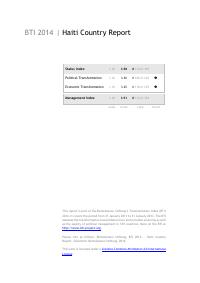
BTI 2014 Country Report - Haiti
- Three years after the earthquake conditions remained precarious.
- The Interim Haiti Recovery Commission is judged largely a failure, with most approved projects incomplete or underfinanced.
- Less than 10% of earthquake relief funds passed through the Haitian government.
- Safe housing for displaced people remained unmet with no comprehensive housing policy.
- Most workers at the Caracol industrial park earn four to six dollars a day.
- Status Index 3.58, Management Index 3.51.
The Bertelsmann Transformation Index 2014 country report covers 31 January 2011 to 31 January 2013 and finds Haiti precarious and unstable three years after the earthquake. President Michel Martelly had not delivered the promises of his 2011 campaign. The Interim Haiti Recovery Commission, co-chaired by former United States president Bill Clinton and former prime minister Jean-Max Bellerive and given eighteen months to oversee reconstruction projects, is judged largely a failure, with most approved projects incomplete or underfinanced.
Less than 10% of the earthquake relief funds allocated to Haiti passed through the government; the rest went to international agencies, their related companies and international NGOs. Safe housing for displaced people, the most obvious need, remained unmet, and in the absence of a comprehensive housing policy the shelter problem was approached without clear priorities, with the poorest families neglected unless they happened to live in a tent camp or a targeted neighbourhood. The Strategic Outlook records no substantial progress on free education, well-paying jobs, agriculture or energy, notes that most workers at the Caracol industrial park earn between four and six dollars a day, and judges that Martelly may not finish his five-year term without a more progressive policy toward the poor who elected him.
How to cite
Bertelsmann Stiftung, BTI 2014 Country Report - Haiti, https://bti-project.org/fileadmin/api/content/en/downloads/reports/country_report_2014_HTI.pdf