Teks ki soti nan dokiman orijinal la pou endeksasyon.
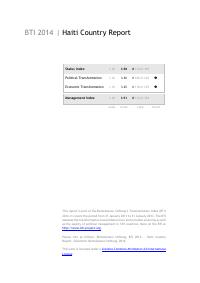
BTI 2014 | Haiti Country Report
Status Index
1-10
3.58
# 114 of 129
Political Transformation
1-10
3.92
# 100 of 129
Economic Transformation
1-10
3.25
# 118 of 129
Management Index
1-10
3.51
# 112 of 129
scale
score
rank
trend
This report is part of the Bertelsmann Stiftung’s Transformation Index (BTI)
2014. It covers the period from 31 January 2011 to 31 January 2013. The BTI
assesses the transformation toward democracy and a market economy as well
as the quality of political management in 129 countries. More on the BTI at
http://www.bti-project.org.
Please cite as follows: Bertelsmann Stiftung, BTI 2014 — Haiti Country
Report. Gütersloh: Bertelsmann Stiftung, 2014.
This work is licensed under a Creative Commons Attribution 4.0 International
License.
�BTI 2014 | Haiti
2
Key Indicators
Population
M
10.2
HDI
Pop. growth1
% p.a.
1.4
HDI rank of 187
Life expectancy
years
62.3
54.6
Urban population %
0.456
GDP p.c.
$
161
Gini Index
UN Education Index
0.407
Poverty3
%
77.5
Gender inequality2
0.592
Aid per capita $
136.1
1228.0
59.2
Sources: The World Bank, World Development Indicators 2013 | UNDP, Human Development Report 2013. Footnotes:
(1) Average annual growth rate. (2) Gender Inequality Index (GII). (3) Percentage of population living on less than $2 a
day.
Executive Summary
Since the devastation wrought by the 2010 earthquake, the state of affairs in Haiti has remained
precarious and unstable. President Michel Martelly has failed to fulfill the ambitious promises
made during his 2011 electoral campaign, and the Interim Haiti Recovery Commission, charged
with reconstruction after the 2010 earthquake, has proved mainly a failure. Led by former U.S.
President Bill Clinton and Jean-Max Bellerive, Haiti’s former prime minister, the commission was
originally given an 18-month period to oversee numerous reconstruction projects. To date, most
of the approved projects remain incomplete or underfinanced. Less than 10% of total earthquake
relief funds slated for Haiti went through the hands of the government. Instead, most of the money
went to international agencies and their related companies or international NGOs.
As a result, three years after the devastating earthquake, the most obvious need – safe housing for
displaced persons – remains unmet. In the absence of a comprehensive housing policy, Haiti’s
shelter problem has been approached without clear priorities. Many families with the least
resources have been neglected unless they happened to reside in a tent camp, a specific
neighborhood or belong to a vulnerable population targeted by a particular program. Food and
nutrition security remain out of reach for many, as does access to clean water and sanitation, a
condition that fostered the cholera epidemic. Some small progress has been made, however. About
one-half of the 10 million cubic feet of quake debris has been removed. An industrial park called
Caracol has been built with foreign investment funds in the northeast, aimed at creating 20,000
jobs. But most of the factories in the country do not pay the official minimum wage, and it is
unclear if Caracol will meet labor law requirements.
The U.N. Security Council extended the mandate of the United Nations Stabilization Mission in
Haiti (Mission des Nations Unies pour la stabilisation en Haïti, MINUSTAH) for another year,
planning a reduction in size from the current 10,500 to 8,871 troops. However, MINUSTAH is
�BTI 2014 | Haiti
likely to face a distrustful population given its growing unpopularity among Haitians for its role
in the cholera outbreak and involvement in various sexual abuse scandals.
According to MINUSTAH, more than half of the country is ready to be safeguarded by the national
police force, but the International Crisis Group has stated that the government cannot guarantee
the security needed to protect citizens, enforce the law and underpin political stability. A recent
study found that lawlessness has risen, including murder and kidnapping. Police bribes increased
in 2012, and public scandals revealed that high-ranking security officers are implicated in
kidnapping and murder. The United States and Canada issued unsafe travel advisories to their
citizens for Haiti.
Haiti’s leading human right attorney, Mario Joseph, has been the subject of death threats and police
surveillance. Joseph has taken on a number of politically sensitive cases, including efforts to
prosecute former dictator Jean-Claude Duvalier, whom the Martelly administration has been
reluctant to pursue. While Duvalier remains cleared of most of the charges against him, moves
freely in the capital and enjoys posh restaurants, former President Aristide has been charged with
minor offenses. Two prosecutorial summonses for Aristide – who remains a strong symbol for
many Haitians – led to nationwide anti-Martelly protests. Endemic corruption in Haiti reaches up
to very high levels of government. Indeed, the Martelly administration appears to be no exception,
leading the government of Canada to state in January 2013 that it was freezing all new aid to Haiti.
History and Characteristics of Transformation
Haiti’s first free and democratic elections were held in 1990, when Jean-Bertrand Aristide, a
former priest, emerged as president. Ten months later, a coup d’état interrupted the process of
democratization, forcing Aristide into exile and installing a three-year military regime (1991 –
1994).
The return to a constitutional order in 1994, enforced by international military intervention under
U.S. leadership and a U.N. mandate, returned Aristide to the presidency and triggered substantial
economic progress. In 1996, René Préval, a close ally of Aristide, succeeded him in the presidency.
Against the background of a political crisis triggered by controversial parliamentary elections in
2000 and an increasingly difficult relationship between the opposition and Aristide’s Fanmi
Lavalas party, Aristide was elected president for a second time in 2000.
Very popular among the poor population, Aristide began implementing serious redistribution
measures and cut privileges for the wealthy. At the same time, the United States introduced harsh
economic measures against a government it considered antidemocratic. The country’s fragile
economy suffered several blows as a result, making it increasingly difficult for Aristide to govern
as he lacked the resources to keep his promises amid an increasingly polarized political
environment.
3
�BTI 2014 | Haiti
In 2003, students in Port-au-Prince organized public protests against Aristide that triggered
nationwide resistance. At the end of February 2004, an armed rebellion led by former members of
the Haitian Armed Forces (previously dissolved by Aristide) and rebels linked to armed gangs
from northern parts of the country prompted the breakdown of Aristide’s government and his
departure on 29 February 2004. Whereas the United States described Aristide’s departure as a
“voluntary escape,” Aristide accused the United States of hijacking him.
The U.N. Security Council authorized the deployment of a multinational interim force to reestablish stability until the arrival of a U.N. peacekeeping Mission (MINUSTAH) in June 2004.
A political pact was signed in order to transfer power to a newly elected government. Aristide’s
party, Fanmi Lavalas, boycotted this pact and civil unrest punctuated the transitional government’s
tenure, revealing the deterioration of the state’s capacity to guarantee the rule of law. After several
delays, presidential and parliamentary elections were held in February 2006. René Préval, former
prime minister and president, was declared winner (after creative counting) with 51% of the vote
after the first round.
The political system stabilized somewhat until 2009, although high levels of party fragmentation
and constant political conflict between the executive and the legislative branches blocked real
progress. A slight recovery of the economic situation, prompting a 2.5% growth rate in 2009, failed
to translate into considerable improvements in the living conditions of the majority of the
population. The institutional stability came to a sudden halt when President Préval discharged
Prime Minister Michele Pierre-Louis at the end of 2009, after only one year in office.
The earthquake on January 2010 had a devastating impact on the country’s political, economic
and social situation by derailing the economy, killing more than 250,000 individuals and leaving
more than one million people homeless. One year after the earthquake, no major reconstruction
effort had been undertaken, and the political situation grew increasingly unstable after rigged
elections were held on 28 November 2010. Only after the intervention of the Organization of
American States (OAS), the popular singer Michel Martelly was declared winner and sworn in as
the new president in May 2011.
4
�BTI 2014 | Haiti
5
The BTI combines text analysis and numerical assessments. The score for each
question is provided below its respective title. The scale ranges from 1 (worst) to
10 (best).
Transformation Status
I. Political Transformation
1 | Stateness
Question
Score
Haiti is now marking the eighth year of the U.N. Stabilization Mission in Haiti
(MINUSTAH). The U.N. Security Council extended the mandate for another year
and reduced its size to 8,771 from the current 10,500. It is the fifth-largest and third
most costly U.N. peacekeeping mission in the world. The country’s still limited police
force alone cannot guarantee the security needed to protect citizens, enforce the law
and underpin political stability. Since the dissolution of the Haitian Army in 1995,
the national police represent the country’s only national security force. According to
the United Nations, the transfer from military to police units has already been
completed in four of the country’s ten departments, but the occupation of state
property by former members of the military (dissolved in 1995) and some would-be
soldiers in 2012 confirmed existing challenges of stateness in Haiti.
Monopoly on the
use of force
The idea of the nation-state is not essentially questioned, but exists only as a loose
concept at best. In reality, a large majority of the population cannot even acknowledge
this concept, having never experienced the basics of citizenship, such as enjoying the
provision of social services or having participated in elections. Only 20% of the
population participated in the last elections, and many citizens do not possess legal
documentation. Although historical references to the glorious past (Haiti having
gained independence through a slave rebellion) are frequent and strong, powerful and
functioning symbols of modern stateness are missing. The political and intellectual
elites of the country represent a nation, and as such maintain a dialogue with the
international community, while the majority of the population is disconnected from
this reality.
State identity
According to official figures, 80% of the population belong to the Roman Catholic
Church, but in practice 100% of the population believe in voodoo. Most voodoo
temples in Port-au-Prince function as social services agencies, medical and
psychological centers, and places for trade. Voodoo priests and priestesses perform a
function akin to that of social workers. Temples form imaginary families in which
No interference of
religious dogmas
2
7
9
�BTI 2014 | Haiti
6
congregations are the children of priest and priestess, who are often charismatic local
leaders. The most popular political leader, Jean-Bertrand Aristide, won his popularity
and finally the elections for presidency due to his work as a priest. Ever since he left
power, religion has lost its direct influence on political life and today most political
institutions seems to be secularized, although religious belief still plays an important
role in social and thus political life.
The state as a provider of basic functions is nearly nonexistent. Eight million (out of
an estimated population of 10 million) live without electricity, five million cannot
read and write and fewer than 10% have formal work. The majority of public services
are provided with the help of the international community. The executive and
legislative branches have thus far failed to achieve a consensus on the national
priorities that would channel international support. Haiti’s bicameral legislature, the
Parliament, has not renewed the mandate of the Interim Haiti Recovery Commission,
which had been tasked with overseeing reconstruction efforts but was unpopular.
Some progress has perhaps been made in education, as the Martelly government has
provided free transportation and schooling. But there are still no objective numbers
to measure the impact.
Basic
administration
2
2 | Political Participation
Haiti has held 13 elections since the passage of its 1987 constitution. Most of them
have been marred by delays, suspensions, widespread irregularities, fraud or
accusations of fraud, unrest and post-electoral violence.
Free and fair
elections
5
The 2010 elections were held only nine months after the earthquake, even though the
country was ill-prepared for a race and the Provisional Electoral Commission lacked
legitimacy. Voter registers and identity cards did not reflect the reality of the
country’s electoral body. Widespread claims of vote-rigging and fraud undermined
the electoral process. Only in April 2011, six months after the first electoral round,
did the electoral commission declare Michel Martelly the winner – and then only after
the intervention of the OAS (Organization of American States).
Political parties are ill-equipped to mitigate the instability that follows frequent and
contested elections. A law on the organization and financing of political parties aims
at improving party functioning, but it is not clear whether it will pass the Senate.
Constitutional amendments in June 2012 provide for the formation of the Permanent
Electoral Council (Conseil Electoral Permanent, CEP). This has generated mistrust
and additional tension in an already polarized political environment.
Haiti is heavily dependent on foreign aid. More than 70% of its budget comes from
abroad. For nearly 10 years, the country has hosted a U.N. mission that meets most
of Haiti’s security needs and is also charged with organizing and supervising the
Effective power to
govern
2
�BTI 2014 | Haiti
7
elections. MINUSTAH and the United States play a very important role in the
outcome of national elections. Following the 2010 earthquake, the country depends
even more on the international community to rebuild its most important
infrastructure. Since 4% of the population own 60% of the nation’s wealth, the
country has powerful economic elites. The government is very often composed of
members of these elites or strongly connected with members of the international
community (for example U.N. organizations). Therefore it cannot be stated that the
government has an effective power to govern.
The Haitian constitution protects the rights of independent political and civic groups
to associate and assemble freely. Normally a range of different groups are able to
operate free of state interference. Nevertheless, trade unions and other civil society
groups are often too weak to be involved in political discussions or wage negotiations.
Association /
assembly rights
The constitution guarantees citizens the right to freely express opinions and also
guarantees the freedom of the press. In general, people feel free to express their
opinion. There are cases of intimidation of journalists, although it is unclear whether
this is driven by personal interest, especially when corruption claims are involved.
Journalists tend to practice self-censorship, though there are a few newspapers in
Port-au-Prince that play a role in criticizing the government. But with more than half
of the population illiterate, the vast majority relies entirely on radio stations to keep
up with information. In addition, there are some privately run TV channels, although
the state-run channels are considered the main source for some people.
Freedom of
expression
7
6
3 | Rule of Law
According to the constitution, there is a separation of powers between the president
and the prime minister as head of the government. Both houses of the Parliament (i.e.,
Senate and House of Deputies), tasked with oversight functions and guaranteeing a
degree of checks and balances, do not meet these requirements in practice. In practice,
the president of Haiti defines politics of the country. The frequent changing of prime
ministers points to the inherent instability of the system. During the period under
review, the Parliament used its constitutional power for mainly political reasons. In
2011, Martelly had to put forward three candidates for prime minister, as two of them
were rejected by the Parliament. Most of the Assembly’s members do not have the
capabilities necessary to fulfill their legislative role. Political fragmentation and
volatility is extremely high and makes professional cooperation even more difficult.
The Senate maintains a nearly unlimited veto power, which has led to severe political
problems in the past.
Separation of
powers
Political showdowns with the legislature during the Préval years meant delay in
implementing three key pillars of justice reform: the formation and functioning of the
Supreme Court, the opening and running of the judicial academy, and penal and
Independent
judiciary
4
3
�BTI 2014 | Haiti
8
criminal procedures codes reform. For political reasons, there is still no appointment
of members to the Supreme Court, whose head chairs the Supreme Council of the
Judiciary (Conseil supérieur du pouvoir judiciaire, CSPJ). By now the full contingent
of members of the Supreme Court has been nominated by Martelly, which is clearly
against the law. With the amendment of the constitutional in 2012, Haiti has now a
Constitutional Council to oversee the constitutionality of laws, but there is still
dispute in the Parliament about the new constitution.
Judicial investigations into the killing of detainees in the city of Las Cayes led to the
conviction of six police officers. There were irregularities at every stage and concerns
persist that judges in high-profile cases are subject to pressure that limits their
independence. The chief prosecutor of Port-au-Prince claims that he was fired after
he refused to issue an arrest warrant for a leading human rights advocate and 35 other
members of the political opposition. He also reported that the head of the electoral
council – a personal adviser of President Martelly – asked him to serve warrants
against two attorneys who have brought corruption complaints against the
presidential family and members of the government.
Corruption is endemic and part of everyday life. The international community has
never really put an emphasis on fighting corruption and is part of the problem, as it
supports a corrupt system through its regular funding of the administration.
Prosecution of
office abuse
3
Without state institutions that provide social services, Haitians are used to paying for
every need, and corruption has become a cultural norm. Although there is rhetorical
stigmatization of corruption, officeholders do not fear legal consequences. The
official procedures required by the constitution, such as the declaration of assets by
senior state officials and the delivery of end-of-term discharge papers, remain
unfulfilled requirements. All institutions in charge of fighting corruption are in place,
but the number of cases that have been brought to court are few and they concern
minor corruption only.
Various fundamental civil rights are not protected in Haiti, including citizens’ safety
and freedom from harm or torture. Due to the weakness of the legal system, civil
rights violations are seldom prosecuted. Thousands of prisoners have been in jail for
years without trial and many have exceeded by far the maximum jail time for their
alleged crime. The long duration of the period of prisoner remand is a clear violation
of international human rights. There is no counsel guarantee for indigent criminal
defendants, and torture and mistreatment of prisoners is frequent, though not
systematic.
Widespread and general violence against women and children, including rape and
trafficking of persons, are serious threats. Thousands of children work illegally and
without compensation in households and in manufacturing, and are often
malnourished and abused. Few victims claim legal assistance as they cannot afford
Civil rights
5
�BTI 2014 | Haiti
9
it; even if they could, they would not trust their counsel because of Haiti’s weak legal
system.
The approximately 500,000 undocumented Haitian immigrants in the Dominican
Republic are often subject to maltreatment and violations of their international human
rights; the Haitian government is not able or willing to provide them with diplomatic
support. Nor is the Dominican government. For example, it refuses birth certificates
to Haitians born in the Dominican Republic.
The return of ex-dictator Duvalier and his ability to move freely and without
prosecution, despite several cases against him, is a devastating sign for human rights
activists.
4 | Stability of Democratic Institutions
In theory, Haiti’s political system is a semi-presidential republic. The president of
Haiti is the head of state. The prime minister, chosen by the president from the largest
party in the legislature, is the head of government. Executive power is exercised by
the president and prime minister, and legislative power by the two-chamber
Parliament of Haiti. The Assembly comprises a 30-member Senate (the upper house),
which is elected for six-year terms in staggered elections, with one-third of seats
being contested every two years, and a 99-member Chamber of Deputies. But the last
presidential elections, on 28 November 2010, were fraught with organizational
deficiencies and chaotic management. Following months of political gridlock, the
Senate approved Prime Minister Garry Conille, the third candidate presented by
President Martelly – fully one year after the elections. He resigned only four month
later, leading to new political instability. He claimed that in reality the president
would make decisions – with or against the Parliament – and, like many of his
predecessors, he didn’t see real space to fulfill his function.
The electoral process showed yet again organizational incapacity, institutional
weakness and considerable foreign influence. One of the top priorities (at least for
the international community) has therefore been to strengthen and re-establish
democratic institutions. A constitutional council, separate from the Supreme Court,
was recently conceived to review constitutionality of laws and address conflicts
between branches, but it is not yet in place. The Permanent Electoral Council, with
representation from all three branches, was to organize and administer elections, but
until now there has been no consensus on the smaller body President Martelly built
by decree instead. Therefore the main institutions are missing to organize and
administer municipal elections and elections for one-third of the Senate. Due to
cancelled elections after the earthquake, the Senate is now missing a third of its 30
members, whose term ended in May 2012. Uncertainty persists as to how the
Performance of
democratic
institutions
3
�BTI 2014 | Haiti
10
Parliament can name three members of the electoral council, since a two-thirds vote
of both chambers is required.
While in reality nobody notices if municipal elections are held or not – a clear
indicator for the high degree of centralization in the country – the Senate is an
important constitutional body that needs to function if Haiti is to overcome
institutional paralysis.
The majority of political actors in Haiti support democracy in principle, while for the
majority of “nonpolitical” actors, like the rural population, democracy has little
meaning. Ask farmers about the meaning of democracy and elections and they will
refer to those in charge who will resolve their problems: Voting means knowing
where help is supposed to come from. Some political organizations, such as the
Alternative Platform for Progress and Development, have raised the issue of a
government pact with the new leadership.
Commitment to
democratic
institutions
2
Frequent political conflicts between the executive and legislative branches have
drawn severe criticism from civil society and some political leaders and raised
concerns about deepening the country’s already polarized politics. President Michel
Martelly doesn’t always accept democratic principles but follows his own agenda and
frequently ignores democratic procedures.
There are certain business interest groups, including drug-trafficking networks, that
would seek to elect a government that would be the easiest to influence in order to
serve their interests. The two ex-dictators that came back after the earthquake, JeanClaude Duvalier and Jean-Bertrand Aristide are – so far – not active in politics and
are not veto actors.
5 | Political and Social Integration
The party system is highly fragmented and volatile. Political parties do not represent
the interests of the population, but represent mainly individual or clientelistic
interests. In addition, there is little to no social basis in the population outside of urban
centers, and even there it is weak. Political parties can appear or disappear literally
overnight, as was witnessed in the beginning of 2011, when President René Préval
founded a new political movement called Unity (Inite) that became a melting pot for
former members of all other political parties. It is unclear if Inite still holds a majority,
as many of its former members today are among Martelly’s followers – some of
whom also founded their own party in August 2012 (Haitian Tete Kale Party, or
simply “Tet Kale,” which is one of Martelly’s nicknames, meaning “bald head”).
Martelly’s party, Repons Peyizan (Farmers’ Response), has three lower-house
deputies and no senators. According to data provided by the Inter-Parliamentary
Union (IPU), there are 16 parties with representation in the Chamber of Deputies, and
Party system
3
�BTI 2014 | Haiti
11
two independent legislators. The effective number of parties in the Chamber is 4.23,
indicating high fragmentation. Ten parties are represented in the 30-member Senate,
including 17 senators from Lavalas and from parties associated with Lavalas such as
Inite, Lespwa and L’avni. No political party has presented a real program, and only
two or three can claim nationwide structures or representation. Political parties
instead play a more emotional role, which at times has resulted in triggering violent
public demonstrations.
There are some 2,400 officially registered popular organizations, interest groups and
civil society organizations. In general terms, such groups have very limited access
and influence on government decision-making. Some of them are more active than
others, like the Platform for Human Rights, but lots of them serve mainly as vehicles
for personal interest or as a means to access international funding. Trade unions have
lost most of their influence, as a majority of the population is employed in the
informal economic sector. The only groups that can effectively organize are those in
the business sector, and they use their lobbying power to their own advantage.
Interest groups
3
There are many local grassroots organizations, and in some cases such groups are
able to effectively represent the interests of the local population. These organizations’
access to local officials remains traditionally higher than in Port-au-Prince, but given
the high level of centralization, all important political decisions are still made in the
capital. In the aftermath of the earthquake, and during the whole reconstruction
period, it became clear how little the government deals with its local knowledge and
manpower. There were no attempts made to include civil society organizations in the
reconstruction. Main business is done with Chinese investors, while national
professionals and firms are kept apart.
The majority of the population has never experienced any form of material benefit
from democratic governance. The only advantage for most was the absence of
authoritarian rule and repression. Considering the low level of education and the high
level of illiteracy in the country, only a small group of economic and intellectual elite
understands the principles behind democratic institutions. What is important for a
majority of citizens is to simply improve their living conditions. There are no official
polls, but the general perception is that Martelly remains popular among the young
population. The poorest sectors still hope that he will deliver on his campaign
promises of improved social services.
According to the Latin American Public Opinion Project (LAPOP) Americas
Barometer survey 2012, support for democracy remains at a comparatively solid
level. When asked if they agree with the statement “democracy may have its
problems, but it is better than any other form of government,” 70.4% of respondents
agreed, placing Haiti in the midfield close to Brazil. LAPOP data also shows that
support is lowest among Haitians with lightest skin color, and highest among those
in the middle of the color spectrum. However, measuring the combination of both
Approval of
democracy
n/a
�BTI 2014 | Haiti
12
system support and political tolerance – deemed elements of political culture critical
for democratic stability – only 10.7% of citizens hold such attitudes in Haiti, being
second only to Honduras (7.2%) in having the fewest citizens with the combination
of these attitudes.
The 2010 earthquake facilitated the further dissolution of social capital within Haitian
society. Although cooperative mechanisms exist, their impact remains weak. The
main solidarity work is done by churches and religious organizations. The young
generation seeks fortune abroad, rather than staying home to improve living
conditions in their own country.
Social capital
4
Most recent LAPOP data from 2010 shows that interpersonal trust was the lowest in
the Americas, with only 32.7% of respondents affirming that they would trust people
in their community (the second lowest was Peru with 46.2%). LAPOP 2010 found
that the earthquake had boosted levels of not only distrust toward the political system,
but also social distrust, compared to 2008 and 2006.
II. Economic Transformation
6 | Level of Socioeconomic Development
The United Nations Human Development Index ranked Haiti 158th out of a total of
177 countries for 2011. This position was worse than in the years before, and is
related to the effects of the 2010 earthquake. Haiti shows by a large margin the worst
performance in all indicators for Latin America and the Caribbean. One of Latin
America’s biggest slums is situated in Port-au-Prince, with an estimated 500,000
people living in dire conditions featuring high rates of criminality. The income
distribution inequality is very high, with the country’s Gini coefficient of 0.59.
More than 80% of the population live below the poverty line, while approximately
60% live on less than $1 per day. Rural areas are the most affected, with nearly fourfifths of Haiti’s extreme poor living outside cities. School enrollment is estimated to
be 48%, although it may be smaller. Gender differences are high in education; only
39% of women are literate, compared with 53% of men.
Access to health services is limited and worsened with the outbreak of cholera in
2010. More than 7,000 people died in this epidemic because there was insufficient
access to health care or clean water, if any. Infant and maternal mortality in Haiti is
the highest in the Americas, with about 60 deaths per 1,000 live births.
Question
Score
Socioeconomic
barriers
1
�BTI 2014 | Haiti
13
More than one-third of the population lacks sufficient food, as land resources are
limited and traditional methods of farming do not produce the quantities needed.
Economic indicators
2009
2010
2011
2012
6470.3
6634.6
7346.2
7843.5
GDP
$M
GDP growth
%
2.9
-5.4
5.6
2.8
Inflation (CPI)
%
0.0
5.7
8.4
6.3
Unemployment
%
-
-
-
-
Foreign direct investment
% of GDP
0.6
2.3
2.5
-
Export growth
%
9.9
-7.4
18.0
-
Import growth
%
5.8
20.0
-5.0
-
Current account balance
$M
-226.3
-165.8
-338.8
-348.7
Public debt
% of GDP
28.2
17.7
12.2
15.4
External debt
$M
1448.3
985.1
782.9
-
Total debt service
$M
45.0
131.3
5.2
-
Cash surplus or deficit
% of GDP
-
-
-
-
Tax revenue
% of GDP
-
-
-
-
Government consumption
% of GDP
-
-
-
-
Public expnd. on edu.
% of GDP
-
-
-
-
Public expnd. on health
% of GDP
2.1
2.7
3.5
-
R&D expenditure
% of GDP
-
-
-
-
Military expenditure
% of GDP
0.0
0.0
0.0
0.0
Sources: The World Bank, World Development Indicators 2013 | International Monetary Fund (IMF),
World Economic Outlook 2013 | Stockholm International Pease Research Institute (SIPRI), Military
Expenditure Database 2013.
7 | Organization of the Market and Competition
The market in Haiti operates under a very weak institutional framework with hardly
any regulatory mechanisms. The majority of the population works in the informal
economic sector, and most recent estimates by the World Bank and the Office of the
Market-based
competition
3
�BTI 2014 | Haiti
14
Special U.N. Envoy for Haiti suggest that more than 90% of private employment in
Haiti is in the informal sector.
The formal sector is small and highly regulated in some areas, for example in taxes
and tariffs, and not regulated at all in other areas, especially when it comes to
workers’ protections and rights. The country’s most important bilateral agreement
(Hemispheric Opportunity through Partnership Encouragement, HOPE II) gives its
garment industry free access to the U.S. market, with preferential terms for products
from the United States.
On the other hand, most of the national economy in essence belongs to approximately
15 large families. Adding to this are burdensome government regulations and various
exit and entry barriers. Accordingly, Haiti is ranked 142nd among 144 countries in
the 2012 – 2013 Global Competitiveness Report. Considering the country’s weak
legal system and the high level of political interference in judicial decisions,
investments are not protected and market participation is therefore risky. This is
especially problematic when it comes to land ownership, as there is a dual system of
traditional and modern legislation of property rights. Due to these unstable
conditions, foreign investment remains very weak. According to the Caribbean
Journal, in 2012 Haiti established a Commission on Price Controls to propose
measures to stabilize commodity prices considered sensitive by the government due
to their “importance to Haiti’s food basket.” There are no restrictions on currency
convertibility.
Although there has been some economic liberalization, the trend of monopolistic
practices remains unbroken. The lack of regulation reinforces oligopolistic
networking. There is no regulatory mechanism or institution to control mergers, price
fixing or predatory pricing. As an example, in 2012 two of the three private cellular
telephone companies were eliminated by protracted cooperation efforts between the
state and Digicel, which led to a de facto monopoly in telecommunications in the
country. This event not only is a symptom of the high level of corruption in the
country, but it leaves customers with bad service and higher prices. The 2012 – 2013
Global Competitiveness Report on 144 countries ranks Haiti 134th in intensity of
local competition, 144th in extent of market dominance, and 143rd in effectiveness
of antimonopoly policy.
Anti-monopoly
policy
Haiti’s simple average tariff is one of the lowest in the region (about 2.8%, according
to the World Bank). However, non-tariff barriers are still significant, and an
inadequate infrastructure and weak administration further hamper foreign trade.
Trade liberalization has had considerable negative impact on the economy, as local
products cannot compete with cheap imports. This has affected the agricultural sector
in particular, and during the period under review, there has been some discussion of
introducing measures to favor local production. The United States’ introduction in
2010 of the Hemispheric Opportunity through Partnership Encouragement (HOPE II)
Liberalization of
foreign trade
2
6
�BTI 2014 | Haiti
15
gives Haiti 10 years of preferential access to U.S. markets through special tariff
exemptions.
The central bank is the sole financial supervisor in Haiti. Its supervisory mandate
extends to commercial banks, business banks, saving banks and credit unions.
However, the central bank is seriously and increasingly undercapitalized and its
operations have been, until recently, subject to political interference, which led to the
fall of Socabank in 2008. In a recent example of political interference, President
Martelly ordered the central bank to leverage one percent of the remittances to Haiti.
Such a fiscal measure should be taken by the Ministry of Finance and not by the
central bank. Furthermore, according to the constitution, such a decision cannot be
made by the president alone but requires the approval of the Parliament.
Banking system
4
According to an IMF report, capital adequacy requirements are largely Basel Icompliant, and since 1988 they have been primarily focused on credit risk. Others,
such as operational and market risks, which form, together with credit risks, the three
pillars of Basel II, are absent in the Haitian financial system. Therefore, there is
neither supervision nor market discipline. In the aftermath of the 2008 financial crisis,
Basel III (2010) was suggested as a global regulatory standard on bank capital
adequacy, stress testing and market liquidity risk. It should be implemented from
2013 to 2018. There are actually neither specific regulations on minimum standards
for risk management beyond traditional internal control principles, nor independent
auditing system for most banks.
According to the central bank of Haiti, shareholders’ equity as a percentage of assets
dipped from 6.49% in 2008 to 6.17% in 2011, for an average of 6.41% in the last four
years. There was an improvement in the performing of loans, evidenced by the
diminution of nonperforming loans, which, as percentage of total loans, were
estimated at 9.69% in 2008 and 3.69% in 2011, with an average of 6.88% for the
same period. There is no independent auditing system for most banks. It is unclear in
how far the continued non-servicing of loans following the 2010 earthquake will
affect smaller banks.
8 | Currency and Price Stability
Haiti’s monetary policy has not been consistent over time and lacks an adequate
institutional framework. The central bank is subject to political interference. Its role
was weakened further following the 2010 earthquake, and the expected influx of
foreign money toward reconstruction efforts could produce a considerable impact on
inflation and price stability.
The national currency, the gourde, maintained a trend of gradual, nominal
depreciation in the months after the January 2010 earthquake, but recovered later in
Anti-inflation /
forex policy
6
�BTI 2014 | Haiti
16
the year. Today, the budget of the NGOs that received around two-thirds of the
international donation to Haiti, along with remittances of Haitian immigrants of more
than $2 billion, play a stabilizing role against further depreciation of the gourde.
The interruption of imports after the 2010 earthquake (especially fuel imports, which
account for 30% of total imports), to which are added the budgets of NGOs and the
remittances of the diaspora, had an immediate impact on the Haitian gourde.
Consequently, according to central bank data, the local currency appreciated by about
5% since 2010. Nonetheless, living expenditures rose for many Haitians, though this
is not reflected in official figures. Prices have risen considerably since the earthquake,
but, according to official figures, inflation was at 8.3% in 2011 and 6.8% in 2012. A
better way to measure how heavily inflation affected the Haitian population is by
observing prices for specific goods. Alimentation and “rent and water” saw inflation
of 7.8% and 12.9%, respectively, while they were -1% and 3.9% in the previous year.
The 2010 earthquake undermined much of the previous progress made in stabilizing
Haiti’s economic situation and has further limited the government’s capacity to
follow any sort of macroeconomic strategy. The country will have to rely heavily on
foreign aid for many years. Haiti’s original three-year, $140 million poverty
reduction and growth facility was automatically converted to an extended credit
facility prior to the earthquake. The IMF approved, immediately after the earthquake,
an additional $102 million loan, which represents, together with the former loans,
80% of the country’s quota. The fund also reduced the debt service burden and made
arrangements to help maintain an adequate foreign reserve cushion. The worldwide
debt relief enacted after the earthquake reduced pressure on government finances, as
the government’s ability to obtain revenues was severely debilitated; the building of
the Internal Revenue Agency was destroyed along with many of its records.
According to official figures, public debt was at 24.6% of GDP in 2011 and at 26.9%
in 2012.
Macrostability
4
9 | Private Property
The constitution guarantees private property and assigns the state the duty of
protecting and promoting private entrepreneurship. The country has signed
international conventions on patents and trademarks. However, the weak judiciary,
endemic corruption and a general lack of political will impede effective enforcement
of these rights. Given the fact that the majority of the population is living in rural
areas, and taking into the consideration the forthcoming reconstruction efforts
following the 2010 earthquake, problems of land ownership are among the most
urgent in economic terms. Land titles and questions of ownership are often unclear,
and the often nonexistent legal structures lead to violent conflict. Fraudulent sale of
Property rights
4
�BTI 2014 | Haiti
17
land titles and claims to traditional ownership are among the most frequent sources
of these conflicts.
Private companies can act without restrictions and private business engagement is
encouraged by the government, at least on a rhetorical level. The only formal
limitations to start a business are the heavy and complicated administrative
procedures required to register an enterprise. Starting a business in Haiti takes four
times longer than the world average. According to the 2012 – 2013 Global
Competitiveness Report, the process takes 12 steps and 105 days, while in the
neighboring Dominican Republic it lasts 19 days for seven steps. One of the reasons
for this long and frustrating process is that commercial laws are applied inconsistently
and without transparency. Though private companies represent the majority on the
national market, public enterprises occupy important sectors such as
telecommunications, electricity, ports and airports. Only two of the nine state-owned
enterprises were privatized during the 1990s, and these privatizations have been
deemed failures in terms of pricing and production capacity. Until now, there have
been no further privatizations, but the Martelly government is considering the
privatization of the National Port Authority (Autorité Portuaire Nationale, APN) and
the state electricity company. Despite the opening of a Center for the Facilitation of
Investment in 2007, and former U.S. President Bill Clinton’s initiative to attract
investors to the island, substantial improvement has not been observed, mainly due
to the high level of legal and physical insecurity in the country. According to the
World Bank, Haiti has one of the smallest public sectors in the region.
Private enterprise
5
10 | Welfare Regime
A welfare regime is nearly absent in Haiti. The state provides a very basic health and
pension insurance scheme, but as only 10% of the population is formally employed,
only a few citizens in the population of 10 million benefit from this rudimentary
system. According to the U.S. Department of State, infrastructure losses during the
2010 earthquake included 28 out of 29 government ministries buildings, 50 hospitals
and health centers, and 1,300 educational institutions. Public expenditure on health
is about 1% of GDP, and life expectancy is 60 years. Only 3% of all schools are run
by the state. The most important contribution to social welfare comes from the large
Haitian diaspora. International NGOs partially provide some of the most basic
services but cannot replace the state.
Social safety nets
Due to the massive extent of poverty in Haiti, there is no equality of opportunity.
Levels of income inequality are among the highest in the Americas. Nearly half of
national income goes to the richest 10% of the population, while nearly 80% of the
population lives below the poverty line. Women are an especially vulnerable group,
as they suffer more from poverty than do men. Women are on average less educated
and are more often victims of hunger or natural disasters. Three-quarters of women
Equal opportunity
3
3
�BTI 2014 | Haiti
18
under the age of 21 who have children said their pregnancy was undesired. There are
no legal provisions to foster gender equality and many of the laws that protect women
and children are not really implemented.
11 | Economic Performance
The Haitian economy was completely derailed following the 2010 earthquake, and
the government is relying even more heavily than before on international assistance.
In 2010, per capita GDP fell by 6.6%, according to the Economic Commission for
Latin America and the Caribbean (ECLAC, a.k.a. Comisión Económica para América
Latina, CEPAL). In 2011, GDP grew by 5.6%, but for 2012 ECLAC has estimated a
growth rate of only 2.5%, 5.3 percentage points under the projection of 7.8%. Among
the causes of this low performance are the lack of reconstruction, hurricanes that
heavily affected agriculture, and the retrenchment of 12% in international assistance.
Furthermore, an economic take-off seems more unlikely as security remains
insufficient and energy crises are growing in number. In December, the International
Monetary Fund communicated its worry for the energetic crisis, while Michael Forst,
specialist in human rights for the United Nations, declared once again his concerns
about the lack of respect for human rights and the nonperformance of the legal
system.
Output strength
3
The trade and current account deficits have widened during the review period, as
domestic production has been severely weakened and the demand for imported food
and reconstruction materials has risen sharply. The current account deficit, which was
3.9% in 2011, was estimated at more than 4% in 2012. Even though the Haitian
government has been talking extensively about the need to attract foreign investment
as its priority, significant investments seem very unrealistic unless the authorities
attack the legal and physical insecurity problems and give transparency signals. In
fact, international actors as well as Haitian society perceive the contrary. There are
no reliable figures on unemployment, but it is estimated to be more than 70% of the
labor force.
12 | Sustainability
Haiti faces serious environmental degradation, which increases the country’s
vulnerability to natural disaster. There is a high risk that each tropical weather
phenomena produces serious consequences for the population, as flooding and
erosion have most recently shown. The government fails to take environmental
concerns into consideration, and there is no noteworthy environmental policy. Of the
country’s 30 watersheds, 25 are without natural cover. The remaining forests,
covering only 1% of the territory, cannot play any significant environmental role.
Deforestation and land degradation undermine efforts to improve agricultural
Environmental
policy
3
�BTI 2014 | Haiti
19
production. The disastrous and widespread effects of cholera can only be explained
by the large scale of environmental degradation, as the water from the Artibonite
River, one of the main water sources in the country, is used as a source of drinking
water as well as a public toilet. Considering demographic growth, these problems will
only become more serious in the future.
Though a national environmental action plan has been in place and updated since
1999, socioeconomic development and protection of the environment have proved
difficult to reconcile. Though problems and solutions have been widely discussed,
and farmers and politicians are well aware of Haiti’s environmental fragility, the
country’s political, social and economic groups have not been able to come together
to combat continued environmental degradation. In the last Growth and Poverty
Reduction Strategy (GPRS) paper, efforts were made to combine economic policies
and environmental concerns. However, the overall conditions and the lack of capacity
are not in favor of the application of a coherent environmental policy.
The Haitian education sector suffers from lack of state resources and absence of
regulation capacity. It is also impaired by the influx of private service providers.
About 90% of education in Haiti is private and only 10% public. Some 80% of the
national education budget is provided by international donors; there are no reliable
figures on public education expenditures. President Martelly has made the free
schooling issue one of the top priorities on his agenda, but little is known yet how
effective these efforts have been. Before the 2010 earthquake, free schooling existed
for 17% of school-age children; this number has fallen since the disaster. The United
Nations Children’s Fund (UNICEF) estimates that some 500,000 school-age children
do not attend any sort of school service, and the literacy rate is only about 45%.
Access to higher education is extremely limited due to a lack of resources to pay fees,
but also due to poor quality. Universities have irregular schedules and are prone to
student unrest. There is no data on research activities, as such activities hardly exist.
Another constraint is the near total absence of vocational training, which leads to
extremely poor standards of technical qualifications.
Education policy /
R&D
2
�BTI 2014 | Haiti
20
Transformation Management
I. Level of Difficulty
Structural constraints are considerable in Haiti: 80% of the population lives in
absolute poverty, and nearly 50% is illiterate. The 2010 earthquake worsened the
already difficult situation. Government expenditure depends on external aid, and, due
to the high level of corruption, aid influx is decreasing. A severe cholera pandemic,
caused by U.N. staff, is worsening the situation. Vulnerability to natural events like
hurricanes or earthquakes is extremely high. Although the structural constraints are
high, their effect is frequently intensified by Haiti’s notoriously bad governance.
Structural
constraints
Civil society traditions are fairly weak and were mostly quashed during the
successive Duvalier regimes, although in the 1980s civil groups began to develop.
Considering Haiti’s traditionally weak state structures and the lack of trust by the
population in political institutions, the country today has a fairly active civil society
culture, especially at the local level. But many groups have been incorporated or
manipulated by political and economic elites in recent years. It also should be noted
that much international humanitarian engagement in Haiti has been channeled
through civil society organizations, and thus membership in such groups has become
a means to live and survive for many Haitians. The emergence of civil society
organizations in recent years reflects more the strong engagement of international
NGOs than a real push in local civic engagement. It has to be added, however, that
the 2010 earthquake revitalized a sense of solidarity and community that was
previously lost. Civil society organizations are sometimes very outspoken and critical
towards government policies and international presence. Sometimes members of
human rights organizations face threats. Yet Haitian civil society is still highly
fragmented and split along religious, social, political and cultural lines. This reduces
civil society groups’ capacity to influence political decisions.
Civil society
traditions
Although Haiti is not marked by significant ethnic or religious cleavages, social and
political conflicts are an inherent part of the country’s history and have impeded
democratic and economic transformation. The exclusion of major parts of the
population and the enrichment of the political and economic elites have deeply
divided Haitian society, fuelled violence and hindered dialogue. Political conflict is
often carried out in the streets, as the demographically most significant group –
Conflict intensity
9
8
7
�BTI 2014 | Haiti
21
young, poor men between the ages of 15 and 25 – are easy to influence and are often
manipulated to engage in violent protest.
II. Management Performance
14 | Steering Capability
Question
Score
The Martelly administration has failed to set strategic priorities and to implement
them. While Martelly claimed in his campaign that education, energy, agriculture and
the economy would be priorities of his government, in none of those areas has there
been substantial progress. Two and a half years after the earthquake, the most obvious
need – safe housing for displaced persons – remains unmet. In the absence of a
comprehensive housing policy, Haiti’s shelter problem has been tackled
unsystematically and without clear priorities. Many families with the least resources
have been neglected unless they happened to belong to a tent camp, neighborhood or
vulnerable population targeted by a particular program. An estimated 8 million
people remain without access to clean and safe water, a condition that fostered the
cholera epidemic.
Prioritization
Martelly’s campaign promises of free education, jobs and housing haven’t been
implemented so far. Instead, prices increased significantly and reduced poorer
households’ access to basic staple foods. It remains unclear where the money from a
special fund for the “1 million in school for free” program went and how many pupils
have been actually reached. In agriculture, literally nothing happened; nor did
anything happen in the energy sector. The only achievement Martelly can present so
far is the opening of the industrial park Caracol, a long-planned project that is
supposed to offer job opportunities for 20,000 people. However, the wages in the
industrial park Caracol are far away from being adequate: Most of the workers earn
between four and six dollars a day. Between August and October 2012, Martelly
faced 128 public protests related to not fulfilling his promises.
Implementation
The government doesn’t follow a clear strategy in most of the reconstruction issues
and leaves the country in the hands of international donors and NGOs. The 2010
earthquake set the path of future governments: Reconstruction of the devastated
capital and the main affected sectors was at the top of the agenda. Donor countries
pledged to donate $5.3 billion over two years and a total of $9.9 billion over three
years more. The money was to be deposited with the World Bank and distributed by
an internationally controlled fund, co-chaired by Bill Clinton and Jean-Max
Bellerive, prime minister at that time. The Interim Haiti Reconstruction Commission
(IHRC) was created for a period of 18 months, beginning in April 2010. In May 2011,
3
2
�BTI 2014 | Haiti
22
an audit found that the IHRC was not fully operational, that only 30% of all pledges
had been approved in project proposals, and that it failed to take into consideration
the proposals and priorities set by the government. The future of this commission
remains unclear. Most of the donated money has been administrated and spent
through the World Bank, the United Nations and the Inter-American Development
Bank – without direct influence of the Haitian government.
Polarization and a general lack of willingness for political compromise historically
have made policy learning difficult in Haiti. President Martelly follows this tradition;
his style is more defined by confrontation and fighting than compromise and
discussion. According to public opinion, his way of convincing political opponents
is to offer them money, if intimidation doesn’t work. By comparison with his
predecessor Préval, Martelly is more dynamic and unconventional and his style
appears to be more forward driven, although the decisions are made without taking
into consideration lessons learned or international experiences. So far, the result of
this style has been mainly conflict between the president and Parliament.
Policy learning
3
15 | Resource Efficiency
Poor fiscal management and economic governance have inhibited the efficient use of
both domestic resources and external assistance in recent years. Tax revenue is
limited, dropping significantly after the 2010 earthquake and totaling approximately
8% of GDP in 2012. The already inadequate quality and quantity of human resources
have further deteriorated with the heavy loss of life and damage to public
infrastructure. The country’s administrative system suffers from a lack of incentives
for motivated civil servants. Low wages reinforce corruption and clientelism, which
have come to be deeply embedded in the system. The lack of public sector
performance and absorption is a serious obstacle to reconstruction. Due to the
deteriorating security situation, the few well educated and trained people who remain
in the country prefer to migrate rather than risk their families’ lives.
Efficient use of
assets
Haiti relies heavily on foreign aid, and most of these funds are seen as personal assets
of politicians. One cannot really talk of policies, as decisions are taken on a day-today basis, depending on opportunities. The continued confrontation between the
executive and legislative branches, due to the government’s formal and legal
negligence, shows once more the failure of the Martelly government to formulate and
coordinate proper policies in accordance with democratic rules. This malaise is not
unique to the current government; it reflects the structural challenges Haiti has faced
for decades. But it has become even worse since 2010. What is still needed is
dialogue, trust building, compromise and consensus among all actors.
Policy
coordination
3
3
�BTI 2014 | Haiti
Haiti has always been one of the most corrupt countries in the world and has a
population that is used to paying for any service given the absence of state services.
But, especially in the security sector, the situation seems to be deteriorating. While
the police had a rather good reputation in prior years, a recent report found that police
bribes had increased between August 2011 and July 2012, and that various highranking security officials had been involved in corruption and crime scandals. With
some of Martelly’s closest allies involved, people do not expect that there will be an
effective anticorruption fight. All public institutions in charge of corruption – the
financial intelligence unit, the Anti-Corruption Unit and the Public Administration
Audit Court – suffer from bad reputation and/or a chronic lack of material and human
resources. There have been no major corruption trials so far. An anticorruption law
has been proposed to the Parliament but has not been adopted.
23
Anti-corruption
policy
3
16 | Consensus-Building
The electoral fiasco in 2010 showed serious mistrust in the system. Although
democracy as a principle is widely accepted, only a minority of the political players
really want to act according to democratic rules. The main objective is to remain in
power and to have access to funds. The Martelly government has set its priorities on
a market economy without regulation that primarily benefits the political elite and
secondarily the population. The best example is an analysis of how the reconstruction
money had been spent and how some high-ranking politicians made big business with
senior officials from development or aid agencies. While some actors in the
Parliament ask for more regulation and law enforcement, the majority seek their own
political or economic advantage.
Consensus on goals
While ex-army members and supporters of former President Jean-Bertrand Aristide
who favor autocratic rule have lost much of their political influence, new
antidemocratic actors have been emerging who could challenge reforms. There are
close relations between political actors and business interest groups that support weak
state institutions to better serve their individual interests, and a considerable amount
of drug-trafficking money circulates in the political realm. Some members of
Congress use their immunity to pursue illicit or criminal business activities. Highranking security officials are involved in cases of kidnapping and organized crime.
The role of drug trafficking and its impact on politics are underestimated by the
international community but remain unclear in their impact.
Anti-democratic
actors
The management of cleavages and conflict has not substantially improved in recent
years. The Préval administration left behind a legacy of political and social
polarization that has fostered corruption, clientelism and inefficiency. Martelly’s
presidency so far has been punctuated by conflicts with the Parliament and other
sectors that have blocked the consensus needed to facilitate governance and pave the
way for reconstruction and development. Inite, the party that holds the majority in
Cleavage /
conflict
management
5
5
4
�BTI 2014 | Haiti
24
the Assembly, delayed for several months the forming of a new government in 2011,
successively rejecting two of Martelly’s nominees for the post of prime minister.
Other conflicts are provoked by Martelly himself, like the arrest – despite
parliamentary immunity – of a member of the Parliament with whom Martelly had a
personal confrontation one day prior to his arrest. These are only two examples of
the especially aggressive and arbitrary style of the president.
Overcoming the state’s historic weakness and mustering the political will to mitigate
social cleavages remain major challenges. The almost amorphous structure of
political and civil society, reflected in the highly fragmented and volatile party
system, complicates this task. Despite a further increase of poverty and a
deterioration of living conditions, the political elites seem incapable of overcoming
governance patterns dominated by short-term interests.
There are numerous civil society organizations, some of them well-rooted in society,
and they provide for the majority of social services that the government fails to offer.
While civil society participation has increased slightly in recent years, the 2010
earthquake and the following process of reconstruction constituted a sobering
experience. None of the civil society organizations, except for in the business sector,
were consulted in the process of outlining a medium- and long-term reconstruction
plan. Only one seat within the Interim Reconstruction Committee was reserved for
civil society groups, although such groups provide major competencies in nearly all
strategic sectors. National organizations of architects and engineers complained
about their noninvolvement in both planning and in realizing the reconstruction
efforts in the last years.
Civil society
participation
Little effort has been made to overturn the culture of impunity in Haiti with respect
to past human rights violations. While the end of the Aristide era was marked by
frequent human rights violations that have remained unchallenged, the transition
toward a democratic government has been accompanied by imprisonment without
trial, although in many cases there is widespread doubt of any basis for the
accusations.
Reconciliation
The return of former dictator Jean-Claude Duvalier, or “Baby Doc,” in January 2011,
revealed the criminal negligence of courts in pursuit of injustice. In the period under
review, no case had been successfully brought against Duvalier, and he moves freely
in Port-au-Prince and the national territory. President Martelly seems to be unwilling
to prosecute the former dictator; instead, he invites him to official events like the
inauguration of the new university in Limonade.
4
4
�BTI 2014 | Haiti
25
17 | International Cooperation
The international community plays a major role in Haiti’s political and social
development. The most visible is the presence of the United Nations Stabilization
Mission in Haiti (MINUSTAH). In past years, with the support of multilateral
institutions, the government has developed several strategy papers on reconstruction.
In addition, Bill Clinton, the U.N. special envoy for Haiti, tried to give a personal
push to the reconstruction effort. But it has been questioned whether the government
really felt it owned the plans and had the drive to implement the necessary measures.
Moreover, international aid still was not being used effectively. Corruption is
endemic and it appears that personal gain is still the major driving force behind the
majority of politicians.
Effective use of
support
4
After the 2010 earthquake, the reluctance of bilateral donors to actually transfer funds
that had been promised during donor conferences reflects donor fatigue and doubts
about the government’s commitment and capacity to effectively use the money.
While Haiti had gained more donor trust throughout the first decade of the
millennium, which was reflected by the IMF approval of additional disbursements
and the augmentation of Haiti’s quota within the institution, the 2010 earthquake and
following rigged elections represented a clear step backward. The government’s
ability to manage the crisis was so poor that donors felt reluctant to disburse urgently
needed reconstruction money for fear of further mismanagement. Despite the
establishment of an Interim Reconstruction Commission, where the main donor
countries have important influence on how reconstruction is managed, not one single
project was approved in 2010. Although things are starting to move forward, there
have been no major improvements in living conditions during the first two years of
President Martelly’s government. Although he tries to project the image of a decent
statesman, donors remain reluctant.
Credibility
Haiti is a member of the Caribbean Community and Common Market (CARICOM)
and participates in Venezuela’s PetroCaribe program. Venezuela delivers oil at
preferential prices to member states, which can resell it at international market prices.
Haiti also has special ties with Cuba, which still sees Haiti as an icon as the first postcolonial independent black-led nation in the world and offers the island free medical
assistance. Relations with the Dominican Republic are difficult, which is mainly due
to massive illegal migration to the Dominican Republic.
Regional
cooperation
President Martelly travels a lot, most recently to Spain, Cuba and Japan. The United
States has always played a crucial role in Haiti’s development. One of the major
interests of the United States is to avoid an influx of “boat people,” or immigrants.
The line between aid and interference in internal affairs, however, is often not
respected. The majority of democratization efforts must be understood in this context.
4
6
�BTI 2014 | Haiti
Strategic Outlook
President Martelly promised to stabilize and restructure the Haitian economy, as well as combat
and eventually reverse impunity and insecurity in order to boost economic development. Salient
among his promises were access to free education and the increase of well-paying jobs that could
foster some form of economic stability in the country. In none of those areas has there been
substantial progress. It remains unclear where the money from a special fund for the “1 million in
school for free” program went and how many pupils have been actually reached. In the agriculture
and energy sectors, literally nothing happened. Wages in the industrial park Caracol are far from
adequate: Most of the workers earn between four and six dollars a day.
If Martelly cannot develop a more progressive policy towards the poor, who elected him, he will
probably not finish his five-year term in office. His personal history as a kompas (popular Haitian
rap) star, whose act that made him popular was an obscene performance, indicates a personality
that does not have any scruples against pursuing a personal agenda. This trait made him attractive
to many voters, who thought that the political system and the social situation of the country would
call for innovative and unscrupulous approaches. But as a self-made man his attitude is more with
the rich than with the poor, more with the foreign investor than with the domestic farmer. In
essence, he is an anarchic neoliberal. He is showing a dangerous proximity to Duvalier and what
remains of his personal police force, the Tonton Macoutes. So far, he has acted inadequately in
tackling most of the serious challenges that Haiti is facing. Instead of signs of national
reconciliation and mediation, he is fostering conflict and cleavages. The long and difficult path to
the recently concluded constitutional amendment process, and still inconclusive debate over the
Permanent Electoral Council, are testament to the deficit of confidence and absence of political
consensus. Haiti needs a national accord to manage reconstruction and development, particularly
as it enters a difficult electoral period, whose calendar is still unknown.
President Martelly should pursue public dialogue and consensus building and renounce
confrontational tactics as a means for conflict resolution.
If state corruption remains high, even strong donors will drop out of the “help circle,” and the
stability of the system will be further threatened. President Martelly should show respect for the
constitution and transparent political management.
It is unlikely that the U.N. mission can withdraw its troops in the near future. The country needs
to at least double its current number of police. The police need to be part of a comprehensive and
professional justice system founded on the rule of law. The mission statement of MINUSTAH has
to be changed in order to ensure that a phased withdrawal is linked to stronger institutions. The
Martelly government should put on hold the reconstitution of the army until these goals are met.
26
�