
BTI 2012 Country Report - Haiti
- The January 2010 earthquake killed some 300,000 people, destroyed 250,000 houses and left more than a million in camps, with damage of about 8 billion US dollars, or 120% of GDP.
- The report attributes the scale of loss largely to political disorder and negligence under Preval and earlier governments.
- Haiti cannot manage without external aid, which donors withhold absent a credible government.
- MINUSTAH faced its gravest legitimacy crisis since 2004 over the cholera epidemic.
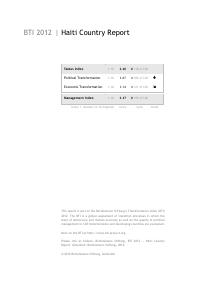
- Status Index 3.40, ranked 118 of 128.
The Bertelsmann Transformation Index 2012 country report is dominated by the January 2010 earthquake. Some 300,000 people died, 250,000 houses were destroyed, and more than one million people were still living in camps when the report was written. Estimated damage of about 8 billion US dollars is put at 120% of GDP. The report argues that the scale of the loss owed largely to political disorder, incapacity and negligence under President Rene Preval and his predecessors, compounded by structural problems rooted in the colonial period and in a condition of dependence.
Support for Preval had already weakened in 2009 as living conditions failed to improve and corruption and clientelism continued, and the report reads the dismissal of Prime Minister Michele Pierre-Louis at the end of 2009 and the manoeuvring before the February 2010 elections in that light. The Strategic Outlook holds that Haiti cannot manage without external aid, which donors will withhold unless the government is judged strong and credible, and records that MINUSTAH faced one of the gravest challenges to its legitimacy since 2004 after large anti-United Nations protests in 2010 and early 2011 triggered by claims that its actions caused the cholera epidemic. The Status Index is 3.40, ranked 118 of 128.
How to cite
Bertelsmann Stiftung, BTI 2012 Country Report - Haiti, https://bti-project.org/fileadmin/api/content/en/downloads/reports/country_report_2012_HTI.pdf