Texte extrait du document original pour l'indexation.
BTI 2012 | Haiti Country Report
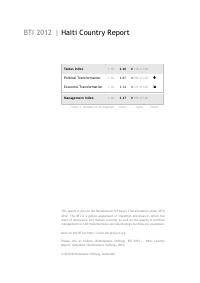
Status Index
1-10
3.40
# 118 of 128
Political Transformation
1-10
3.67
# 106 of 128
Economic Transformation
1-10
3.14
# 121 of 128
Management Index
1-10
3.37
# 109 of 128
scale: 1 (lowest) to 10 (highest)
score
rank
trend
This report is part of the Bertelsmann Stiftung’s Transformation Index (BTI)
2012. The BTI is a global assessment of transition processes in which the
state of democracy and market economy as well as the quality of political
management in 128 transformation and developing countries are evaluated.
More on the BTI at http://www.bti-project.org
Please cite as follows: Bertelsmann Stiftung, BTI 2012 — Haiti Country
Report. Gütersloh: Bertelsmann Stiftung, 2012.
© 2012 Bertelsmann Stiftung, Gütersloh
�BTI 2012 | Haiti
2
Key Indicators
Population
mn.
10.0
HDI
Pop. growth1
% p.a.
1.3
HDI rank of 187
Life expectancy
years
61
49.6
Urban population %
0.454
GDP p.c.
$
158
Gini Index
UN Education Index
0.406
Poverty3
%
72.2
Gender inequality2
0.599
Aid per capita $
111.6
1111
59.5
Sources: The World Bank, World Development Indicators 2011 | UNDP, Human Development Report 2011. Footnotes:
(1) Average annual growth rate. (2) Gender Inequality Index (GII). (3) Percentage of population living on less than $2 a
day.
Executive Summary
The January 2010 earthquake had a devastating impact on Haiti’s political, economic and social
situation. Some 300,000 people died, 250,000 houses were destroyed and more than 1 million
people still live in refugee camps. With the estimated economic damage totaling some 120% of
GDP, the Haitian earthquake has had a profound effect on the country’s economy.
It has to be stressed that the country’s heavy losses were mainly due to political disorder,
incapacity and negligence of President René Préval’s government and former governments. In
addition Haiti suffers from serious structural issues, some rooted in the country’s colonial past
and others stemming from the country’s state of dependency, which has led to a poverty-stricken
life for the majority of Haiti’s population.
The popular support for President Préval had already started to weaken in 2009. The population
had not experienced any changes in their harsh living conditions, while corruption and
clientelism continued as part of everyday life. The dismissal of Prime Minister Michele PierreLouis at the end of 2009, together with the political maneuvering of President Préval to
guarantee his party’s success in the February 2010 elections, offered some insight into the
mainly power-driven political ambitions of the president.
While the administration’s performance was already deemed as poor in 2009, it worsened in
2010. President Préval literally vanished after the earthquake and only reappeared one week after
the disaster. He held his first public speech one month after the earthquake and his message was
lacking the motivation a suffering public needed. No major reconstruction efforts were carried
out in 2010 and only 10% to 20% of rubble from destroyed buildings has been removed. Worse,
refugees in the many refugee camps, some of them located in the middle of Port-au-Prince, have
started to build houses as their tents have started to show wear and tear. Without the engagement
�BTI 2012 | Haiti
of international NGOs the mortality rate would be much higher and the living conditions for
many refugees even worse.
This poor performance further weakened popular support for Préval and his party. While the
president declared a state of emergency in February 2010, the international community insisted
that elections had to be carried out in the same year even though it was clear that the country was
far from being prepared for such a task. Only nine months after the earthquake, on November 28,
presidential and parliamentary elections were held. The process of registering voters and clearing
the existing voter lists, issuing identity cards and finding general technical assistance was
extremely challenging for the Provisional Electoral Commission (CEP), and elections were
marred by massive chaos and fraud.
Only one day after the elections, and although all candidates declared they would not run for a
second round, the U.N. head of the mission in Haiti held secret talks with the two leading
opposition candidates, Mirlande Manigat and Michel Martelly, convincing them to continue their
candidacy into the second round. The U.S. Embassy published a statement that the preliminary
results were inconsistent. This served as a catalyst for government opponents and protesters, who
with violent protests paralyzed the capital for several days. While the United Nations and the
United States seemed determined to prevent Préval from imposing his candidate Jude Celestin,
he struck back by orchestrating the return of former dictator “Baby Doc” Duvalier in January
2010 in an effort to demonstrate his power. However, Préval could finally not insist on his
candidate and Manigat and Martelly run for a second tour on March 20, 2011. On April 4 the
Electoral Commission declared Martelly the winner with almost 68% of the votes.
However, it is unlikely that the newly elected president will succeed at installing a functioning
democracy. Lacking natural resources, beleaguered by poor agricultural performance and
undergoing rapid population growth, Haiti is utterly dependent on foreign aid. The concept of
democracy means little to a population primarily concerned with development and improved
living conditions. This renders them highly vulnerable to promises made by populist and
demagogic figures, and makes the stabilization of political institutions unlikely.
History and Characteristics of Transformation
The breakdown of the Duvalier regime in February 1986 represents the starting point of a
protracted process of democratic transformation in Haiti. After a period of political transition
that was marked by several coups d’état, leading to military and provisional governments, the
first free and democratic elections were held in 1990. Jean-Bertrand Aristide, a former priest,
emerged as president. Ten months later, another coup d’état interrupted the process of
democratization, forcing Aristide into exile and installing a three- year military regime (19911994).
3
�BTI 2012 | Haiti
The return to a constitutional order in 1994, enforced by international military intervention under
U.S. leadership and U.N. mandate, triggered substantial economic progress. Nevertheless, the
structural adjustment program, prescribed by the Bretton Woods institutions and executed by the
Aristide government, was halted two years later following a wave of protests denouncing the
policies’ negative social impacts. Rene Préval, a close ally of Aristide, took over office from
Aristide in 1996 and reintroduced the reforms during his first term, only to face another rupture
when Prime Minister Rosny Smart resigned in 1997.
By this time, the conflict between Aristide and a reformist wing of his Lavalas movement
represented by the Organisation du Peuple en Lutte (OPL) had escalated to the point of splitting
the movement, resulting in a near- complete paralysis of the political administration. Against the
background of a political crisis triggered by controversial parliamentary elections in 2000 and an
increasingly difficult relationship between the opposition and the Fanmi Lavalas Party, Aristide
was elected president for a second time, also in 2000. The political crisis, in combination with a
suspension of international aid programs, put Aristide and his government in an awkward
situation. The implementation of his political and social programs became increasingly difficult.
Opposition parties, frustrated by Aristide’s second electoral victory, tried to prevent his party
from expanding its hegemony and opposed vehemently everything he did.
Negotiations to smoothen the crisis failed and violence increased instead. In September 2003,
students in Port au Prince organized public protests against Aristide that triggered nation-wide
resistance. At the end of February 2004, an armed rebellion led by former members of the
Haitian Armed Forces (formerly dissolved by Aristide) and rebels linked to armed gangs from
northern parts of the country prompted the breakdown of Aristide’s government and his
departure on 29 February 2004. With support from support the so-called Interim Cooperation
Framework (ICF) and financing by the Bretton Woods organizations, a transitional government
was charged with organizing democratic presidential and legislative elections, restoring
macroeconomic stability and improving economic governance. The U.N. Security Council
authorized the deployment of a multinational interim force to re-establish stability until the
arrival of a U.N. peacekeeping Mission (MINUSTAH) in June 2004.
A political pact was signed between political parties, the transitional government and civil
society groups in order to transfer power to a newly elected government. Aristide’s party, Fanmi
Lavalas, boycotted this pact and civil unrest punctuated the transitional government’s tenure,
revealing the deterioration of the state’s capacity to guarantee the rule of law. Finally, after
several delays, presidential and parliamentary elections were held in February 2006. Rene
Préval, a former prime minister and president, was declared winner (after creative counting) with
51% of votes after the first round.
The political system stabilized slightly until 2009, although high levels of party fragmentation
and constant political conflict between the executive and the legislative blocked real progress. A
slight recovery of the economic situation, prompting a 2.5% growth rate in 2009, could not be
translated into considerable improvements in the living conditions of the majority of the
population. The institutional stability came to a sudden halt when President Préval discharged
4
�BTI 2012 | Haiti
Prime Minister Michele Pierre-Louis at the end of 2009, after only one year in office. This was
mainly due to strategic considerations regarding the forthcoming parliamentary elections that
were due to be held in February 2010.
The earthquake on January 2010 had a devastating impact on the country’s political, economic
and social situation by derailing the economy, killing more than 300,000 individuals and leaving
more than 1 million people homeless, most of whom live in refugee camps. One year after the
earthquake, no major reconstruction effort had been undertaken, and the political situation grew
increasingly unstable after rigged elections were held on 28 November 2010.
5
�BTI 2012 | Haiti
6
The BTI combines text analysis and numerical assessments. The score for each
question is provided below its respective title. The scale ranges from 10 (best) to
1 (worst).
Transformation Status
I. Political Transformation
1 | Stateness
Question
Score
The state cannot effectively assure its monopoly on the use of force. Even before
the earthquake, state presence was absent in most rural areas. Since the dissolution
of the Haitian Army in 1995, the national police represents the country’s only
national security force. It has some 8,500 members (although estimates vary, from
5,000 and 9,500) and is poorly equipped. The earthquake left 77 police officers
dead and 250 injured, while 45 police stations were destroyed. Some 5,000
individuals escaped from prison as a result of earthquake damage and confusion
following the earthquake. Many criminal gangs have regrouped and resumed
activities in the commune of Cité Soleil. The United Nations Stabilization Mission
in Haiti (MINUSTAH) has a mandate to guarantee the maintenance of stability and
order, and some 12,000 international troops have been deployed since 2004.
Monopoly on the
use of force
The idea of the nation-state is not essentially contested, but exists only as a loose
concept at best. In reality a large majority of the population cannot even
acknowledge this concept, having never experienced the basics of citizenship, such
as enjoying the provision of social services or having participated in elections. Only
20% of the population participated in recent elections; yet this low number is also
due to many citizens not being provided with necessary voting documentation.
State identity
Religious dogmas play an important role in everyday life, but now less than in the
past and in general, religion has limited influence in politics. The country’s various
churches maintain a visible presence in political affairs, however, although on a
much lower level than before. For example, the President of the Provisional
Electoral Commission, which was one of the most important political institutions
during 2009 and 2010, is of the Protestant faith. Nevertheless, such actors do not
bring their religious beliefs into the workings of their political positions.
No interference of
religious dogmas
2
7
9
�BTI 2012 | Haiti
Government administration was weak before the earthquake and it collapsed
afterwards. The Presidential Palace and the Palace of Justice were completely
destroyed, together with nearly all of the ministries. In total, 95% of all public
buildings in Port-au-Prince were destroyed. In rural areas, public administration is
extremely weak. Few attempts at reconstruction have been made since January
2010. The majority of basic services have been provided with international
assistance.
7
Basic
administration
1
2 | Political Participation
Haiti has held 13 elections since the passage of its 1987 constitution, the majority of
which have been marred by delays, suspensions, widespread irregularities, fraud or
accusations of fraud, unrest and post-electoral violence, and followed often with
general political turmoil.
Free and fair
elections
4
The 2010 elections were held under pressure by the international community on 28
November 2010, even though the country was ill-prepared for a race and that the
Provisional Electoral Commission (CEP) lacked legitimacy. Only nine months after
the earthquake, registering voters, clearing the existing voter lists, issuing identity
cards and managing general technical details was a huge challenge for the CEP,
resulting in an election day marred by chaos and fraud. Sixteen of 18 candidates
declared they would neither accept the results nor would run in a second round.
With the CEP’s preliminary results pointing to a run-off between Jude Celestin, a
technocrat backed by President René Préval, and Mirlande Manigat, the main
opposition leader, widespread claims of vote rigging and fraud by the government
further undermined the electoral process that from the start lacked credibility.
Violent protests engulfed the capital of Port-au-Prince for more than a week.
The political crisis persisted as the second round of voting, originally scheduled for
January 16, was cancelled. While the international community declared Michel
Martelly and Manigat as the legitimate candidates for a second voting round, Préval
insisted that his candidate, Jude Celestin, garnered more votes than Martelly.
However, Préval could finally not insist on his candidate and the opposition leaders
Martelly and Manigat ran in a second round on 20 March 2011. On April 4, the
electoral commission declared Martelly the winner, with almost 68% of the votes.
Haiti was already heavily dependent on external aid before the 2010 earthquake,
with more than 70% of its funding coming from abroad. Considering the massive
reconstruction effort that currently faces the new administration and the absence of
functioning administrative structures, it has to be questioned whether the
government has the means to govern effectively. An Interim Reconstruction
Commission, composed of donor representatives and headed by former U.S.
President Bill Clinton, is charged with assisting in reconstruction efforts. The
Effective power to
govern
2
�BTI 2012 | Haiti
8
United Nations Stabilization Mission to Haiti (MINUSTAH) plays a vital role in
security and is also coordinating reconstruction projects.
The international community has considerable veto power over the current
administration and is in essence limiting national sovereignty.
The Haitian constitution protects the right of independent political and civic groups
to associate and assemble freely. Normally a range of different groups are able to
operate free from state interference. Nevertheless, trade unions and other civil
society groups are often too weak to be involved in political discussions or wage
negotiations.
Association /
assembly rights
The Haitian constitution guarantees citizens the right to freely express opinions as
well as guarantees the freedom of the press. Although Haiti’s past is rife with
violence, the situation has improved considerably in recent years. Yet there are still
many cases of intimidation of journalists and “outspoken public personalities,”
although it is unclear whether these acts are organized by government forces or
driven by personal interest, especially when corruption claims are involved. During
the 2010 election campaign, serious cases of intimidation and murder threats
received by political activists have been reported. Generally journalists tend to
practice self-censorship to avoid violent retaliation over critical reporting. There are
a few newspapers, primarily in the capital Port au Prince, that play a role in
criticizing the government. But as more than half of the population is illiterate,
many rely entirely on state-run television to keep up with political information. The
first cable station, Television Haiti, closed after the quake, ending the distribution of
some 30 national and international channels. Private radio stations are very popular
and important in the larger cities, but cannot always be heard in the countryside.
Freedom of
expression
7
5
3 | Rule of Law
The 1987 Constitution stipulates that citizens delegate the exercise of national
sovereignty to three authorities: the executive, the legislative and the judiciary. This
constitution introduced as well the separation of power between the president and
the prime minister as head of the government.
In reality, neither the separation of power nor checks and balances in government
has ever worked. The president of Haiti defines de facto the politics of the country.
The frequent changing of prime ministers during the period under review
demonstrates the position’s weak role. The majority of parliamentary members do
not have the necessary capabilities to fulfill their legislative role. Political
fragmentation and volatility is extremely high and makes professional cooperation
even more difficult. The Senate maintains a nearly unlimited veto power, which has
led to severe political problems in the past. In 2010, however, the president declared
Separation of
powers
4
�BTI 2012 | Haiti
9
a state of emergency after the earthquake although there are no legislative
provisions for such a measure. Ever since the disaster, the Senate as well as the
Chamber of Deputies has been recessed and the president governs by decree.
The non-existence of an independent and permanent electoral commission as
foreseen by the constitution is another indicator for a lack of political will on behalf
of the government to establish real institutional independence and therefore
guarantee checks and balances.
Haiti, as a former French colony, inherited the five classic Napoleonic Codes, and
the procedure codes have been left almost unchanged since the early 1800s. The
judicial system is undifferentiated and not independent from politics. The Supreme
Court does not function as the president has yet to nominate a judge as president of
this major legal institution. Even before the earthquake, the legal system suffered
from a lack of resources, poor infrastructure and a lack of qualified judges.
Corruption is endemic and a culture of impunity has led to the general conviction
that there is no rule of law at all in Haiti. After the earthquake, the situation
deteriorated even further. Many employees of the courts as well as judges and
lawyers died in the earthquake, and the majority of the infrastructure was
completely destroyed, including numerous archives and files. Today only 10% to
15% of the amount of previous legal activity is proceeding in Haiti.
Independent
judiciary
Corruption is endemic and for citizens a part of everyday life. Without state
institutions that would provide for social services, Haitians are used to paying extra
for every need, so much so that the practice has become a cultural norm. Although
there is rhetorical stigmatization of corruption, officeholders do not fear legal
consequences. President René Préval for example nominated as his electoral
candidate an official who has been suspected to have engaged in corrupt practices.
The government still has not been held accountable for the large sums of aid money
donated after the 2008 hurricanes. Adding to the lack of absorption capacities, many
bilateral donors are reluctant to transfer money that has been promised for
earthquake reconstruction. As a result, no serious reconstruction efforts have been
undertaken nearly one year after the earthquake.
Prosecution of
office abuse
Various fundamental civil rights are not protected in Haiti, including citizens’ safety
and freedom from harm or torture, impunity and general freedoms (such as rights to
a free press and a fair trial). Due to the weakness of the legal system, any civil
rights violations are seldom prosecuted. Thousands of prisoners have been in jail for
years without trial and many exceeded by far the maximum jail time for their
alleged crime. The long duration of the period of prisoner remand is a clear
violation of international human rights. There is no counsel guarantee for indigent
criminal defendants, and torture and mistreatment of prisoners is frequent, though
not systematic.
Civil rights
3
3
5
�BTI 2012 | Haiti
10
Widespread and general violence against women and children, including rape and
trafficking of persons, are serious threats. Thousands of children work illegally in
households and in manufacturing, without compensation and are often
malnourished and suffer abuse. Few victims can claim legal assistance, because for
one they cannot afford it and even if they could, they would not trust the council
given because of Haiti’s systemic legal weakness.
The approximately 500,000 undocumented Haitian migrants in the Dominican
Republic are often subject to maltreatment and violations of their international
human rights; the Haitian government is not able or willing to provide them with
diplomatic support.
4 | Stability of Democratic Institutions
Even before the 2010 earthquake, Haiti’s political institutions were in poor shape.
The country’s weak democratic institutions reflect the Haitian political culture
where self-interest, social segregation and fighting for survival are key components.
The earthquake and its effects on the country’s governing institutions represent a
serious step backward on Haiti’s democratic path. President René Préval declared a
state of emergency after the earthquake and assumed both legislative and executive
power. A Provisional Electoral Commission (CEP) was charged with organizing
presidential elections in November 2010. The electoral commission was not
perceived as being independent and its composition and decisions were highly
contested. Even though the constitution requires the establishment of a permanent
electoral commission that is independent from political influence, Préval, like his
predecessors, failed to see this constitutional stipulation through.
Performance of
democratic
institutions
2
The presidential elections on 28 November 2010 were fraught with organizational
deficiencies and chaotic management. All opposition candidates declared on
election day that they would not accept the results. However, 10 days later the
electoral commission declared that President Préval’s candidate, Jude Celestin, and
the main opposition leader, Mirlande Manigat, won a majority of votes and would
therefore participate in a second round. This decision led to violent protests and
weeks of political turmoil as candidate Michel Martelly was believed to have won
second place after Manigat by the public. Only after votes were recounted by the
Organization of American States and a report was issued did the CEP declare
Manigat and Martelly as winners to compete in a second round on March 20.
Despite deficient democratic institutions and a weak rule of law, all major political
actors in Haiti support the country’s transition toward democracy. Yet public
support for democratic transformation is feared to have weakened after the
earthquake, as citizens are both disappointed and deeply frustrated over the poor
Commitment to
democratic
institutions
2
�BTI 2012 | Haiti
11
performance of the Préval administration and its serious shortcomings in managing
the post-disaster period.
The electoral fiasco in 2010 showed the serious mistrust on behalf of the citizenry
of the government system and an emergence of veto actors that have the ability to
question the democratic process. There are certain business interest groups that
would seek to elect a government that would be the easiest to influence and thus
serve their interests. There are also criminal or drug trafficking networks that prefer
social instability and an unaccountable government. And there are some political
actors who have been excluded from the political process and seek a return to gain
influence within a transitional government. The surprising return of ex-dictators
Jean Claude Duvalier (in January 2011) and Jean-Bertrand Aristide (in March 2011)
could also confuse the general acceptance of democratic institutions.
5 | Political and Social Integration
The party system is highly fragmented and volatile. Political parties do not
represent the interests of the population but represent instead mainly individual or
clientelistic interests. In addition there is little to no social basis in the population
outside of urban centers, and even there it is weak. Political parties can appear or
disappear literally overnight, as was witnessed at the end of 2010, when President
René Préval founded a new political movement called Unity (Inite) that became a
melting pot for former members of all other political parties. No political party has
presented a real program, and only two or three can claim nationwide structures or
representations. Political parties instead play a more emotional role in manipulating
youth, which at times has resulted in triggering violent public demonstrations.
Party system
There are some 2,400 officially registered popular organizations, interest groups
and civil society organizations. In general terms, such groups have very limited
access and influence on government decision-making. Many serve only as a vehicle
for personal interest or as a means to access international funding. Trade unions
have lost most of their influence as a majority of the population is employed in the
informal economic sector. The only groups that can effectively organize are those in
the business sector, and use their lobbying power to their own advantage.
Interest groups
There are many local grassroots organizations and in some cases, such groups are
able to effectively represent the interests of the local population. Access of these
organizations to local officials remains traditionally higher than in Port-au-Prince,
but given the high level of centralization, all important political decisions are still
made in the capital. In the aftermath of the earthquake it was made clear how little
clout local organizations have with the government. There were no attempts made
to include civil society organizations in the formulation of reconstruction plans. The
only groups involved were from the business sector, while many other groups were
3
3
�BTI 2012 | Haiti
12
only consulted during a one-day show event that had little real impact on the
formulation of future priorities. Trade unions have further lost members and thus
power in the wake of the earthquake, as the official unemployment rate stands at
nearly 80%.
The inadequate response of the Préval administration in the wake of the 2010
earthquake both in showing leadership and dealing with damages has weakened
citizens’ acceptance of democratic governance. In an OXFAM survey conducted in
March 2010 more than 60% of Haitians claimed they would prefer that a foreign
country would head up the reconstruction process rather than their own government.
The respondents’ overall feeling was a deep sense of frustration and disappointment
with the Haitian government. Only 20% of registered voters participated in the 2010
presidential elections.
Approval of
democracy
n/a
The majority of the population has never experienced any form of material benefit
from democratic governance. The only advantage for most was the absence of
authoritarian rule and repression. Considering the low level of education and the
high level of illiteracy in the country, only a small group of economic and
intellectual elite understands the principles behind democratic institutions. What is
important for a majority of citizens is to simply improve their living conditions.
The 2010 earthquake saw the disintegration of the Haitian community’s previously
solid traditions of solidarity and mutual help. However no serious looting or
significant social unrest was reported in the weeks after the earthquake, although
many prisoners escaped from damaged prisons following the earthquake.
Cooperative and associative mechanisms of self-organization do exist, both in the
rural and urban context, but their impact remains underdeveloped. Today more than
1.5 million internally displaced persons are living in refugee camps, where they rely
heavily on external help. Nevertheless, given the extreme high number of Haitians
living abroad, young people are now looking abroad for solutions rather than
staying home to focus on how to improve living conditions in their own country.
Social capital
4
II. Economic Transformation
6 | Level of Socioeconomic Development
The United Nations Human Development Index ranked Haiti at 145 out of a total of
177 countries for 2010. Haiti shows by a large margin the worst performance in all
indicators for Latin America and the Caribbean. One of Latin Americas’ biggest
slums is situated in Port-au-Prince, with an estimated 500,000 people living in dire
Question
Score
Socioeconomic
barriers
1
�BTI 2012 | Haiti
13
conditions with high rates of criminality. The income distribution inequality is very
high, with a Gini Index of 0.59%.
The 2010 earthquake severely impacted Haiti’s economy, at an estimated 120% of
GDP. After Haiti’s GDP grew by a comparatively strong 2.9% in 2009,
expectations are that growth will contract sharply in 2010 and 2011.
More than 80% of the population lives below the poverty line, while approximately
60% live on less than $1 per day. Rural areas are the most affected, with nearly
four-fifth of Haiti’s extreme poor living outside cities. Before the 2010 earthquake
only half of Haiti’s children were enrolled in school; after the disaster this has
dropped to 30% to 40%. Gender differences are the starkest in education; only 39%
of women are literate, compared to 53% of men.
Access to health services are limited and worsened with the outbreak of cholera in
2010. More than 3,500 people died in this epidemic because there either was no or
insufficient access to health care or simply clean water. Infant and maternal
mortality in Haiti is the highest in the Americas, with about 60 deaths per 1,000 live
births.
More than one-third of the population lacks sufficient food, as land resources are
limited and traditional methods of farming do not produce the quantities needed.
More than 1 million internally displaced persons depend on food aid provided at
refugee camps.
Economic indicators
2007
2008
2009
2010
5971.3
6407.7
6478.6
6709.7
GDP
$ mn.
GDP growth
%
3.3
0.8
2.9
-5.1
Inflation (CPI)
%
8.5
15.5
0.0
5.7
Unemployment
%
-
-
-
-
Foreign direct investment
% of GDP
1.2
0.5
0.6
2.2
Export growth
%
-2.9
13.6
9.9
-7.3
Import growth
%
0.5
5.3
5.8
19.7
Current account balance
$ mn.
-85.1
-292.4
-226.7
-165.6
�BTI 2012 | Haiti
14
Economic indicators
2007
2008
2009
2010
Public debt
% of GDP
35.0
37.6
24.7
15.7
External debt
$ mn.
1580.1
1950.9
1325.2
491.8
Total debt service
$ mn.
82.4
57.8
44.7
130.9
Cash surplus or deficit
% of GDP
-
-
-
-
Tax revenue
% of GDP
-
-
-
-
Government consumption
% of GDP
-
-
-
-
Public expnd. on edu.
% of GDP
-
-
-
-
Public expnd. on health
% of GDP
5.7
6.1
6.1
-
R&D expenditure
% of GDP
-
-
-
-
Military expenditure
% of GDP
0.0
0.0
0.0
-
Sources: The World Bank, World Development Indicators 2011 | International Monetary Fund (IMF),
World Economic Outlook 2011 | Stockholm International Pease Research Institute (SIPRI), Military
Expenditure Database 2011.
7 | Organization of the Market and Competition
The majority of the population works in the informal economic sector, and former
estimates by the World Bank suggest that 95% of private employment in Haiti is in
the informal sector. As up to 25,000 government offices and businesses collapsed
during the 2010 earthquake, this figure is probably higher for the period under
review.
The formal sector is small and highly regulated in some areas, for example in taxes
and tariffs, and not regulated at all in other areas, especially when it comes to
workers’ protections and rights. The country’s most important bilateral agreement
(Hemispheric Opportunity through Partnership Encouragement, HOPE II) gives its
garment industry free access to the U.S. market, with preferential terms for products
from the United States. Import barriers are high, but due to endemic corruption
large parts of taxes and tariffs are simply not applied. Most of the national economy
in essence belongs to approximately 15 large families.
Considering the country’s weak legal system and the high level of political
interference in judicial decisions, investments are not protected and market
participation is therefore risky. This is especially problematic when it comes to land
ownership, as there is a dual system of traditional and modern legislation of
property rights.
Market-based
competition
3
�BTI 2012 | Haiti
15
The national currency, the gourde, maintained a trend of gradual nominal
depreciation in the month after the January 2010 earthquake, but recovered later in
the year.
Through most of Haitian history, the economic and political elite has been protected
by the military. Although there has been some economic liberalization, this trend of
monopolistic practices remains unbroken. The lack of regulation reinforces
oligopolistic networking. There is no regulatory mechanism or institution to control
mergers, price fixing or predatory pricing.
Anti-monopoly
policy
Formally, Haiti made steps to liberalize its economy significantly in the 1990s. The
tariff structure has been simplified and rates reduced as a part of a structural
adjustment. Haiti’s simple average tariff has thus become one of the lowest in the
region (about 5%). However, non-tariff barriers are still significant, and inadequate
infrastructure and administration further hamper foreign trade. Trade liberalization
has had considerable negative impact on the economy, as local products cannot
compete with cheap imports. This has especially affected the agricultural sector,
and in the period under review it has been discussed whether some of the
dispositions should be changed to favor local production. With the enactment of the
Hemispheric Opportunity through Partnership Encouragement (HOPE II) with the
United States, Haiti gains 10 years of preferential access to U.S. markets through
special tariff exemptions.
Liberalization of
foreign trade
The Central Bank is the sole financial supervisor in Haiti. Its supervisory mandate
extends to commercial banks, business banks, saving banks and credit unions.
However, the Central Bank is seriously and increasingly undercapitalized and its
operations have been until recently subject to political interference, which led to the
fall of Socabank in 2008. According to an IMF report, capital adequacy
requirements are largely Basel I compliant, but there are no specific regulations on
minimum standards for risk management beyond traditional internal control
principles. There is no independent auditing system for most banks. The average
capital-to-assets ratio was 7.2 in 2008 and the trend of non-performing loans was 18%. It is unclear in how far the continued non-service of loans following the 2010
earthquake will affect smaller banks.
Banking system
3
6
4
8 | Currency and Price Stability
The Haitian gourde maintained a trend of gradual depreciation during 2009, with
the exchange rate weakening from HTG 39.8 to HTG 42 to $1 in the end of 2009.
The interruption of imports after the 2010 earthquake (especially fuel imports which
count for 30% of total imports) had an immediate impact on the Haitian gourde, and
by the end of January 2010, the exchange rate had appreciated by around 25% to
HTG 30 to $1. Living expenditures rose for many Haitians, although this is not
Anti-inflation /
forex policy
6
�BTI 2012 | Haiti
16
reflected in official figures. Prices have risen considerably after the 2010 earthquake
but according to official figures, inflation is estimated to be only 6%. This figure is
questionable as when taking into consideration the decrease of nearly all economic
activity following the disaster, and also shows that the government’s main lever to
control inflation consists simply in manipulating the official rate of inflation.
The Central Bank is subject to political interference. Its role was weakened further
following the 2010 earthquake, and the expected influx of foreign money toward
reconstruction efforts could produce a considerable impact on inflation and price
stability.
The 2010 earthquake undermined much of the recent progress made to stabilize
Haiti’s economic situation and has further limited the government’s capacity to
follow any sort of macroeconomic strategy. For years the country will have to rely
heavily on foreign aid. Haiti’s original three-year, $140 million poverty reduction
and growth facility was automatically converted to an extended credit facility prior
to the earthquake. The IMF approved immediately after the earthquake an
additional $102 million loan, which represents together with the former loans 80%
of the countries’ quota. Haiti is not expected to make any payments to the IMF until
2012. The fund also reduced debt service and made arrangements to help maintain
an adequate foreign reserve cushion. This will save the country at least 3% of the
2008 overall expenditure in debt service. The worldwide debt relief enacted after
the earthquake reduced pressure on government finances, as the government’s
ability to obtain revenues was severely debilitated; the building of the Internal
Revenue Agency was destroyed along with much of its records.
Macrostability
5
9 | Private Property
The constitution guarantees private property and assigns the state the duty of
protection and promotion of private entrepreneurship. The country has signed
international conventions on patents and trademarks. However, the weak judiciary,
endemic corruption and a general lack of political will impede effective
enforcement of these rights. Given the fact that the majority of the population is
living in rural areas and taking into the consideration the forthcoming
reconstruction efforts following the 2010 earthquake, problems of land ownership
are among the most urgent. Land titles and questions of ownership are often unclear
and the often inexistent legal structures lead to violent conflict. Fraudulent sale of
land titles and claims to traditional ownership are among the most frequent sources
of these conflicts.
Property rights
Private companies can act without restrictions and private business engagement is
encouraged by the government, at least on a rhetorical level. The only formal
limitation to start a business is the heavy and complicated administrative procedures
Private enterprise
4
5
�BTI 2012 | Haiti
17
required to register an enterprise. Starting a business in Haiti takes four times longer
than the world average. Commercial laws are applied inconsistently and nontransparently. Though private companies represent the majority on the national
market, public enterprises occupy important sectors such as telecommunication,
electricity, ports and airports. Only two of the nine state-owned enterprises were
privatized during the 1990s, and these privatizations have been deemed failures in
terms of pricing and production capacity. Despite the opening of a Center for the
Facilitation of Investment in 2007 and former U.S. President Bill Clinton’s
initiative to attract investors to the island, substantial improvement has not been
observed.
10 | Welfare Regime
The state provides a very basic health and pension insurance scheme, but as only
10% of the population is formally employed, only a few citizens benefit from this
rudimentary system. Public expenditure on health is about 1% of GDP, and life
expectancy is an average of 60 years. Only 3% of all schools are run by the state.
While Haiti’s social net was already sparse, following the 2010 earthquake the
country depends almost entirely on international humanitarian aid. The outbreak
and spread of cholera following the disaster, which claimed more than 3,000 lives,
shows the severe limitations of Haiti’s health system.
Social safety nets
3
The most important contribution to social welfare comes from the large Haitian
diaspora. While their remittances represented 19% of GDP in 2008, this figure
dropped significantly in 2009 due to the economic crisis in the United States.
The emigration exodus that began after the 2010 earthquake, especially toward the
United States and Canada, further eroded the traditional system of social solidarity.
There would be no viable welfare system following the disaster without
international support.
Due to the massive poverty in Haiti there is no equality of opportunity. Levels of
income inequality are among the highest in the Americas. Nearly half of national
income goes to the richest 10% of the population, while nearly 80% of the
population lives below the poverty line. Women are an especially vulnerable group,
as they suffer more from poverty than do men. Women are on average less educated
and are more often victims of hunger or natural disasters. Three-quarters of women
under the age of 21 who have children said their pregnancy was undesired. There
are no legal provisions to foster gender equality and many of the laws that protect
women and children are not really implemented.
Equal opportunity
3
�BTI 2012 | Haiti
18
11 | Economic Performance
The Haitian economy has been completely derailed following the 2010 earthquake,
and the government will rely even more heavily than before on international
assistance. While economic performance began to improve in 2009, with annual
growth rising from 1.8% in 2005 to 2.5% in 2009, this gain did not translate into
any significant improvement in the living conditions of the large, impoverished
majority. In 2010, GDP per capita sank by 8.5% according to the Economic
Commission for Latin American (Comisión Económica para América Latina,
CEPAL). The GDP per capita (PPP) remained at its very low level of $1,153
(2009). There are no reliable figures on unemployment, yet some figures have
ranged from 50% to 70% of the population.
Output strength
2
The trade and current account deficits have widened during the review period, as
domestic production has been severely weakened and the demand for imported food
and reconstruction materials has risen sharply.
The restoration of Haiti’s economy was one of the main subjects discussed at the
World Economic Forum in Davos at the beginning of 2010. Former U.S. President
Bill Clinton as the U.N. special envoy to Haiti tried to convince investors to come
to Haiti, but the call has yet to be heeded. Before the 2010 earthquake Haiti was still
servicing debt totaling over $1 billion. But calls for the cancellation of Haiti’s debt
have been answered positively by bilateral and multilateral donors, and most debt
has been cancelled.
12 | Sustainability
The government fails to take environmental concerns into consideration and there is
no noteworthy environmental policy. Haiti faces serious environmental degradation,
which increases the country’s vulnerability to natural disaster. There is a high risk
that each tropical weather phenomena can produce serious consequences for the
population, as flooding and erosion have shown in the past. Of the country’s 30
watersheds, 25 are without natural cover. The remaining forests, covering only 1%
of the territory, cannot play any significant environmental role. Deforestation and
land degradation undermine efforts to improve agricultural production. The
disastrous and widespread effects of cholera can only be explained by the large
scale of environmental degradation, as the water from the Artibonite River, one of
the main water sources in the country, is used as a source of drinking water as well
as a public toilet. Considering demographic growth, these problems will only
become more serious in the future.
Environmental
policy
3
�BTI 2012 | Haiti
19
Though since 1999 a national environmental action plan has been in place and
updated, socioeconomic development and protection of the environment have
proved difficult to reconcile. Though problems and solutions have been widely
discussed, and farmers and politicians are well aware of Haiti’s environmental
fragility, the country’s political, social and economic groups have not been able to
come together to combat continued environmental degradation. In the last Growth
and Poverty Reduction Strategy paper (GPRS), efforts were made to combine
economic policies and environmental concerns. However, the overall conditions
and the lack of capacity are not in favor of the application of a coherent
environmental policy.
The Haitian education sector suffers from lack of state resources, absence of
regulation capacity and is impaired by the influx of private service providers. About
90% of education in Haiti is private and only 10% public. Some 80% of the national
education budget is provided by international donors; there are no reliable figures
on public education expenditures. Free schooling services existed before the 2010
earthquake for 17% of school-age children, yet that number has fallen after the
disaster. The United Nations Children’s Fund (UNICEF) estimated that some
500,000 school-age children do not attend any sort of school service, and the
literacy rate is about 45%. Access to higher education is extremely limited due to a
lack of resources to pay fees, but also due to poor quality. Universities have
irregular schedules and are prone to student unrest. There is no data on research
activities, as such activities hardly exist. Another constraint is the near total absence
of vocational training, which leads to extremely poor standards of technical
qualifications.
Education policy /
R&D
1
�BTI 2012 | Haiti
20
Transformation Management
I. Level of Difficulty
Structural constraints were already very high in Haiti prior to the 2010 earthquake
and following the disaster, the situation has worsened. Nearly 80% of the
population lives in absolute poverty and nearly half of the population is illiterate.
One year after the earthquake, more than 1 million internally displaced persons live
in refugee camps. The cholera pandemic added another limitation and shows the
effect of an absence of basic health services. The majority of government buildings
were destroyed during the earthquake as well as large swaths of the capital, Port-auPrince. The government is completely dependent on external aid to rebuild
destroyed infrastructure and provide the population with a minimum of social
services. Democratic institutions and traditions are in general weak and the
government depends on the presence of United Nations troops to maintain peace
and stability. The country’s political paralysis following the chaotic elections in
2011 further demonstrated the fragility of Haiti’s institutions.
Structural
constraints
Civil society traditions are fairly weak and were mostly quashed during the
successive Duvalier regimes, although in the 1980s civil groups began to develop.
Considering Haiti’s traditionally weak state structures and the lack of trust by the
population in political institutions, the country today has a fairly active civil society
culture, especially at the local level. But many groups have been incorporated or
manipulated by political and economic elites in recent years. It also should be noted
that much international humanitarian engagement in Haiti has been channeled
through civil society organizations, and thus membership in such groups has
become a means to live and survive for many Haitians. The emergence of civil
society organizations in recent years reflects more the strong engagement of
international NGOs than a real push in local civic engagement. It has to be added
however that the 2010 earthquake revitalized in a way a sense of solidarity and
community that was previously lost. Yet Haitian civil society is still highly
fragmented and split along religious, social, political and cultural lines. This
reduces civil society group’s capacity to influence political decisions.
Civil society
traditions
Although Haiti is not marked by significant ethnic or religious cleavages, social and
political conflicts are an inherent part of the country’s history and have impeded
Conflict intensity
10
8
7
�BTI 2012 | Haiti
21
democratic and economic transformation. The exclusion of major parts of the
population and the enrichment of the political and economic elites have deeply
divided Haitian society, fuelled violence and hindered dialogue. Political conflict is
often carried out in the streets, as the demographically most significant group,
young, poor men between 15 and 25 years old, are easy to influence and are often
manipulated to engage in violent protest.
II. Management Performance
14 | Steering Capability
In 2008, the government presented a plan of strategic action to reduce poverty and
foster economic growth, following the release of a Poverty Reduction Strategy
Paper (PRSP). This strategy had been prepared with strong support from the World
Bank. The strategy outlined human development, democratic governance and the
promotion of growth in specific sectors as the three strategic pillars of action. But
none of these actions had been realized by 2009, as most of the internal political
capacity had been absorbed by the frequent change of prime ministers.
Question
Score
Prioritization
3
These strategies had to be replaced by new plans after the 2010 earthquake. During
the first quarter of 2010 and with massive support by the international agencies, the
government presented a Plan for the Reconstruction of Haiti. This plan, mainly
established by international consultants, distinguished between short-term, mediumterm and long-term measures and served especially as a first step for international
donors to better channel their funds. The findings of the PRSP were taken into
account with a focus on reconstructing infrastructure, providing social services,
developing the agricultural sector and strengthening state institutions. Civil society
groups had only limited participation and the plan still needs large reconsideration
to become operational; most plan points have yet to be realized.
The government has failed to implement many of its policies. Already in 2009 the
effects of the financial crisis and the preparation for national elections drew
considerable attention and capacity from the pursuit of defined political goals, such
as those outlined in the Poverty Reduction Strategy Paper (PRSP). At the end of
2009, a rare period of political stability came to an end when the Senate passed a
vote of no confidence in Prime Minister Michele Pierre-Louis, removing her and
her cabinet after less than 14 months in office. Pierre-Louis had been appreciated by
the international community as a guarantor of institutional stability, a fighter
against corruption and leader in the pursuit of strategic goals. The official
Implementation
2
�BTI 2012 | Haiti
22
explanation was that Pierre-Louis couldn’t explain what had happened to a large
sum of emergency aid disbursed after the 2008 hurricanes.
The ouster of Pierre-Louis has to be seen as part of a pre-electoral strategy rather
than the expression of a demand for the government to take a new economic
direction. This step was followed by the overnight creation of a new party by
President Préval that seriously damaged the political landscape. Various members
of Congress and senators attached themselves to the new movement, leaving their
old parties in despair.
The already negative impression of Préval’s time in office worsened after the
earthquake as the president literally disappeared after the disaster and only made a
public appearance one full week later. His first public speech was held four weeks
after the earthquake, and during that time his abilities for crisis management were
sharply criticized. One year after the earthquake little visible reconstruction has
been pursued by the government, and in essence 2010 was a lost year for Haiti. A
lack of leadership and coordination plus the preparation of Préval’s succession amid
presidential elections made a bad situation even worse.
Polarization and a general lack of willingness for political compromise have
historically made policy learning difficult. There have been some small
improvements at the beginning of the period under review. The Pierre-Louis
government had more success in communicating with Congress and with the
population, as well as within executive. More experts took part in ministerial
administration. But the dismissal of Pierre-Louis, the earthquake’s effects and
especially the rigged November 2010 elections have offered proof of the island
nation’s old traditions of power politics.
Policy learning
2
15 | Resource Efficiency
Poor fiscal management and economic governance have inhibited the efficient use
of both domestic resources and external assistance in recent years. Tax revenue is
limited, totaling approximately 10% of GDP in 2009, and dropping significantly
after the 2010 earthquake. The already inadequate quality and quantity of human
resources have further deteriorated with the heavy loss of life and damage to public
infrastructure.
The forthcoming reconstruction effort will be hindered by the scarcity of skilled
people, a situation exacerbated by massive outward migration. The country’s
administrative system suffers from a lack of incentives for motivated civil servants.
Low wages reinforce corruption and clientelism, which have come to be deeply
embedded in the system. The lack of public sector performance and absorption
Efficient use of
assets
3
�BTI 2012 | Haiti
23
capacity will be a serious obstacle to reconstruction. Due to the humanitarian crisis
after the earthquake, remittances from the diaspora have risen considerably.
The ouster of Prime Minister Michele Pierre-Louis in 2009 was yet another sign of
the government’s failure to coordinate conflicting objectives. In this case, shortterm-orientated and power-driven strategies were more important than the pursuit of
the alleviation of poverty. Prime Minister Jean-Max Bellerive, who replaced PierreLouis, represents the old-fashioned Francophone elite and its bureaucratic,
centralized and hierarchy-orientated policy style that has proven ineffective over the
last decade. Haiti relies heavily on foreign aid, and after the 2010 earthquake more
than ever before, and thus the government should continue to play the role of
intermediary between the population and the donors. Instead, foreign aid is more
treated as a personal asset of the government, without any input from the people
that said funds are supposed to benefit.
Policy
coordination
A number of integrity mechanisms have been implemented to reduce corruption.
The government has strengthened the management of public finances, including
internal audits and accounting processes. It has reviewed the regulations of public
institutions but has yet to put forth a complete anti-corruption bill. While these
steps seem significant, the starting point needs to be taken into consideration, as
there have never been any real mechanisms in place to monitor and control
government activities. One of the most sensitive points in the political realm
remains party funding, and especially campaigning. There are no regulations over
party financing or over electoral campaigns, which has led to the abuse of public
funds through the presidential party.
Anti-corruption
policy
3
3
In 2010, due to Haiti’s state of emergency and the resulting absolute power vested
in the president, no efforts at public accountability have taken place. The
international community has pledged $11.5 billion to “refound” the nation and an
Interim Reconstruction Commission is charged with monitoring this process and to
channel appropriate funds. It is still unclear which procedures will be followed to
prevent misuse and corruption.
16 | Consensus-Building
The majority of national stakeholders agree on the establishment of a market
economy and democracy, yet their ideas and strategies are very different. Major
dissent arose over the debate on the neo-liberal impact of reforms and the absence
of meaningful domestic participation. Due to a lack of democratic tradition and
experience, there have been various attempts to reach a “national consensus”
through a government of reconciliation or a consensual committee, but these
attempts failed.
Consensus on goals
5
�BTI 2012 | Haiti
24
The electoral fiasco in 2010 showed serious mistrust in the system and the
emergence of veto actors who question the democratic process. A small number of
business interest groups seek to elect a government that would be the easiest to
influence and which would serve the business community’s interests. Criminal and
drug trafficking networks prefer instability and unaccountable government. Other
political actors who have been excluded from the political process now seek to gain
influence in a transitional government. Especially worrisome was the return of exdictators Jean-Claude Duvalier in January 2011 and Jean-Bertrand Aristide in
March 2011.
While ex-army members and supporters of the former President Jean-Bertrand
Aristide who favor autocratic rule have lost much of their political influence, there
have been new anti-democratic actors emerging that could challenge reforms. There
are close relations between some political actors and business interest groups that
would support weak state institutions to better serve their individual interests, and a
considerable amount of drug-trafficking money circulates in the political realm.
Some members of Congress use their immunity to pursue illicit or criminal business
activities. Whether all these actors can be controlled remains unclear after the 2011
elections.
Anti-democratic
actors
The management of cleavages and conflict has not substantially improved in recent
years. The Préval administration inherited a legacy of political and social
polarization that has fostered recurring armed violence. Overcoming the state’s
historic weakness and mustering the political will to mitigate social cleavages
remains a major challenge in Haiti. The almost amorphous structure of political and
civil society, reflected in the highly fragmented and volatile party system,
complicates this task. Despite a further increase of poverty and a deterioration of
living conditions, the political elites seem incapable of overcoming governance
patterns dominated by short-term interests.
Cleavage /
conflict
management
There are numerous civil society organizations, some of them well-rooted in
society, and they provide for the majority of social services that the government
fails to offer. While civil society participation has increased slightly in recent years,
the 2010 earthquake was a sobering experience. None of the civil society
organizations, except for in the business sector, were consulted in the process of
outlining a medium- and long-term reconstruction plan. Only one seat was reserved
for civil society groups within the Interim Reconstruction Committee, although
such groups provide the major competences in nearly all strategic sectors. Civil
society groups should also play an important role in monitoring the government’s
financial transactions in the reconstruction phase, an oversight role which was
rejected by the Préval presidency.
Civil society
participation
Little effort has been made to overturn the culture of impunity in Haiti with respect
to past human rights violations, and what has been achieved has been mostly donor-
Reconciliation
4
4
4
3
�BTI 2012 | Haiti
25
driven. While the end of the Aristide era was marked by frequent human rights
violations that have remained unchallenged, the transition toward a democratic
government has been accompanied by imprisonment without trial, although in
many cases there is widespread doubt of any basis for the accusations. There have
also been several cases of U.N. forces being involved in civilian deaths, which have
yet to be investigated.
The return of former dictator Jean-Claude Duvalier, or “Baby Doc,” in January
2011 revealed not only the strategy of President Rene Préval to increase the
political chaos on the ground but also the criminal negligence of courts in pursuit of
former injustice. In the period under review no case had been successfully brought
against Duvalier and his attorney claims the former dictator cannot be charged
before the International Criminal Court in The Hague as the Congress failed to
ratify the government’s signature of the international treaty.
17 | International Cooperation
The international community plays a major role in Haiti’s political and social
development. The most visible contribution is the presence of the United Nations
Stabilization Mission in Haiti (MINUSTAH), that maintains 8,000 soldiers, and
4,000 civilian and police officers. Their mandate has been expanded until 2012, and
includes tasks such as supporting the democratization process, securing Haiti’s
borders and controlling illegal migration.
Effective use of
support
4
During past years and with the support of the multilateral institutions, the
government has developed needed documents such as the Interim Cooperation
Framework, the Interim Strategy Note and a Poverty Reduction Strategy Paper. But
over time it was questioned whether the government really felt it owned the plans
and had the drive to implement the necessary measures, and what’s more,
international aid still was not being used effectively. Corruption is endemic and it
appears that personal gain is still the major driving force behind the majority of
politicians.
The 2010 earthquake further exacerbated lending issues. The reluctance of bilateral
donors to actually transfer funds that had been promised during donor conferences
after the earthquake reflects donor fatigue and doubts about the government’s
commitment and capacity to effectively use the money. Even for well-organized
NGOs, the administrative hurdles are difficult to navigate to deliver funds and help
efficiently.
While Haiti gained more donor trust in recent years, which was reflected by the
IMF’s approval of additional disbursements and the augmentation of Haiti’s quota
within the institution, the 2010 earthquake and following rigged elections
Credibility
4
�BTI 2012 | Haiti
26
represented a clear step backward. The government’s ability to manage the crisis
was so poor that donors felt reluctant to disburse urgently needed reconstruction
money for fear of further mismanagement. Despite the establishment of an Interim
Reconstruction Commission, where the main donor countries have important
influence on how reconstruction is managed, not one single project was approved in
2010.
Haiti is a member of the Caribbean Community and Common Market (CARICOM)
and participates in Venezuela’s PetroCaribe program. Venezuela delivers oil at
preferential prices to member states, who can resell it at international market prices.
Haiti has also special ties with Cuba, which still sees Haiti as an icon as the world’s
first free slave republic and offers the island free medical assistance. Relations with
the Dominican Republic are tense, although the presidents of the two countries
pretend to maintain a personal friendship. This is mainly due to massive illegal
migration to the Dominican Republic.
The United States has always played a crucial role in Haiti’s development. One of
the major interests of the United States is to avoid an influx of “boat people,” or
immigrants. The line between aid and interference in internal affairs, however, is
often not respected. The majority of democratization efforts must be understood in
this context.
Regional
cooperation
6
�BTI 2012 | Haiti
Strategic Outlook
The devastating 2010 earthquake as well as the political crisis in the aftermath of the 2010
elections have further compromised Haiti’s fragile transformation process. With damage from
the earthquake alone put at $8 billion, or 120% of the country’s GDP, not to mention the damage
caused by annual hurricanes, Haiti cannot survive without external aid. This aid however will be
withheld unless the government is deemed strong and credible. The international community has
always played a crucial role in Haiti’s development and continues to wield considerable
influence.
While the international community seeks a stable and credible government for Haiti, the United
Nations Stabilization Mission in Haiti (MINUSTAH) is facing one of the biggest challenges to
its legitimacy since its establishment in 2004. In 2010 and early 2011 there were large anti-U.N.
protests, triggered by rumors that actions by MINUSTAH were responsible for the current
cholera epidemic. Many people have questioned both the results and the future of one of the
largest and most expensive U.N. missions in the world. While MINUSTAH’s mandate includes
assisting Haiti in its process toward more democratization, the mission’s support of democratic
institutions has not been significant. If MINUSTAH intends to play a leading role in the
democratization process that goes beyond organizing elections, the profile of its staff would have
to change considerably. The majority of the MINUSTAH team is military staff, and most
officers do not speak either French or Creole. What the national administration needs are welleducated experts and specialists that could help improve the substandard services offered by
Haiti’s public administration. The improvement of these services, for example, could be coupled
to the disbursement of international aid. Another option for MINUSTAH could be to limit its
mandate to mainly security issues, a task that could be achieved with half its current staff. While
nationalistic voices in the country have called for a complete drawback of U.N. troops, this is
unrealistic given the weakness of the national police and the country’s still seething potential for
violence.
There are no simple or clear strategic options for Haiti. The future of the country’s political crisis
is as uncertain as the island’s reconstruction efforts. Michel Martelly, the winner of the
presidential elections in 2011, will need to devote just as much time to overhauling the fragile
political and electoral landscape as spending the billions of dollars in reconstruction assistance.
The spending however may not be the main problem; instead the supervision of complex,
multifaceted projects and the need to maintain transparency in the process may prove to be
insurmountable challenges. Haiti needs credible government, supported by a majority of the
population and willing to fight corruption and incompetence. It is difficult to see how President
Martelly might fulfill these expectations, as he lacks political experience as well as political
support. Due to Haiti’s fragile and volatile political institutions, this will be a severe handicap.
27
�BTI 2012 | Haiti
Haiti might serve as a good example for the argument that electoral legitimization alone is not
enough to stabilize a country. Even if a democratically elected government is sworn in, it will
lack the means to provide the population with basic, desperately needed services, while NGOs
and the United Nations attempt to fill in the gaps. President Martelly has to show the public that
he will be able to change this landscape.
28
�