
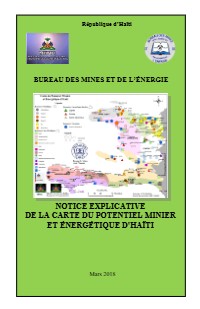
Explanatory Notice of the Mining and Energy Potential Map of Haiti
- Gold is found only in the Massif du Nord, where artisanal alluvial mining continues at Vallières, Mont Organisé and Carice, among other places.
- The Grand Bois gold and silver deposit has 4.73 million tonnes of ore at 2.23 grams of gold and 14.9 grams of silver per tonne, about 340,000 ounces of gold.
- The Maïssade lignite deposit holds 8.7 million tonnes and could fuel 40 megawatts for 17 years.
- Eleven oil wells were drilled between 1945 and 1977, 8 onshore and 3 offshore, without confirming or ruling out hydrocarbons.
- Limestone is the most abundant mineral, since 75 percent of Haiti's geology is sedimentary.
This 34-page notice, published in March 2018 by the Bureau of Mines and Energy (BME) with a preface by the Minister of Public Works, accompanies the official map of Haiti's mining and energy potential. The foreword traces two periods of research, 1939 to 1972 on hydrocarbons and lignite and 1972 to 1992 on both sectors, supported by UNDP, OAS, IDB, BGR and others. Sections cover metallic resources, including the Grand Bois deposit with 4.73 million tonnes of ore at 2.23 grams of gold per tonne, non-metallic resources led by limestone and cement materials, fossil energy including the Maïssade lignite deposit of 8.7 million tonnes, thermal springs, and renewable energy.
How to cite
Bureau of Mines and Energy (BME), 2018, Explanatory Notice of the Mining and Energy Potential Map of Haiti, accessed via HaitiDocs, https://www.haitidocs.org/doc/bme-2018-explanatory-notice-mining-energy