
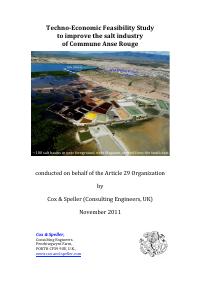
Techno-Economic Feasibility Study to Improve the Salt Industry of Anse-Rouge
- The study says about 70 percent of Haiti's salt is produced in Anse-Rouge commune.
- Existing Anse-Rouge salt production relies on hand-dug salt basins below sea level, using a labor-intensive process exposed to flood damage from rainfall on hills about 20 km inland.
- A January 2011 market study identified road-salt sales to the United States as a potential income source worth well over 2 million US dollars per year.
- Cox & Speller judged it technically feasible to transform several hundred existing basins into modern saltworks able to meet Haiti's iodized-salt needs and export at least 200,000 tonnes per year.
- The report notes that there are over 2,700 salt basins in Anse-Rouge commune, with more than 1,400 recorded individual owners.
Conducted on behalf of the Article 29 Organization by the British consulting engineers Cox & Speller and dated November 2011, this techno-economic feasibility study addresses the salt industry of the commune of Anse-Rouge in the Artibonite. It identifies a pilot project area of roughly 100 salt basins near Magazen and a future jetty, and its acronym list signals the range of concerns it brings together: brine density measured in Baumé, cubic meters and deadweight tonnage on the engineering side; iodine deficiency disorder, the Global Alliance for Improved Nutrition and IOM on the public-health and development side; and the Direction Départementale d'Agriculture and MARNDR on the institutional side. Salt iodisation is the thread joining an artisanal production question to a nutrition one. It complements the corpus's existing study of the Anse-Rouge sea-salt economy.
How to cite
Article 29 Organization; Cox & Speller (Consulting Engineers, UK), 2011, Techno-Economic Feasibility Study to Improve the Salt Industry of Anse-Rouge, https://agripubhaiti.org/wp-content/uploads/2025/03/Sel-A29-FINAL-Report-study-feasibility.pdf