Full Document Text
Extracted text from the original document for search indexing.
Public Disclosure Authorized
WAT E R G L O B A L P R A C T I C E C A S E S T U D Y
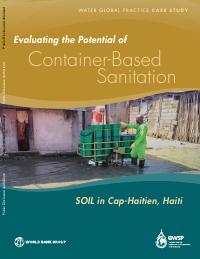
Evaluating the Potential of
Container-Based
Public Disclosure Authorized
Sanitation
Public Disclosure Authorized
Public Disclosure Authorized
SOIL in Cap-Haitien, Haiti
�About the Water Global Practice
Launched in 2014, the World Bank Group’s Water Global Practice brings
together financing, knowledge, and implementation in one platform.
By combining the Bank’s global knowledge with country investments,
this model generates more firepower for transformational solutions to
help countries grow sustainably.
Please visit us at www.worldbank.org/water or follow us on Twitter
@WorldBankWater.
About GWSP
This publication received the support of the Global Water Security
& Sanitation Partnership (GWSP). GWSP is a multidonor trust fund
administered by the World Bank’s Water Global Practice and supported
by Australia’s Department of Foreign Affairs and Trade; the Bill &
Melinda Gates Foundation; The Netherlands’ Ministry of Foreign Trade
and Development Cooperation; Norway’s Ministry of Foreign Affairs;
the Rockefeller Foundation; the Swedish International Development
Cooperation Agency; Switzerland’s State Secretariat for Economic Affairs;
the Swiss Agency for Development and Cooperation; Irish Aid; and the
U.K. Department for International Development.
Please visit us at www.worldbank.org/gwsp or follow us on Twitter #gwsp.
�Evaluating the Potential of
Container-Based
Sanitation
SOIL in Cap-Haitien, Haiti
�© 2019 International Bank for Reconstruction and Development / The World Bank
1818 H Street NW, Washington, DC 20433
Telephone: 202-473-1000; Internet: www.worldbank.org
This work is a product of the staff of The World Bank with external contributions. The findings, interpretations, and
conclusions expressed in this work do not necessarily reflect the views of The World Bank, its Board of Executive
Directors, or the governments they represent.
The World Bank does not guarantee the accuracy of the data included in this work. The boundaries, colors,
denominations, and other information shown on any map in this work do not imply any judgment on the part of
The World Bank concerning the legal status of any territory or the endorsement or acceptance of such boundaries.
Rights and Permissions
The material in this work is subject to copyright. Because The World Bank encourages dissemination of its knowledge,
this work may be reproduced, in whole or in part, for noncommercial purposes as long as full attribution to this work
is given.
Please cite the work as follows: World Bank. 2019. “Evaluating the Potential of Container-Based Sanitation: SOIL in
Cap-Haitien, Haiti.” World Bank, Washington, DC.
Any queries on rights and licenses, including subsidiary rights, should be addressed to World Bank Publications,
The World Bank Group, 1818 H Street NW, Washington, DC 20433, USA; fax: 202-522-2625; e-mail: pubrights@
worldbank.org.
Cover photo: © Sasha Kramer/SOIL.
Cover design: Bill Pragluski, Critical Stages, LLC.
�C ONT E NTS
ACKNOWLEDGMENTS • v
EVALUATING THE POTENTIAL OF CONTAINER-BASED SANITATION: AN OVERVIEW • vi
EXECUTIVE SUMMARY • vii
ABBREVIATIONS • xii
INTRODUCTION • 1
Background • 1
Study Objectives • 1
Study Methodology • 1
Report Structure • 2
Notes • 2
Reference • 2
CHAPTER 1: CBS SERVICE AREA CONTEXT • 3
Implementation of SOIL in Cap-Haitien and Haiti • 3
General Context of Haiti • 3
Urban Context of Cap-Haitien • 4
Water and Sanitation Services in Cap-Haitien • 5
Policy and Regulatory Environment for Sanitation Services • 7
Notes • 9
References • 9
CHAPTER 2: OVERVIEW OF EXISTING CBS SERVICES • 10
Background: Brief History of SOIL • 10
Overview of Services Provided • 10
Legal and Policy Environment and Impact on CBS Services • 14
References • 15
CHAPTER 3: CBS SERVICE PERFORMANCE • 16
SOIL Customer Growth • 16
Assessing the Value of SOIL Services to Customers • 16
Notes • 19
Reference • 19
Evaluating the Potential of Container-Based Sanitation: SOIL in Cap-Haitien, Haiti iii
� CHAPTER 4: FINANCIAL PERFORMANCE • 20
Current Costs and Financing Sources • 20
Improving Operational Efficiency • 21
Plans to Achieve Economies of Scale through Expansion • 21
Boosting Revenues and Identifying Reliable Subsidies • 23
Notes • 25
References • 25
CHAPTER 5: KEY LESSONS • 26
APPENDIX A: PEOPLE INTERVIEWED • 27
APPENDIX B: SOIL ORGANOGRAM • 29
Boxes
4.1 Operations and Customer Expansion in Port-au-Prince • 22
4.2 Estimation of Potential CBS Customer Base in Cap-Haitien • 23
4.3 Compost Volume as a Performance Indicator in a Payment-for-Results Proposed Project • 24
Figures
1.1 Key Institutional Relationships for Sanitation Services in Cap-Haitien • 8
2.1 Sanitation Service Chain for Sanitation Options in Cap-Haitien (as of April 2017) • 12
2.2 Sales Channels through which EkoLakay Customers Signed Up in 2015–16 • 13
3.1 Evolution of Numbers of EkoLakay Customers • 17
4.1 Relation between Cost of S ervice and Number of Collections Per Week • 21
Maps
1.1 Aerial Picture of Cap-Haitien and Part of SOIL’s Intervention Area • 4
1.2 Map Locating EkoLakay Customers in Cap-Haitien Neighborhoods (as of April 2017) • 5
Photos
2.1 Pictures Presenting Different Services Provided by SOIL in Cap-Haitien • 11
2.2 Pictures of EkoLakay Toilet, Wooden and Ferrocement Models • 13
Tables
1.1 Sanitation Facilities for Urban Areas in Haiti • 6
3.1 Qualitative Comparison of CBS and Alternatives • 19
iv Evaluating the Potential of Container-Based Sanitation: SOIL in Cap-Haitien, Haiti
�A C K NO W L E DG M E NTS
This case study was written by Adrien Mazeau (i-San consultant), in collaboration with Julian Parker (indepen-
dent consultant) and Sophie Trémolet (Senior Economist, World Bank), and with support from Clémentine Stip
(Operations Analyst, World Bank).
The authors would like to thank the SOIL team for hosting the study and facilitating interviews and field visits. Special
thanks go out to Sasha Kramer, Nick Preneta, and Claire Remington, who coordinated the various activities and pro-
vided valuable comments; Julian Boys for his assistance on the financial analysis; and World Bank Haiti staff for their
logistical support.
Evaluating the Potential of Container-Based Sanitation: SOIL in Cap-Haitien, Haiti v
� E VALUATING TH E P OT E NTIAL OF C ONTAIN E R -
BASE D SANITATION: AN OV ERVIE W
The World Bank Water Global Practice (WGP) has to support Bank teams and their clients when engaging
developed an approach to urban sanitation based on in CWIS. One of the aims of this work is to explore inno-
citywide inclusive sanitation (CWIS) principles, which vative approaches to provide safely managed sanitation
have been developed in conjunction with sector part- services along the whole service chain and to support cli-
ners (Bill & Melinda Gates Foundation et al., 2017). This ents in identifying when such options might make sense.
approach aims to shift the paradigm around urban sani- The study “Evaluating the Potential for Container-Based
tation approaches in World Bank engagements, promot- Sanitation” aims to answer some of these questions for
ing the following principles: container-based sanitation (CBS), an emerging sanita-
tion approach.
• Everybody benefits from adequate sanitation
service delivery outcomes. The objective of this study is to document and assess
• Human waste is safely managed along the whole existing CBS approaches, with a particular focus on eval-
sanitation service chain. uating their safety, reliability, affordability, and financial
viability. The report also seeks to identify the circum-
• Comprehensive approaches to sanitation improve-
stances in which CBS approaches are most appropriate
ments are deployed, with long-term planning,
and whether they could be considered as part of a port-
technical innovation, institutional reforms, and
folio of options for CWIS. The study was motivated by
financial mobilization.
growing interest in the emerging CBS experiences and
• A diversity of technical solutions, which are adap-
by the fact that many governments, city authorities, and
tive, mixed, and incremental, is embraced.
financing entities are often not familiar with the approach.
• Effective resource recovery and reuse is considered.
• Cities demonstrate political will and technical and The study builds on four case studies (Sanergy, Nairobi,
managerial leadership, and they identify new and Kenya; Sustainable Organic Integrated Livelihoods
creative ways of funding sanitation. [SOIL], Cap-Haitien, Haiti; Clean Team, Kumasi, Ghana;
and x-runner, Lima, Peru) to provide insights into these
• Both on-site sanitation and sewerage solutions,
questions. The present document is one of these four
in either centralized or decentralized systems, are
case studies. The full suite of documents is available at
considered to better respond to realities faced in
www.worldbank.org/cbs.
cities.
• Complementary services (including water supply,
drainage, greywater, and solid waste) are considered. Reference
As part of the implementation of these principles, the Bill & Melinda Gates Foundation, Emory University, The University
of Leeds, WaterAid, Plan International, and World Bank. 2017.
WGP is developing a suite of tools and other material Citywide Inclusive Sanitation: A Call to Action.
vi Evaluating the Potential of Container-Based Sanitation: SOIL in Cap-Haitien, Haiti
�E XE C UTIV E SU M M ARY
This case study, along with three others, is a component meet service needs along the sanitation service chain.
of a wider study by the World Bank on container-based These programs are:
sanitation (CBS) models. CBS consists of an end-to-end
service—that is, one provided along the whole sanitation • EkoLakay, the service managing containment—
service chain—that collects excreta hygienically from which uses urine-diverting container-based toilets—
toilets designed with sealable, removable containers and and local collection of feces;
strives to ensure that the excreta is safely treated, disposed • Konpòs Lakay, which supports transport from the
of, and reused.1 Rather than having to build a sanitation transfer stations, treatment of the feces, and trans-
facility, households (or public toilet operators) can sign formation of feces into compost; and
up for the service. The CBS service provider then installs • EkoMobil, which offers mobile container-based toi-
a toilet with sealable excreta receptacles (also referred to as let rental services.
cartridges) and commits to emptying them (that is, remov-
ing and replacing them with clean ones) on a regular basis. The report discusses SOIL’s CBS activities (EkoLakay
and Konpòs Lakay) in Cap-Haitien.
The objective of this study is to document and assess
existing CBS approaches with a particular focus on eval- SOIL, through its container-based program known as
uating their safety, reliability, affordability, and financial EkoLakay, operates mainly in the eastern part of Cap-
viability. The report also seeks to identify the circum- Haitien in low-income areas characterized by a high
stances in which CBS approaches are most appropriate population density, irregular alley layout, and higher
and whether they could be considered as part of a port- exposure to floods (compared to the rest of the city).
folio of options for citywide inclusive sanitation (CWIS). Its area of intervention covers about one-third of the ter-
ritory of the city. SOIL has a smaller EkoLakay program
This study is focused on Sustainable Organic Integrated in Port-au-Prince.
Livelihoods (SOIL), a U.S.-based nongovernmental
organization (NGO), and its operations mostly in Cap- In areas where the EkoLakay service is being offered,
Haitien and to a lesser extent in Port-au-Prince. The customers can sign up for the CBS service. The monthly
objective of this case study is to better understand how fee provides the client with the following benefits:
SOIL’s CBS business model fits in the overall context of
• Toilet installation
the low-income settlements in which it operates. SOIL
presents itself as a research and development nonprofit • Weekly collection of filled feces containers
organization that is developing sustainable sanitation • Repairs as necessary
services and business models to increase access to safely • Provision of a carbon cover material (called bon-
managed sanitation in vulnerable urban communities. zodè or “good smell”)
• Final treatment at a SOIL composting waste treat-
Overview of SOIL Business Model ment facility
In the cities of Cap-Haitien and Port-au-Prince in All material is eventually transformed into compost
Haiti, SOIL programs include three elements that through a carefully monitored thermophilic process,
Evaluating the Potential of Container-Based Sanitation: SOIL in Cap-Haitien, Haiti vii
� which adheres to World Health Organization (WHO) Since 2012, DINEPA has been developing techni-
standards for excreta treatment. This final compost, cal reference guidelines that include standards to
branded by SOIL as Konpòs Lakay, is then sold to be respected for water and sanitation interventions.
recover some of the costs of the treatment process. The framework discusses shared/community eco-
logical sanitation but does not directly cover CBS
approaches. The activities of SOIL are recognized and
SOIL Operating Context
authorized by the municipalities in which it intervenes.
Reported and observed rates of open defecation and DINEPA acknowledges the expertise of the organization
use of plastic bags (from 40 to 50 percent) in low- in terms of composting excreta. Concerning the con-
income urban areas of Cap-Haitien are much higher tainment solution, DINEPA does not have an explicit
than the official figures for urban Haiti (8 percent). position and considers CBS approaches to be a transi-
There is little data on containment, transport, and treat- tional intervention as opposed to a permanent solution.
ment of fecal sludge in the city. Pit latrines are most fre- From its perspective, subscribing to CBS services does
quently emptied by private manual emptiers, who are not necessarily mean that one house has gained a toilet
likely to dispose of the collected fecal sludge into the in the long term. However, given the fact that traditional
environment without treatment. sanitation interventions are technologically infeasible
in some of the communities where EkoLakay is offered,
Water and sanitation reform, as voted by the Haitian par- DINEPA is not yet offering any alternatives.
liament in 2009, created a regulatory body—Direction
Nationale de l’Eau Potable et de l’Assainissement (National
Assessment of SOIL’s Services
Directorate of Water and Sanitation; DINEPA)—and laid
out its organizational structure, as well as its funding, eval- Within this sanitation landscape and since 2012, SOIL
uation, and control mechanisms. The reform also placed has developed a CBS service. In Cap-Haitien, the
responsibility for oversight of sanitation (both off-site and EkoLakay service reportedly had 849 customers in
on-site) within DINEPA, which is part of the Ministère April 2017. Customers can choose between two urine-
des Travaux Publics, Transports et Communications diversion models: a wooden version that costs approxi-
(Ministry of Public Works, Transport and Communi- mately US$50 to produce and a ferrocement model that
cations; MTPTC). However, management, regulation, costs approximately US$27. Both models are produced
and governance over sanitation services are shared by locally, and there are currently no additional installa-
DINEPA, the Ministère de la Santé Publique et de la tion costs associated with the service. Toilets remain the
Population (Ministry of Public Health and Population; property of SOIL, and customers rent them by paying a
MSPP), the Ministère de l’Environnement (Ministry of monthly service fee of G 200 (US$3.20).
Environment; MdE), and local governments (municipali-
ties). Despite ongoing discussions, regulation, education, SOIL’s stated intention is to increase its number
and enforcement, responsibilities are not clearly allocated of customers per neighborhood, especially in the
among the ministries involved in the sanitation sector, areas of Cap-Haitien where there is a high density
and responsibilities for financing, training of staff, and of housing and potential customers. The objective is
implementation at the local level have yet to be decided. to reach about 3,500 EkoLakay toilets in 16 neighbor-
On the ground, there are no incentives or enforcement hoods by 2020. This slow initial scale-up represents an
(either documented or observed) that promote uptake by upfront focus on cost reduction and improving gross
the local population of improved sanitation facilities or margins and should be followed by a much more rapid
safe management of fecal sludge. scale-up once positive margins have been achieved.
viii Evaluating the Potential of Container-Based Sanitation: SOIL in Cap-Haitien, Haiti
�The long-term objective is to reach more than 60,000 Future Expansion Plans
households in both Cap-Haitien and Port-au-Prince,
with the largest part of customer growth taking place SOIL intends to increase the density of customers
within the capital city. within the neighborhoods it already serves. This will
enable the organization to evaluate the efficiencies cre-
Customers expressed satisfaction with the toilet tech-
ated by dense collection and transport areas and gather
nology and did not highlight issues regarding smell
more robust information about expenses associated with
or the presence of maggots or flies in the buckets.
provision of the service. Increasing customer density is
This outcome is potentially related to the way customers
also important to maximize the public health impact of
use and maintain their toilets, including not only how
the intervention. The information will be used to refine
they carry out maintenance but also the quality of the
cost projections, identify opportunities for greater cost
organic cover material used. Made primarily of bagasse,
recovery, and refine the service delivery business model.
the cover material supply is not guaranteed in the long
term, which could jeopardize part of the operations as
The ambitious goal of reaching 60,000 households
the service goes to scale.
is based on assumptions that once SOIL has refined
Affordability is a key issue for customers and non- its service delivery business model, the organization
customers. SOIL uses a single tariff for the EkoLakay will be able to hand over part(s) of the service chain
service in Cap-Haitien: G 200 (US$3.20) per month to private enterprise(s)—for instance, neighborhood
(in Port-au-Prince, it is G 250 or US$4 per month). collection services and transport from transfer points to
The majority of customers pointed out that most of the treatment sites—and create a public–private partnership
neighborhood inhabitants cannot afford the monthly (PPP) model for transport, treatment, and reuse. The
user fees. However, other customers disagreed, explain- management of the treatment site could also be dele-
ing that some individuals have different priorities, gated to public institutions such as the Office Régional
influencing their willingness to pay. Payment rates each d’Eau et d’Assainissement (OREPA) with support from
month are between 60 and 80 percent. DINEPA or managed as a PPP. However, there is concern
about the technical capacity of both private companies
Critically, the user fee is unlikely to cover all costs of and the public sector to provide services of an adequate
the sanitation service, which includes excreta treat- standard.
ment and transformation. In 2016, the provision of
services by SOIL had a total annual cost of a little less As there are several organizations interested in replicating
than US$435,000, with about 10 percent (US$43,900) SOIL’s CBS and treatment models elsewhere in Haiti,
recovered via fees from toilet users and from sales of there is a potential role for SOIL in providing training,
the reuse product. Revenues from the fees charged monitoring, and developing a franchise and/or support-
to users amounted to a little less than US$25,000 in ing standardization. SOIL leadership is evaluating these
2016—5 percent of the total costs and 27 percent of possible roles, though finalizing the business model will
the cost of providing the toilet service (when taking necessarily precede any decision-making in this regard.
overhead costs into account). Reuse activities gener-
ated revenues that covered only 10 percent of the costs SOIL points out that in countries with well-developed
of producing the reuse product. External funding sanitation sectors, public sector subsidies of excreta
to cover the gap is provided by several institutional treatment is the rule, not the exception. Although SOIL
funders, philanthropic organizations, and individual is working to ensure that revenues from customer fees
donors. can cover the cost of containment and collection, the
Evaluating the Potential of Container-Based Sanitation: SOIL in Cap-Haitien, Haiti ix
� organization does not intend to place the entire respon- Another important feature is SOIL’s principle of
sibility of covering the cost of transport, treatment, and providing the full-cycle ecological sanitation, where
reuse on the toilet customers or compost purchasers. excreta is treated and transformed into compost, bene-
SOIL suggests piloting a payment-for-results model, fiting agricultural projects and development. It does not
where the amount of feces treated or compost produced expect the cost of transport, treatment, and reuse to be
would be used as a key performance indicator. This covered by service fees from its low-income customers
appears judicious as the quantity of produced compost is nor the sale of compost. Demand for compost has been
a direct byproduct of the quantity of people served with high, but the price point cannot be increased significantly
sanitation services. without jeopardizing the client base. As such, SOIL is
looking at mechanisms to cover transport, treatment,
CBS services provided by SOIL offer a sound alter- and transformation costs, such as payments provided by
native to other forms of sanitation in areas where the Haitian government through output-based aid.
difficult access and restrictions on water availabil-
ity create challenges for these alternatives. When SOIL intends to transfer implementation and scale-up
interviewed, customers, community leaders, and of its CBS business models to the public and private
local organizations highlighted the lack of adequate sectors in Haiti. Therefore, an important aspect of its
alternatives. According to some sources, most cus- CBS approach is to develop a viable and replicable busi-
tomers were not using toilets before subscribing to ness model. According to its figures and projections
the service, instead relying on plastic bags for defeca- from May 2018, customer fees may soon be able to cover
tion. In addition, several customers describe positive the cost of containment and collection of feces, thereby
changes in their neighborhoods, noticing less excreta permitting potential replication by the private sector.
thrown around, and they emphasized the importance
of the service reaching a greater number of clients to Beyond the current service sector, CBS services could be
increase its impact. expanded in a number of areas in Haiti, with a particu-
lar focus on high-density urban neighborhoods, which
often offer little space for construction of septic tanks or
Key Lessons
even pit latrines, as well as a particular focus on flood-
SOIL is the only service provider in Cap-Haitien (and prone areas or hilly neighborhoods, desludging trucks
in Haiti at large) that is able to manage a sanitation cannot easily access.
system that covers the whole sanitation service chain.
In Cap-Haitien, and in a context of poor regulation, To meet its ambitious target number of customers in
none of the other existing solutions seems to guarantee Cap-Haitien and Port-au-Prince, SOIL will need to
safe containment, transport, and disposal or reuse of the continue to influence the institutional environment,
excreta. along with other organizations and donors in the sector.
SOIL is considering transferring parts of its operation to
CBS is a particularly suitable approach for the the private and public sectors. Success of such a strategy
segment of the urban population living in high- will depend on financial and human resources available
population-density areas. In these areas where to those sectors. To improve the chances of success, the
infrastructure is limited and where customers have little sanitation policy and related bylaws need to strengthen
disposable income and are used to “free” or pay-per-use the mandates and responsibilities of the public institu-
services, SOIL has managed to introduce a safe, paid, tions (ministry and municipality), including how these
subscription-based sanitation service. would be implemented on the ground. The influence of
x Evaluating the Potential of Container-Based Sanitation: SOIL in Cap-Haitien, Haiti
�SOIL would potentially continue to be expressed through for the four CBS case studies and the main report, feces and urine are
separated using urine-diverting toilet technologies. Cases where the
the demonstration of its success in reaching low-income CBS service provider collects only feces is referred to accordingly as
feces. Also note that cover material (for example, sawdust or carbon
customers, as well as through capacity-building of public cover) is added to the excreta in all cases.
and private sanitation providers.
Reference
Note
Tilley, E., L. Ulrich, C. Lüthi, P. Reymond, and C. Zurbrügg. 2014.
1 In this report, the term excreta is used instead of waste to avoid any Compendium of Sanitation Systems and Technologies. 2nd rev. ed.
potential confusion with solid waste. Tilley et al. (2014) define excreta Duebendorf, Switzerland: Swiss Federal Institute of Aquatic Science
as “urine and feces that is not mixed with any flushwater.” Note that and Technology (Eawag).
Evaluating the Potential of Container-Based Sanitation: SOIL in Cap-Haitien, Haiti xi
� A B B R E VIATIONS
AECID Agencia Española de Cooperación Internacional para el Desarrollo (Spanish Agency for
International Development Cooperation)
CAMEP Centrale Autonome Métropolitaine d’Eau Potable (Autonomous Metropolitan Drinking
Water Plant)
CBO community-based organization
CBS container-based sanitation
CRM customer relationship management
CWIS citywide inclusive sanitation
DHS Demographic and Health Survey
DINEPA Direction Nationale de l’Eau Potable et de l’Assainissement (National Directorate of Water
and Sanitation)
FSM fecal sludge management
GDP gross domestic product
IDB Inter-American Development Bank
IHSI Institut Haïtien de Statistique et d’Informatique (Haitian Institute for Statistics and Data Processing)
JMP Joint Monitoring Programme
MdE Ministère de l’Environnement (Ministry of Environment)
MSPP Ministère de la Santé Publique et de la Population (Ministry of Public Health and Population)
MTPTC Ministère des Travaux Publics, Transports et Communications (Ministry of Public Works,
Transport and Communication)
NGO nongovernmental organization
OREPA Office Régional d’Eau Potable et d’Assainissement (Regional Potable Water and Sanitation Office)
OSS on-site sanitation
PPP public–private partnership
SNEP Service National d’Eau Potable (National Potable Water Service)
SOIL Sustainable Organic Integrated Livelihoods
UNICEF United Nations Children’s Fund
US$ United States dollar
WASH water, sanitation, and hygiene
WHO World Health Organization
Exchange rate: US$1 = G 61.92, as of June 10, 2017.
xii Evaluating the Potential of Container-Based Sanitation: SOIL in Cap-Haitien, Haiti
�INTRODU C TION
Background financial viability. The study also seeks to identify the
circumstances in which CBS approaches are most appro-
This case study, along with three others, is a component priate. The ultimate objective is to identify whether these
of a wider study by the World Bank of container-based solutions could be considered as part of a mix of options
sanitation (CBS) models. CBS models have emerged over for citywide inclusive sanitation (CWIS).
the past 10 years as an alternative to network-based san-
itation or on-site sanitation (OSS) services. This case The objective of this case study is to better understand
study focuses on the operations of Sustainable Organic how the SOIL CBS business model fits in the overall
Integrated Livelihoods (SOIL), a CBS service provider context of Cap-Haitien and Haiti. Where relevant, the
operating in Haiti since 2011. case study also discusses SOIL’s operations in the capital
city of Port-au-Prince.
CBS consists of an end-to-end service—that is, one pro-
vided along the whole sanitation service chain—that
collects excreta hygienically from toilets designed with Study Methodology
sealable, removable containers and strives to ensure that
The field work for this case study was carried out in
the excreta is safely treated, disposed of, and reused.1
early 2017 based on interviews with key SOIL staff,
Rather than having to build a sanitation facility, house-
covering the range of activities and functions of the
holds (or public toilet operators) can sign up for the
organization, and local stakeholders, as well as focus
service. The CBS service provider then installs a toilet
group discussions. Relevant data and documents were
with sealable excreta receptacles (also referred to as car-
collected and analyzed until May 2017, though major
tridges) and commits to emptying them (that is, removing
developments and updates through May 2018 are
and replacing them with clean ones) on a regular basis.
reflected.
Transport methods can vary (and may involve tuk tuks,
motorcycles, hand carts, and donkey carts) and adapt to
The case study was based on the analysis of primary and
a variety of space and logistical constraints. Some CBS
secondary data. This includes scientific papers written
entrepreneurs build and operate resource recovery facil-
by SOIL staff and researchers, project proposals, SOIL
ities, taking advantage of the high-nutrient content of
activity reports, policy documents, statistical data form
the relatively “fresh” and undiluted excreta, to produce
a range of organizations, and nonpublished material
biogas, fertilizers, or protein for animal feeds. Some CBS
from consultants and nongovernmental organizations
operators manage the entire cycle themselves, whereas
(NGOs). In order to further assess this information, a
some partner with other groups or local authorities to
field visit was organized during the first two weeks of
implement parts of the sanitation service chain.
May 2017 to Cap-Haitien and Port-au-Prince. Ques-
tionnaires common to all four cases studies were used
Study Objectives to interview ministry representatives, local authori-
ties, water and sanitation directorate, SOIL staff, other
The objectives of the overall study are to document and sanitation service providers, international NGO repre-
assess existing CBS approaches with a particular focus sentative, and independent consultants (2). Appendix A
on evaluating their safety, reliability, affordability, and provides details on the interviewees.
Evaluating the Potential of Container-Based Sanitation: SOIL in Cap-Haitien, Haiti 1
� Due to fieldwork constraints, the majority of custom- environment is briefly examined. Chapter 3 assesses the
ers and non-customers were interviewed through focus performance of the service from the customers’ points of
groups organized with the support of SOIL (that is, trans- view and reviews customer growth. Chapter 4 presents a
lation and meeting points), which may have introduced financial analysis of the operation and briefly discusses
bias.2 Meetings were also organized with representatives the main cost drivers. Chapter 5 summarizes key lessons.
of community-based organizations (CBOs) active in two
neighborhoods of Cap-Haitien and two neighborhoods
of Port-au-Prince. Notes
1 In this report, the term excreta is used instead of waste to avoid
The fieldwork contributed to providing an overview any potential confusion with solid waste. Tilley et al. (2014) define
excreta as “urine and feces that is not mixed with any flushwater.”
of the urban sanitation conditions in the case study loca- Note that for the four CBS case studies prepared for this report, feces
and urine are separated using urine-diverting toilet technologies.
tions, highlighting how access to sanitation is currently Cases where the CBS service provider collects only feces is referred
provided, by whom, and at which service level. to accordingly as feces. Also note that cover material (for example,
sawdust or carbon cover) is added to the excreta in all cases.
2 With the support of local organizations working with SOIL—to
balance logistical issues with potential bias of answers—three focus
group discussions were organized: one in the Saint Michel area with
Report Structure nine participants and two in the Aviation area with five participants
each. All groups were mixed by gender. Discussion topics included
customers’ motivations to sign up for the service, existing alterna-
Chapter 1 describes the CBS operation’s service area tives, customers satisfaction, and affordability.
and the basic geographic, economic, and demographic
characteristics of Cap-Haitien. Chapter 2 provides an
overview of the CBS operation, with a technical descrip- Reference
tion of the different components of the operation as well Tilley, E., L. Ulrich, C. Lüthi, P. Reymond, and C. Zurbrügg. 2014.
as the management strategies, systems, and processes Compendium of Sanitation Systems and Technologies. 2nd rev. ed.
Duebendorf, Switzerland: Swiss Federal Institute of Aquatic Science
behind them. The impact of the policy and regulatory and Technology (Eawag).
2 Evaluating the Potential of Container-Based Sanitation: SOIL in Cap-Haitien, Haiti
�C HA P T E R 1 • C B S S E RVI C E AR E A C ONT E X T
Implementation of SOIL in Cap-Haitien and Haiti d’Informatique [IHSI] 2014), more than 6 million out
of 10.4 million (59 percent) of Haitians live under the
Sustainable Organic Integrated Livelihoods (SOIL) is national poverty line of US$2.42 per day. Haiti is also one
a U.S.-based nongovernmental organization (NGO). of the most unequal countries, with a Gini coefficient of
SOIL describes itself as a research and development 0.61 (as of 2012). Unemployment affects 40 percent of
nonprofit organization that is developing sustainable the urban workforce and almost 50 percent of the female
services and business models to increase access to safely workforce; underemployment is also an issue. Haitian
managed sanitation in vulnerable urban communities. youth face unemployment rates of more than 60 percent,
These business models consist of a private sector business triggering not only economic but also social concerns
for containment and collection of feces, with costs cov- (World Bank 2014).
ered by user fees, and a public–private partnership (PPP)
Although the country has the formal structures of a
for transport, treatment, and reuse of feces, with costs
democracy, many have yet to become fully functional, as
covered by a combination of compost revenue, tipping
evidenced by recurring periods of political and institutional
fees, payment for results, and carbon credit revenue. Like
instability. Haiti’s state institutions are under-resourced
Sanergy in Kenya and x-runner in Peru, SOIL intends to
and provide only limited services to a small percentage
build a circular sanitation business model where collected
of the population (United States Agency for International
excreta is safely transformed into compost, which is sold
Development [USAID] 2017). Progress in recent years has
to partially cover the cost of treatment.
been hampered by natural disasters and disease epidemics.
The organization is active in Cap-Haitien and Port-au-
In January 2010, Haiti was hit by a magnitude
Prince, where the main office is located. The 84 staff
7.0 earthquake that “killed over 220,000 people, injured
members working for SOIL are divided between both cities
300,000, left well over one million homeless, and
and across different departments, including direction and
destroyed infrastructure, services and homes” (Clermont
research, administration, logistics, and operations (collection
et al. 2011). Haiti has suffered significant environmental
and transport of containers, compost production, and mobile
degradation, contributing to poor sanitation and water
toilet deployment). More details are provided in appendix B.
quality. As a result, various public health risks exist for
SOIL, unlike other container-based sanitation (CBS) busi-
Haitians (Gracia et al. 2017). The lack of basic water
nesses that have reached more than 500 customers, operates
and sanitation services has contributed to the spread of
in two different cities and faces a range of challenges related
waterborne diseases, including the largest and most vir-
to context, from flood-prone areas in Cap-Haitien to hilly
ulent cholera outbreak in recent global history in 2010.
and rocky soil in some areas of Port-au-Prince.
According to the World Health Organization (WHO)/
General Context of Haiti United Nations Children’s Fund (UNICEF) Joint
Monitoring Programme (JMP) for Water Supply and
Haiti remains the poorest country in the Americas, Sanitation, coverage of improved drinking water in Haiti
and one of the poorest in the world, with a gross domes- remained stable—at about 60 percent between 1990 and
tic product (GDP) per capita of US$740 in 20161 and sig- 2012—leaving 3.8 million people drinking from unim-
nificant needs relating to basic services. According to the proved sources in 2012. In the same period, improved
latest household survey (Institut Haïtien de Statistique et sanitation coverage rose only from 19 to 24 percent
Evaluating the Potential of Container-Based Sanitation: SOIL in Cap-Haitien, Haiti 3
� nationally, still excluding 7.7 million people (WHO and the historical center of Haiti, and today, tourism remains
UNICEF 2014). an important source of income to the city, together with
development of the port (trade). The majority of the
Haiti, given its geographical location, exposure to economy, however, consists of informal trade activities
climatic events such as hurricanes, and its economic (UN-Habitat 2012).
situation, is considered as particularly vulnerable to
the effects of climate change. According to the World Urban development planning has been limited, and a
Bank, “Poor quality of housing, transportation net- large part of the population lives in the cités—informal
works, communication infrastructure, and access to neighborhoods characterized by poor access to services
health services all exacerbate Haiti’s vulnerability to nat- such as water, electricity, and sanitation. Cap-Haitien,
ural disasters and climate change” (2011). similar to Port-au-Prince, is a large coastal city where set-
tlements are expanding in the hills located around the city
center and in flood-prone areas close to river mouths. Since
Urban Context of Cap-Haitien 1970, poverty and rural emigration have transformed the
city, leading to the expansion of low-income urban areas.
Cap-Haitien is the second largest city in Haiti with a In Cap-Haitien, more recent low-income urban areas are
population of 250,000 in 2009. Cap-Haitien used to be expanding on the east side of the airport (see map 1.1).
Map 1.1 • �Aerial Picture of Cap-Haitien and Part of SOIL’s Intervention Area
Airport
Source: SOIL.
4 Evaluating the Potential of Container-Based Sanitation: SOIL in Cap-Haitien, Haiti
�SOIL’s area of intervention covers approximately one- A baseline survey carried out among three cohorts of the
third of the territory of Cap-Haitien city, as shown by population (two from Shada and one from Avyasyon),
the areas highlighted in blue in map 1.1. SOIL is also with a total of 366 participants, provided some informa-
present in the south of the city in peri-urban areas, tion on income levels of the population. Results across
such as Tilari or Katye Moren, and in the smaller city cohorts showed that one-third of the population owns
of Limonade, where SOIL has its regional office and its a television and has access to electricity, and more than
composting site. It is not active in the hilly sections of three-quarters own mobile phones. The median reported
the town (located in the north and west). monthly expenditures of US$152 and US$141 for the
two cohorts from Shada and US$136 for the cohort from
SOIL’s container-based program, known as Eko- Avyasyon (Russel et al. 2015).
Lakay, operates mainly in the eastern part of
Cap-Haitien in the neighborhoods of Avyasyon,
Nan Bannann, Fosenmichel, and Shada, as shown Water and Sanitation Services in Cap-Haitien
in map 1.2. These neighborhoods share some com-
mon features, including high population density and There is no disaggregated data or recent studies
irregular alley layout. They are also more exposed to regarding access to drinking water specifically in
flooding than the rest of the city. Cap-Haitien. Data on urban areas in general show that
Map 1.2 • �Map Locating EkoLakay Customers in Cap-Haitien Neighborhoods (as of April 2017)
Evaluating the Potential of Container-Based Sanitation: SOIL in Cap-Haitien, Haiti 5
� the majority of the population gets its drinking water In Cap-Haitien, two desludging firms report carrying
from water sachets and water kiosks, which are pres- out mechanical emptying of septic tanks for organiza-
ent in all neighborhoods. Water kiosks are most often tions and individuals. As a large percentage of facilities
owned by individuals or private companies, and water is in Cap-Haitien are pit latrines, manual emptiers are
delivered by water trucking and pumped from boreholes reported to be numerous, but no specific numbers
outside the city. are available. These manual emptiers are not formally
organized.
There are also no recent statistics of sanitation cov-
erage in Cap-Haitien. The Demographic and Health Given the lack of functioning public treatment
Survey (DHS) data from 2013 provides statistics for sites in Cap-Haitien, manual emptiers are likely to
urban Haiti as a whole (see table 1.1) but does not disag- dispose of most of the collected fecal sludge in the
gregate these data by city. environment without treatment, sometimes burying
it. One desludging company reports disposing of and
In Shada, one of the areas where SOIL operates, treating septic tank content in their privately owned
it is reported that approximately one-third of the ponds, but there was no evidence available on treat-
inhabitants are using their own or their neighbors’ ment, according to an interview between the authors
private latrines, 50 percent are using public toilets, and an employee.
and 40 percent are practicing open defecation (Russel
et al. 2015).2 Although SOIL operates three free public In both Cap-Haitien and Port-au-Prince, wastewa-
toilets in Shada, public toilets are generally not pres- ter treatment plants are built with external funds and
ent in other neighborhoods of the city. Sharing toilet managed by the public sector (see Policy/Regulatory
facilities among tenants and neighbors is a common Environment for Sanitation Services). There is a septage
practice in urban Haiti, especially in low-income urban treatment plant in Cap-Haitien that was built in 2013 that
areas. Reported (Kaupp 2006)3 and observed (GRET worked for only a few months but is now nonoperational
2016) rates of open defecation and use of plastic bags in (GRET 2016; field observation).4 In Port-au-Prince,
low-income urban areas of Cap-Haitien are much higher there were two government-run treatment stations built
than the official figures describing sanitation facilities in after the 2010 earthquake, though one of them closed
urban Haiti. Wealthier households in the northern part down in 2014. The other station, Morne à Cabrit, is the
of the city, hotels, or institutions are the primary parties only operational government treatment site in the coun-
with access to septic tanks. try. Secondary data and observation indicate that there is
no treatment in Cap-Haitien other than SOIL’s compost
As for emptying/collection and transport, there is lit- site. As a result, safe management of excreta collected
tle data describing services along the sanitation chain. outside of SOIL’s services is negligible.
Table 1.1 • Sanitation Facilities for Urban Areas in Haiti
Septic tank Improved Non-improved Shared toilet
Sewer No toilet
(and cesspool) pit latrine pit latrine (often pit latrine)
a
Percentage 1 16 24 10 41 8
Source: Cayemittes et al. 2013.
a. The 1 percent identified as sewer is likely to include essentially toilets connected to a pipe. In several cases, the pipe is not connected
to any treatment and discharges in a nearby open ditch. Very few simplified sewerages connected to a septic tank exist in Haiti.
6 Evaluating the Potential of Container-Based Sanitation: SOIL in Cap-Haitien, Haiti
�Policy and Regulatory Environment for public institutions’ capacities and roles on both national
and local levels; demand stimulation; and public services
Sanitation Services
development for desludging services and treatment.
Reform of the water and sanitation sector was voted However, management, regulation, and governance over
unanimously into law by the Haitian parliament and sanitation services are shared by DINEPA, Ministère
published in March 2009 (Le Moniteur 2009). The de la Santé Publique et de la Population (Ministry of
intent of the reform was to generate a new focus on the Public Health and Population; MSPP), Ministère de
sector and take the first step toward spurring develop- l’Environnement (Ministry of Environment; MdE), and
ment and investment plans. local governments. The MSPP, for example, has the role
of “ensuring the regulation and control of any public or
The reform created a regulatory body, Direction private action within its fields of competence.” (MSPP
Nationale de l’Eau Potable et de l’Assainissement
2018) In the sanitation sector, the MSPP is working
(National Directorate of Water and Sanitation; with DINEPA to develop standards and quality con-
DINEPA), and laid out its organizational struc- trol of services while MdE provides guidance on qual-
ture, as well as its funding, evaluation, and control ity of effluents to be released in the environment. The
mechanisms. The reform also placed responsibility framework law mentioned above envisages the transfer
for oversight of sanitation (both off-site and on-site) of responsibility either by decentralization (for example,
within DINEPA, which had not been in the mandate transferring responsibilities to municipalities and their
of previous water authorities (Gelting et al. 2013). urban planning departments) or deconcentration (for
The Offices Régionaux d’Eau Potable et d’Assainisse- example, transferring responsibilities to the OREPAs)
ment (Regional Potable Water and Sanitation Offices; (Oxford Policy Management [OPM] 2017). As illus-
OREPAs) are regional offices—deconcentrated struc- trated in figure 1.1, regulation, education, and enforce-
tures of DINEPA—in charge of managing water systems ment responsibilities are not clearly allocated among the
and wastewater treatment plants. Before 2009, the dis- ministries involved in the sanitation sector.
tribution of drinking water for urban areas was under
In February 2016, DINEPA signed a tripartite
the responsibility of two public agencies: the Centrale
agreement with the MSPP and the MdE for the coor-
Autonome
Métropolitaine d’Eau Potable (Autono-
dination of the sanitation sector for 2016–21. The
mous Metropolitan Drinking Water Plant; CAMEP),
agreement focuses on three axes: a central regulatory
from 1964 to 2009, and for the rest of Haiti, the Service
structure within DINEPA with guidance, coordination,
National d’Eau Potable (National Potable Water Service;
and regulatory roles in the sanitation sector; develop-
SNEP), from 1977 to 2009. Sanitation was not clearly
ment of the sector and deconcentration of services at
allocated to any agency.
the level of OREPA and operators in the private sector;
and decentralization or transfer of fecal sludge manage-
Institutional Arrangements for Sanitation ment (FSM) to town halls (while infrastructure remains
state property). As of May 2017, the specific allocation
DINEPA is part of the Ministère des Travaux Publics, of responsibilities for financing, training of staff, and
Transports et Communications (Ministry of Public implementation at the local level was still to be decided.
Works, Transport and Communications; MTPTC). As a result, the sanitation policy cannot be fully imple-
In 2014, DINEPA issued a revised version of the strate- mented and some questions remain—for instance, on
gic document for sanitation in Haiti. The main areas of the roles and resources (financial and human) of munic-
intervention of the public authorities are development of ipalities and different ministries.
Evaluating the Potential of Container-Based Sanitation: SOIL in Cap-Haitien, Haiti 7
� Figure 1.1 • �Key Institutional Relationships for Sanitation Services in Cap-Haitien
Ministère des Travaux Publics, Ministère de la Santé Ministère de
Transports et Communication Publique et de la l’Environnement
Government of Haiti
(MTPTC) Population (MSPP) (MdE)
Direction Nationale de
l´Eau Potable et de
l´Assainissement (DINEPA)
Office Régional d’Eau Municipality of Cap-Haitien
Municipal
Potable et d’Assainissement
Local government
technicians
(OREPA)
Direction de la Planification
et du Développement Urbain
Service providers
Wastewater Septage and fecal Population
treatment plant sludge operators
Key
Sets targets, oversees organizational development Manages Regulates, educates, enforces (under discussion)
Provides technical support Responsibilities under discussion
In Cap-Haitien, interviews with the different insti- intentions of the sanitation policy, there is no enabling
tutions highlight disparities between perceived environment to encourage uptake of sanitation facilities.
responsibilities of DINEPA, the municipality, and Roles and responsibilities, as well as corresponding funds
the private sector. Stakeholders do not agree on their and financial mechanisms, are not well-defined among
responsibilities regarding desludging, treatment, or the different ministries and municipalities. For instance,
environmental control. authorities responsible for education and enforcement
have neither a strong mandate nor the human and finan-
On the ground, there are no incentives or enforce- cial resources to undertake their responsibilities.
ment (either documented or observed) that promote
the uptake of improved sanitation facilities or the safe
management of fecal sludge. Cap-Haitien, and most Financing Arrangements
areas of Port-au-Prince, lack regulated FSM at the city/
neighborhood level. Most emptiers operate without In Haiti, the majority of the water, sanitation, and
authorization, environmental controls are not effective, hygiene (WASH) sector is funded by donors. DINEPA
and there is no monitoring of the volume and quality of reports that, of the total funding for the sector
fecal waste transported and disposed. Despite the stated between 2006 and 2015, only 1 percent is contributed
8 Evaluating the Potential of Container-Based Sanitation: SOIL in Cap-Haitien, Haiti
�by the Haitian government. DINEPA’s monthly expen- GRET. 2016. Etude sur la Gestion des Excrétas dans les Quartiers
Précaires en Haiti. Livrable n´2: Etat des Lieux. GRET, Oxfam, and
diture for the salary of its employees equals more than Direction Nationale de l’Eau Potable et de l’Assainissement.
US$660,000. More than 50 percent of the salary is
Kaupp, R. 2006. “Sanitation in Urban and Peri-urban Areas of Cap-
paid by donors. Major donors of the overall WASH Haitien, Haiti: The Promotion of Different Latrine Options through
a Social Marketing.” Unpublished MSc Dissertation. UK: Institute
sector include the Agencia Española de Cooperación of Irrigation and Development, School of Civil Engineering and the
Internacional para el Desarrollo (Spanish Agency for Environment, University of Southampton.
International Development Cooperation; AECID) and
“Loi Cadre Portant Organisation du Secteur de l’Eau Potable et de
the Inter-American Development Bank (IDB). Several l’Assainissement. LOI No.: CL01 – 2009 – 001.” 2009. Le Moniteur,
Journal Officiel de la République d’Haïti 164, no. 24.
other bilateral donors provide additional funding
(USAID 2014). Ministère de la Santé Publique et de la Population (MSPP). 2018. « Le
Ministère – Attributions du Ministère. » Website. Accessed October 4,
2018. <https://mspp.gouv.ht/newsite/?page_id=15>
Notes OPM (Oxford Policy Management). 2017. Etude des Marchés
Privés Relatifs à l’Eau Potable et à la Gestion des Boues de Vidanges
1 World Bank Open Data database, https://data.worldbank.org dans la Région Métropolitaine de Port-au Prince (RMPP), Rapport
/indicator/NY.GDP.PCAP.CD. de Synthèse, Version Provisoire. Oxford Policy Management,
2 Multiple responses permitted for each household. GroupIntellconsult, Overseas Development Institute for World
Bank Group, and Direction Nationale de l’Eau Potable et de
3 Reported rate of open defecation and use of plastic bags in Shada l’Assainissement.
went as high as 75 percent of the population resorting to it.
4 A truck of oil has deposited its loading in one of the tanks, and the Russel, K., S. Tilmans, S. Kramer, R. Sklar, D. Tillias, and J. Davis.
rehabilitation work on the site has not been completed. 2015. “User Perceptions of and Willingness to Pay for Household
Container-Based Sanitation Services: Experience from Cap-Haitien,
Haiti.” Environment & Urbanization 27, no. 2: 1–15.
References UN-Habitat. 2012. Haïti: Profil Urbain du Cap-Haitien. Programme
des Nations Unies Pour les Établissements Humains.
Cayemittes, M., M. Fatuma Busangu, J. Bizimana, B. Barrère,
B. Sévère, V. Cayemittes, and E. Charles. 2013. Enquête Mortalité,
Morbidité et Utilisation des Services, Haïti, 2012. Calverton, Maryland: USAID (United States Agency for International Development). 2014.
Ministère de la Santé Publique et de la Population—MSPP/Haiti, “Water, Sanitation, and Hygiene Sector Status and Trends in Haiti.”
l’Institut Haïtien de l’Enfance—IHE, and ICF International. http:// United States Agency for International Development.
dhsprogram.com/publications/publication-FR273-DHS-Final
-Reports.cfm#sthash.styz5Jzt.dpuf. ———. 2017. “Democracy, Human Rights and Governance.” Fact
sheet. United States Agency for International Development.
Clermont, C., D. Sanderson, A. Sharma, and H. Spraos. 2011. Urban
Disasters: Lessons from Haiti. London: Disaster Emergency Committee. World Bank. 2011. Vulnerability, Risk Reduction, and Adaptation to
Climate Change: Haiti. Climate Risk and Adaptation Country Profile.
Institut Haïtien de Statistique et d’Informatique (IHSI). 2014. Enquête World Bank, Global Facility for Disaster Reduction and Recovery,
sur les Conditions de Vie des Ménages Après Séisme. Synthèse des Climate Investment Funds.
Premiers Résultats. Ministère de l’Economie et des Finances.
———. 2014. Investing in People to Fight Poverty in Haiti: Reflections
“GDP Per Capita (Current US$).” The World Bank. https://data for Evidence-Based Policy-Making. Washington, DC: International
.worldbank.org/indicator/NY.GDP.PCAP.CD. Bank for Reconstruction and Development.
Gelting, R., K. Bliss, M. Patrick, G. Lockhart, and T. Handzel. 2013. World Health Organization (WHO) and United Nations
“Water, Sanitation, and Hygiene in Haiti: Past, Present, and Future.” Children’s Fund (UNICEF). 2014. Progress on sanitation and
American Journal Tropical Medicine Hygiene 89, no. 4: 665–70. drinking-water - 2014 update. JMP (Joint Monitoring Programme).
Geneva: World Health Organization and the United Nations
Gracia, J. N., C. M. Brown, D. M. Sampson, and L. Ejike-King. 2017. Children’s Fund.
“Haiti.” Centers for Disease Control and Prevention. June 13. https://
wwwnc.cdc.gov/travel/yellowbook/2018/select-destinations/haiti.
Evaluating the Potential of Container-Based Sanitation: SOIL in Cap-Haitien, Haiti 9
� CHAPTER 2 • OVERVIEW OF EXISTING CBS SERVICES
Background: Brief History of SOIL • Konpòs Lakay, which assists in the transport and
treatment of feces collected from EkoLakay and
Sustainable Organic Integrated Livelihoods (SOIL) EkoMobil toilets, as well as other fecal sludge (toilet
started operating in 2006 with the intention to pro- pit/septic tank contents from others, disposed of at
mote ecological sanitation in Cap-Haitien. Sasha SOIL’s site for a fee), and transforms all fecal sludge
Kramer, a co-founder of SOIL who was living in Cap- into agriculture-grade compost.
Haitien, told the authors in an interview that she
wanted to “address urban sanitation challenges in a
mid-sized city undergoing rapid growth.” The first
Overview of Services Provided
intervention included the construction and manage-
In areas where the EkoLakay service is offered, cus-
ment of 50 double-vault public ecological toilets in
tomers can sign up for the CBS service. The service fee
three years. These community-managed public toilet
covers the installation of the toilet as well as a weekly
blocks were reported to be difficult to manage and fell
exchange of filled feces containers for clean, empty ones;
into disrepair.
provision of a carbon cover material termed bonzodè,
or “good smell;” toilet repairs as needed; and final treat-
Jointly with Oxfam, a household ecological sanita-
ment at a SOIL composting treatment facility. All mate-
tion pilot was initiated in 2009. The project was put
rial is eventually transformed into compost through a
on hold following the 2010 earthquake in the Port-au-
carefully monitored thermophilic composting process
Prince area. SOIL restarted the project in 2011, adapting
that meets World Health Organization (WHO) stan-
the container-based sanitation (CBS) approach it had
dards for safe treatment of fecal sludge. This final com-
piloted during the emergency response for household
post, branded by SOIL as Konpòs Lakay, is then sold
use (Kilbride, Kramer, and Preneta 2013). The goal was
to recover some of the costs of the treatment process
to develop social business models around specific eco-
(Remington et al. 2016).
logical sanitation services, and in 2013, customers began
to pay a monthly fee for the service. Today, SOIL’s pro- Figure 2.1 summarizes the key elements of the sanita-
grams (see photo 2.1 for pictures) include (Remington tion service chain in Cap-Haitien with a focus on CBS
et al. 2016) the following: services.
• EkoLakay, the service managing containment
Demand Creation
through household urine-diversion container-based
toilets and local collection and supporting the cus- SOIL’s approach to demand creation and its sales
tomers and population through education and train- strategy are changing to focus on densification. The
ing sessions on EkoLakay use, as well as general sales strategy in the past relied heavily on door-to-door
water, sanitation, and hygiene (WASH) issues. sales combined with some community events. The cur-
• EkoMobil, which offers rental services of mobile rent strategy is to densify the number of customers in
urine-diversion, container-based toilets outside of areas already served and focus demand creation on pro-
the EkoLakay service zones and during events such moting referrals and reaching out through community
as festivals. meetings and community leaders.
10 Evaluating the Potential of Container-Based Sanitation: SOIL in Cap-Haitien, Haiti
�Photo 2.1 • �Pictures Presenting Different Services Provided by SOIL in Cap-Haitien
Source: SOIL.
There is no dedicated sales team; instead, all team mem- service by optimizing operations to reduce costs and
bers are responsible for marketing efforts. As shown in improve economies of scale. A shift to establishing a
figure 2.2 below, it is reported that half of the leads are dedicated sales team may be made once positive gross
created by the service coordinators, who each supervise margins are achieved.
half of the service area. A significant number of sales is
made through referrals (customers referring new cus- Containment
tomers get a reward of G 100 or US$1.6) and word of
mouth. These three methods facilitate reaching new cus- The EkoLakay toilet is a urine-diversion container-
tomers in areas where EkoLakay is already implemented based toilet, which houses both a 20-liter container
and, therefore, allow densification of the service area that captures the excreta and a 3-liter container that
without a significant marketing investment. captures the urine. The separation of urine and feces
is achieved by the installation of a plastic funnel in the
At the time of the case study, EkoLakay was not forward section of each seat. Each toilet has a hatch in
aggressively looking at increasing sales as the team the front that allows customers to easily monitor the
was focused on slow and sustained growth in strate- level of urine within the 3-liter container so as to avoid
gic geographic areas. The short-term objective is to any overflow (Remington et al. 2016). After defecation,
reach positive margins for the collection phase of the excreta is covered with carbon materials—sugarcane
Evaluating the Potential of Container-Based Sanitation: SOIL in Cap-Haitien, Haiti 11
� Figure 2.1 • �Sanitation Service Chain for Sanitation Options in Cap-Haitien (as of April 2017)
Service Demand End Use/
Containment Emptying Transport Treatment
chain creation Disposal
Bucket collected
Customers
on the customer’s Compost
referrals
Technical details
Wooden or doorstep
and community Flatbed truck to produced
ferrocement with Composting
events Collector with transport from and sold to
Western-style using bin systems
modified transfer sites to organizations
Door-to-door toilet seat, both in April 2017
wheelbarrows treatment site and individuals
sales locally made
and three-wheel
SOIL CBS service chain
(initial focus)
motorcycles
Avg. 340
849 toilets/ toilets emptied
Quantities
Capacity to treat 7.53 t of
customers at end per day 500-bucket
approximately compost
of April 2017 truck capacity
Urine: Disposed 68 t per month per month
(Cap-Haitien)
of by customers
Twelve staff members: One treatment
Personnel
One sanitation service director, two coordinators, two payment
supervisor, one treatment site supervisor,
No sales team collectors, one technical supervisor, one driver,
one lab technician, five site operators,
five waste collectors
three security staff, one driver
Manual Indiscriminate Untreated waste
Pit latrine None
desludging dumping to environment
Alternative
Sanitation Discharged to
Services Flush toilet/ Mechanical Private dumping
Vacuumtruck environment
septic tank desludging site
(quality unknown)
Note: Avg. = average; t = ton.
bagasse (pulp residue), ground peanut shells, or other Emptying
dried agricultural waste—provided by SOIL.
On the day of collection, customers seal the buckets
Customers can choose between two different models: themselves with the cover provided; they then place
a wooden version that costs US$50 to produce and the bucket on their doorstep. Collection is done once
a ferrocement model that costs US$27, as seen in (in 43 percent of cases in Cap-Haitien in April 2017) or
photo 2.2. All materials used to build the EkoLakay twice per week on scheduled days, though SOIL is mov-
toilets are sourced locally, and toilets are built by local ing toward once-weekly collections across its service
contractors in SOIL’s workshops. Generally, one bucket area. The once-weekly collection was first introduced
can serve one family of five members for one week. in Port-au-Prince and then to new customers in Cap-
Larger families can request a second bucket for free. Haitien, and it is now progressing to earlier customers.
For the EkoLakay service, customers pay a monthly fee SOIL plans to move to once-weekly collection for all
of G 200 (US$3.20) in Cap-Haitien and G 250 (US$4) customers in the coming year. Although this does not
in Port-au-Prince. Customers do not currently pay a require an adjustment of the toilet design, customers can
separate installation fee—only monthly fees. New cus- ask for a second bucket. One SOIL collector proceeds
tomers receive training on proper toilet usage, sign a door to door to exchange the buckets containing feces
service contract, and make an upfront payment for the with clean containers filled with the covering material
first month. (bagasse and peanut shells).
12 Evaluating the Potential of Container-Based Sanitation: SOIL in Cap-Haitien, Haiti
�Figure 2.2 • �Sales Channels through which EkoLakay Customers Signed Up in 2015–16
Marketing events, 3%
Door-to-door, 3%
Special offers, 2%
Local NGO referral, 1%
Client referral,
22%
During daily
operations,
54%
Word of mouth,
11%
Subsidization by
another company,
4%
Source: Author elaboration based on interview data.
Note: NGO = nongovernmental organization.
Photo 2.2 • �Pictures of EkoLakay Toilet, Wooden and Ferrocement Models
Source: SOIL.
Evaluating the Potential of Container-Based Sanitation: SOIL in Cap-Haitien, Haiti 13
� Management of the urine container is done by the containers are emptied into bins made of modified wooden
customers themselves, who can choose to dispose of pallets, which allows for passive aeration of the compost.
urine into the informal drainage canals or reuse it Important characteristics of these bins include sloped
after dilution for farming purposes. There is presently cement foundations to facilitate removal of leachate from
no organized collection or commercialized reuse of the pile, metal roofs to protect against the elements, and a
urine. mesh cover for vector control. The temperatures through-
out each pile are monitored to ensure they exceed the WHO
Transport standard of eight consecutive days at sustained tempera-
tures higher than 50°C. After two and a half months, SOIL
Cap-Haitien, the geographical area where the EkoLakay confirms treatment by testing each pile for Escherichia coli.
service is implemented, is divided into two blocks, and
each block is divided into zones. On each block, there is The compost is then moved to windrows, which are roofed
one transfer station or depot. Depots are used to store and protected from flooding by a cement block frame but
(for two days maximum) buckets of feces and buckets are otherwise laid on bare ground. The compost piles are
of cover material, but they also serve as an office where turned and watered at two-week intervals for three months,
customers can interact with the operations coordinators at which point they are tested again for E. coli before being
and make their monthly payments. moved to a curing windrow. Here, the compost remains
until mature, which is confirmed by additional tests
(pH, conductivity, and germination) (Preneta et al. 2017).
Collections are conducted in an area, zone by zone, over
five days (Monday to Friday). The collections start at
6 a.m. and last as long as five hours. In most cases, collec- End Use
tors push a modified wheelbarrow (32-bucket capacity)
from collection zones to the depot. In cases where the All compost is sieved, bagged, and sold as Konpòs
zones are too far from the depot, buckets are gathered Lakay either in 18-kilogram bags (US$6/bag) or in
at temporary seating points until they are collected by a bulk (US$280/ton) (Preneta et al. 2017). From the start
pickup truck (70-bucket capacity). In more peri-urban of operations to May 2017, SOIL sold 206 metric tons
areas, buckets are collected by motorized three-wheeled of compost to clientele made up of large agricultural
vehicles (60-bucket capacity). Twice a week, one flatbed companies, foundations, nongovernmental organiza-
truck (500-bucket capacity) transports the filled contain- tions (NGOs), and private individuals. SOIL currently
ers from the depots and pickup points to the centralized is unable to meet the demand for compost and sells out
composting facilities (located 15 kilometers away from regularly. According to calculations by SOIL, the reve-
Shada and the center of Cap-Haitien). nue generated by compost sales covered an estimated
20 to 40 percent of SOIL’s operational costs at the com-
post site in 2016 (see Chapter 4).
Treatment
SOIL’s composting process is made up of three phases: Legal and Policy Environment and Impact on
a passively aerated static pile phase; a windrow-turning CBS Services
phase where the compost is turned and aerated; and a final
curation phase. At the beginning of the process, sugarcane Since 2012, Direction Nationale de l’Eau Potable et de
bagasse is added to the compost piles as a bulking agent l’Assainissement (National Directorate of Water and
and for vector control. Upon entering the compost site, Sanitation; DINEPA) has been developing technical
14 Evaluating the Potential of Container-Based Sanitation: SOIL in Cap-Haitien, Haiti
�reference guidelines that include standards to be in some contexts, it could mean more than two decades.
respected for water and sanitation interventions. It is important to note that DINEPA has neither imple-
This framework forbids the use of shared/community mented nor demonstrated a viable alternate solution in
ecological sanitation in urban areas unless the inter- the low-income urban areas and/or transitional areas.
est for use of compost is guaranteed and demand
comes from users rather than an external organiza- One representative of the municipality of Cap-Haitien
tion. Management of the whole sanitation chain—from indicated his approval of the use of CBS in low-income
toilet construction to final reuse—also needs to be settlements. The representative praised the organization
ensured (DINEPA 2013). for its capacity to create a willingness to pay for sanitation
in the “poorest” areas of the city. However, he indicated that
DINEPA and SOIL have continuously discussed the such settlements do not have legal tenure or the right to
principles of CBS in Haiti, but the framework does remain and will be modernized within five years, making
not directly address CBS. DINEPA considers SOIL CBS a transitional approach. The only alternative the repre-
to be a social business and recognizes its intervention sentative proposed was the relocation of the population in
and its valuable knowledge concerning composting of another area of the town, without providing more details.
human excreta. Thus, it is briefly mentioned as a source
In general, the authorities (municipalities of Cap-
of information in the reference documents.
Haitien and Limonade as well as DINEPA) and other
SOIL reports an ongoing discussion with DINEPA con- sanitation providers do not currently identify SOIL as
cerning the inclusion of CBS in the next version of the a provider of toilets or desludging operator but rather
technical reference framework. DINEPA acknowledges as an organization with expertise in fecal sludge treat-
the interest of several organizations and individuals to ment and composting. On the treatment and reuse
copy or adapt the CBS model introduced by SOIL in dif- side, composting of excreta is considered as an accept-
ferent areas of the country. The representatives of DINEPA able form of treatment if proper management, including
are considering how such initiatives would be supported storage time, is guaranteed.
and controlled in the future. The role of SOIL as a training
or quality certification entity are options under discus- References
sion, as well as the franchising of part of the activities.
DINEPA (Direction Nationale de l’Eau Potable et de
l’Assainissement). 2013. “Référentiel Technique National EPA.
In its strategy to raise demand, awareness, and toilet République d’Haïti: Fascicule Technique/Directives Techniques/etc.
2.1.3 FIT1.” Projet DINEPA-OIEau-UNICEF 2012–13.
construction, DINEPA indicated it would probably
include CBS as a potential solution. However, DINEPA Kilbride, A., S. Kramer, and N. Preneta. 2013. “Piloting Ecological
Sanitation (EcoSan) in the Emergency Context of Port-au-Prince,
representatives insisted on what they see as the transi- Haiti, after the 2010 Earthquake.” WEDC Conference 2013, Nakuru,
Kenya. https://www.oursoil.org/soil-presents-at-wedc-2013-piloting
tional nature of CBS approaches—it is concerned that -ecological-sanitation-ecosan-in-the-emergency-context-of-port-au
the mobile nature of EkoLakay toilets may undermine -prince-haiti-after-the-2010-earthquake/.
the ultimate goal of guaranteeing that each house has one Preneta, N., B. Mesa, S. Kramer, and C. Remington. 2017.
“Thermophilic Composting as an Effective Waste Treatment Option
permanent toilet. Yet for houses that already exist and in Low-Resource Settings.” Poster presentation. FSM4 Conference,
present technical constraints for the construction of a Chennai, India.
permanent toilet, CBS is an accepted transitory solution. Remington, C., M. Cherrak, N. Preneta, S. Kramer, and B. Mesa.
In addition, the duration of this transitory phase is not 2016. “A Social Business Model for the Provision of Household
Ecological Sanitation Services in Urban Haiti.” Briefing paper. WEDC
clearly defined, even though DINEPA acknowledged that Conference 2016, Kumasi, Ghana.
Evaluating the Potential of Container-Based Sanitation: SOIL in Cap-Haitien, Haiti 15
� C HA P T E R 3 • C B S S E RVI C E PE RFOR M AN C E
This section examines the EkoLakay service’s growth, Assessing the Value of SOIL Services to
the factors affecting this progression, as well as customer Customers
perceptions concerning the service.
This analysis shows that container-based sanitation
(CBS) services provided by SOIL offer a sound alter-
SOIL Customer Growth native to other forms of sanitation in the urban areas
of Cap-Haitien. The majority of the population in
In April 2017, Sustainable Organic Integrated
the target area cannot afford sanitation systems and
Livelihoods (SOIL) had 849 EkoLakay custom-
services that guarantee a safe sanitation chain (for
ers in Cap-Haitien and 164 in Port-au-Prince.
example, a well-built septic tank emptied by a truck
Historically, an average growth rate of 290 clients
transporting sludge to an end site with a proper
per year has been observed in a relatively slow but
treatment service). Furthermore, difficult access and
steady growth path.
restrictions on water availability in these areas cre-
ate challenges for alternatives such as pit latrines or
The sanitation situations of EkoLakay users before
septic tanks.
signing up for the service differ. Some customers
had pit latrines in their houses but could not afford
the desludging and chose to abandon their latrines. Quality and Reliability of Services
Elements of dissatisfaction with pit latrines include
bad smells, spread of insects, lack of comfort, and dif- Comfort
ficulties of cleaning. Some moved into a rented house
with no toilet. Others were sharing a pit latrine in a The majority of the EkoLakay service customers
multihousehold block and preferred to have their expressed high satisfaction with the toilet itself and the
own service. In general, the decision of becoming an collection service and did not highlight issues of smell,
EkoLakay customer is fostered by attending a mar- maggots, or flies in the buckets.1 The absence of odors
keting meeting, which raises awareness of health and was mentioned by several customers and stakeholders
hygiene issues, and hearing positive feedback from as a key element not only for them to accept the toilets
other EkoLakay customers. in their houses themselves but also for the population
to accept the conveyance of the buckets in the streets.
During fiscal year 2015–16, EkoLakay installed 417 toi- This outcome is potentially related to how customers
lets and uninstalled 167 in Cap-Haitien, serving a total use and maintain their toilets (which, in turn, is poten-
of 687 customers by year-end. The churn rate that year tially related to the quality of training and monitoring
was 2.6 percent. The reduction in the number of users provided by the EkoLakay team), as well as the quality
observed during the first trimester of 2017, shown in of the organic cover material. Customers report that all
figure 3.1, stems from the explicit focus on reducing costs members of the house normally use the toilets except for
through, for instance, terminating services to customers children younger than five (who use chamber pots—the
who were not paying. content is disposed of later into the EkoLakay toilet).
16 Evaluating the Potential of Container-Based Sanitation: SOIL in Cap-Haitien, Haiti
� Figure 3.1 • �Evolution of Numbers of EkoLakay Customers
1,000
900
800
700
Number of Customers
600
500
400
300
200
100
0
14 14 14 15 15 5
.1 15 15 15 16 16 .1
6 16 16 16 17 17
g. ct. c. b. r. Jun g. ct. c. b. r. Jun g. ct. c. b. r.
Au O De Fe Ap Au O De Fe Ap Au O De Fe Ap
Date
Cap-Haitien Port-au-Prince
Source: SOIL.
Note: Data prior to 2014 was not shared.
Customers interviewed did not report sharing their Collection Frequency
EkoLakay toilets with neighbors.
The weekly feces collection appears to be satisfactory
High levels of satisfaction are also observed with the for customers. Some did not welcome the change from
transfer point (depot). Although neighbors in close twice-weekly to once-weekly collections as they feared
proximity to the depot did not initially welcome it, they the bucket would be filled before the collection day.
relaxed their stance upon the absence of offensive odors However, for these customers, SOIL provides the option
and other nuisances. of an extra bucket.
Reliability Impact on the Surrounding Environment
The customers interviewed did not report any signifi- Several customers described positive change in their
cant delays from collectors. Collection of feces is done neighborhood, including less excreta strewn around, and
regularly on the day and time agreed upon in advance. they emphasized the importance of the service reaching a
SOIL reported receiving very few complaints. Between greater number of clients to increase its impact. Ecological
March and May 2017, there were only two complaints aspects and potential to reuse excreta to produce compost
(out of approximately 870 customers) for missed col- was not widely discussed in Cap-Haitien, unlike in Port-
lection services. Where collection services had been au-Prince where the ecological motivation was pointed
missed, the issue was addressed by collecting buckets in out by two customers and a local leader. Finally, for
the next collection. those customers living in flood-prone areas, customers
Evaluating the Potential of Container-Based Sanitation: SOIL in Cap-Haitien, Haiti 17
� consulted during the focus group discussions mentioned service regularly (through collectors or at the depot) and
that they preferred the EkoLakay toilets compared to any report only severe issues, such as elements of the toilet
other alternative as they could still use their toilets during being broken or missed collections.
floods. Several customers commented observing feces
from pit latrines or defecation plastic bags floating during
flood events. Customer Tariffs and Affordability
Affordability is a key issue for customers and non-
Challenges with Cover Material
customers. In Cap-Haitien, SOIL offered a single tariff
for the EkoLakay service, which was G 200 (US$3.20)
The organic cover material is a mix of bagasse and peanut
per month in May 2017. The majority of customers
shells. Bagasse is an essential element of the mix, but the
who were interviewed in Cap-Haitien for the case study
sourcing of cover material at scale constitutes a significant
expressed the wish for the service tariff to be halved. SOIL
risk as supplies are limited. Additionally, sugarcane produc-
coordinators and staff engage in regular dialogue with
ers now provide it for free (with SOIL responsible for trans-
customers to explain why the tariff cannot be reduced
port charges), but should bagasse become of interest to other
in order to preserve service quality. The majority of cus-
companies (for instance, as biofuel), it become costly—and
tomers pointed out that most of the neighborhood inhab-
this would increase the cost of the EkoLakay service. As of
itants could not afford the monthly user fees. However,
May 2018, SOIL was looking into alternative cover material
other customers disagreed, explaining that those who are
with more secure supply chains, such as compost.
already paying for the services were not better off than the
non-customers. They estimated that most people could
Constraints to Accessing the Service for Non-Customers
pay the user fees and have a CBS toilet at home but that
A number of people interested in the service during some individuals have different priorities, influencing
marketing efforts were unable to subscribe to the ser- their willingness to pay.2
vice for two main reasons: space (there is not enough
space in their house, or in the section of the house they
SOIL Services vs. Available Alternatives in the
rent, to install the toilet) and affordability (they are not
Service Area
able to regularly pay the monthly fees). It seems, accord-
ing to interviews with two non-customers with function- Customers as well as community leaders and local
ing on-site sanitation (OSS) systems, that people who organizations highlight the lack of adequate alter-
already have in-house toilets with septic tanks are not natives. According to community-based organization
interested in EkoLakay toilets as long as their systems (CBO) representatives and local leaders, most customers
function well and they are able to pay for desludging were not using toilets before subscribing to the service,
services (or the landlords if they are in a rented house). instead relying on plastic bags for defecation.
As mentioned, some customers moved from a pit latrine
Cost to Service Users
to CBS service. This change often happens at the time
Payment Options of desludging. In urban areas where SOIL operates,
characteristics of pit latrines vary significantly: size and
Several customers report that the payment system depth, water table levels, type of slabs, and so on. In Cap-
could be improved with more flexibility. Apparently, Haitien and Port-au-Prince, a latrine (digging, eventual
customers are not used to reporting issues about the lining, and slab) costs between G 20,000 and G 30,000
18 Evaluating the Potential of Container-Based Sanitation: SOIL in Cap-Haitien, Haiti
�Table 3.1 • �Qualitative Comparison of CBS and Alternatives
Safety of sanitation service chain
Potential
Disposal/
Containment Emptying Transport Treatment reach
reuse
SOIL CBS CBS In sealed containers Composting Extensive
Lined pits + FSM Lined pit Manual Hand carts None To hand-dug Extensive
pits and
waterways
Flush toilet + FSM Septic tank Mechanical Trucks Variable Not Medium
regulated
Note: Green = safe; yellow = partially safe; red = unsafe. Sewer-based alternatives are not mentioned as these solutions would not be
implementable in the near to medium-term. CBS = container-based sanitation; FSM = fecal sludge management.
Note on potential reach: Potential to provide defined sanitation service to all households in specific targeted geographical area.
(an average of US$404) (GRET 2016; consultant’s field- to a modern toilet, which is perceived as a flush toilet
work data). supposedly connected to a septic tank, in the future. The
associated cost of a flush toilet would be more than G
Depending on the size of the pit, the height of the 25,000 (US$404) without guarantee on the quality of the
water table, and the number of users, desludging of septic tank.3
pit latrines may happen every two to 10 years. Manual
Table 3.1 compares the safety of SOIL’s CBS service with
emptiers (referred to as bayakou) empty the pit latrines
the alternative at each point in the sanitation service
in low-income areas. In some cases, content is buried
chain, as well as their potential reach—that is, how well
in a new pit, but often the fecal sludge is discharged
into the environment without treatment (into either they can penetrate the informal settlements.
water bodies or free land). According to interviewed
service providers, tariffs for manual desludging depend Notes
on the techniques used by the emptiers and volume of 1 This assessment was based on satisfaction surveys conducted by
sludge, usually between G 3,000 and G 6,000 (average of SOIL, focus group discussions, and interviews conducted for the
purpose of the case study.
US$73). Fees for mechanical emptying in Cap-Haitien 2 In Port-au-Prince, SOIL carried out a willingness-to-pay survey,
range from G 20,000 to G 25,000 (average US$310) for which led to fee increases from G 250 to G 350 (US$4 to US$5.65)
with an 80 percent customer retention rate. As of May 2018, they
3,000 gallons. were considering following a similar process for Cap-Haitien.
3 The interviewed representative of the desludging company reports a
significant variation of the quality of the septic tanks in the city, both
In Cap-Haitien, there is no sewerage system, and local in terms of design and construction.
authorities did not share plans for sewerage rollout
in the future. Facing few other available options, CBS
Reference
services appear for several of the customers interviewed
as an acceptable mid-term solution (that is, for the next GRET. 2016. Etude sur la Gestion des Excrétas dans les Quartiers
Précaires en Haiti. Livrable n´2: Etat des Lieux. GRET, Oxfam, and
five years). Several customers hope to be able to upgrade Direction Nationale de l’Eau Potable et de l’Assainissement.
Evaluating the Potential of Container-Based Sanitation: SOIL in Cap-Haitien, Haiti 19
� C HA P T E R 4 • FINAN C IAL PE RFOR M AN CE
This section reviews the financial performance when the density of customers situated around that
of Sustainable Organic Integrated Livelihoods depot is high enough.
(SOIL). The organization has documented its business
model, including its cost drivers, through a number of Critically, the user fee does not currently cover all
publications (Remington et al. 2016; Remington et al. costs of the sanitation service. According to SOIL’s own
2017). In addition, specific financial analysis was con- analysis—and excluding the cost of transport, treatment,
ducted for the case study to assess SOIL’s current finan- and transformation—the user fee of G 200 (US$3.20)2
cial position, its sources of funding, as well as potential remains below the cost needed for containment
ways to increase cost recovery. (US$1.37) and collection (US$2.90) (total of US$4.27).
SOIL’s business model has also been negatively impacted
by the devaluation of the Haitian gourde as the staff is
Current Costs and Financing Sources
paid in U.S. dollars but revenue is generated in Haitian
The provision of services by SOIL had a total annual gourdes. In 2013, when the service fee was set at G 200, it
cost of a little less than US$435,000, with about was equal to US$5; however, in 2016, the value of G 200
10 percent (US$43,900) recovered via fees from toilet dropped to US$3.20.
users and from sales of the reuse product. Revenues
from the fees charged to toilet users were a little less At the end of the chain, compost sales are not sufficient to
than US$25,000 in 2016, amounting to 5 percent of cover processing costs; the revenue generated by compost
the total costs and 27 percent of the costs of provid- sales currently covers an estimated 20 to 40 percent of
ing the toilet service (when taking overhead costs into SOIL’s operational costs at the compost site (less if taking
account). Reuse activities generated revenues that cov- into account overhead costs, as stated previously) (Pre-
ered only 10 percent of the costs of producing the reuse neta et al. 2017). SOIL is reluctant to increase the tariff
product. for the compost, however, as Konpòs Lakay is currently
the most expensive organic amendment on the market.
To recover its full costs (including overhead and
research and development costs), SOIL relies on a SOIL receives support from a wide variety of insti-
combination of earned income (compost and service tutional funders, philanthropic organizations, and
fees) and external subsidies. individual donors. Previously, SOIL has received sig-
nificant funding from the following groups: 11th Hour
To inform strategic decisions around the operational Project, Swedish Postcode Foundation, Grand Chal-
model, SOIL has quantified costs for each activity, lenges Canada, Inter-American Development Bank
providing a cost per household.1 Treatment and pro- (IDB), American Red Cross, and Open Road Alliance.
duction of compost is identified as the costliest process In addition, SOIL funds more than 10 percent of its
before collection and transport, but it is also one of the annual budget through individual contributions.
processes generating some revenue. Within the trans-
port component, the most expensive item is the rental SOIL has been deploying various approaches to reduce
of depots used as transfer stations, but the model has its external funding requirement, including improv-
proved these transfer stations reach an economy of scale ing its operating model and generating efficiency
20 Evaluating the Potential of Container-Based Sanitation: SOIL in Cap-Haitien, Haiti
�gains, growing the operations to generate econo- To reduce payment collection costs, SOIL is introduc-
mies of scale, and seeking to generate revenues from ing mobile phone payments to reduce door-to-door
its reuse activities. Despite these strategies, however, visits and their associated costs. At the time of the
securing reliable flows of external subsidies (potentially visits, few customers had chosen this option. Mobile
through results-based financing contractual arrange- money is less common and developed in Haiti than
ments) will be critical to ensure the financial viability of where other container-based sanitation (CBS) service
the operation. providers operate, such as Kenya or Ghana. Therefore,
this process may take longer and require targeted com-
munication campaigns.3
Improving Operational Efficiency
SOIL is also implementing a new software to support
To improve the efficiency of its operations, and fol- customer relationship management (CRM). This is
lowing its own analysis, SOIL decided to implement done through an integrated solution using TaroWorks
several changes in its operations in 2017, which (for offline mobile data collection) and SalesForce
included an overall switch to a once-weekly collection (a CRM software for reporting and analysis). This solu-
and the use of mobile money. According to projections, tion is already facilitating better management of the sales
the increased percentage of households served once per pipeline with new prospects and more market insights,
week was expected to have a direct impact on the cost of addressing customers’ complaints, resolving customer
providing the service, as shown in figure 4.1 (Remington debts, and making data collection and analysis more
et al. 2017). Customers are provided with more than efficient and effective.
one bucket if one is not sufficient for a weekly collec-
tion. Several customers are already using more than one
bucket and seem to have the capacity to store their filled Plans to Achieve Economies of Scale through
extra bucket until the weekly collection. Expansion
SOIL intends to increase the density of customers within
Figure 4.1 • �Relation between Cost of Service the neighborhoods it already serves. This will enable
and Number of Collections Per Week the organization to evaluate the efficiencies created by
dense collection and transport areas and gather more
17
robust information about expenses associated with ser-
16
vice provision. The information will be used to refine cost
Average cost of providing service
15 projections, identify opportunities for greater cost recov-
14 ery, and refine the service delivery business model. The
13 objective is to reach approximately 3,500 EkoLakay toilets
in 16 neighborhoods by 2020 (from 14 neighborhoods to
(US$/Household/Month)
12
date, including operations in Port-au-Prince; see box 4.1).
11
The long-term objective is to reach more than 60,000
10
households in both Cap-Haitien and Port-au-Prince, with
9 the largest part of the growth in the capital city.
8
0 25 50 75 100 The customer map for Cap-Haitien updated in April
Households with once-weekly collection (percent) 2017 helps identify where SOIL intends to increase den-
Source: Remington et al. 2017. sity of customers. The zones of Avyasyon, Fosenmichel,
Evaluating the Potential of Container-Based Sanitation: SOIL in Cap-Haitien, Haiti 21
� Box 4.1 • Operations and Customer Expansion in Port-au-Prince
In Port-au-Prince, SOIL is operating in a single neighborhood ‘Ti Plas Kazo. This neighborhood had been
chosen partly for reasons of convenience as it is located between the office and the treatment site but also
because it presents different features than the ones in Cap-Haitien. Most notably, it is a higher income neigh-
borhood, thereby providing an opportunity to test the viability of this solution in a more aspirational setting.
Ti Plas Kazo is a planned settlement built in 1985 for local factory workers and initially provided with
infrastructure including sewers connected to large shared septic tanks. Today, the population and number
of houses have significantly increased and the sanitation systems have rapidly deteriorated due to lack of
maintenance and investment. In terms of income, the population is more heterogeneous than that of the
areas of Cap-Haitien where EkoLakay operates. Within the neighborhood, some customers have septic
tanks regularly emptied by vacuum trucks from known desludging companies; some still use the 1985
sanitation system that has, in one section, been rehabilitated by a NGO; some use EkoLakay; and others
rely on pit latrines. In this hilly neighborhood, EkoLakay has to use motorized vehicles to do the collection
of buckets, which increases the cost of collection. The heterogeneity of household income in these neigh-
borhoods means that the density of potential customers is lower. In the future, EkoLakay will expand its
activities in Port-au-Prince in areas with a high density of potential customers (although optimal density
has not been identified) and in areas located in the North of the city in order to be close to the Titanyen
treatment site.
Nan Bannann, and Shada are low-income urban areas SOIL’s office and compost site are located). These areas
located in the center of Cap-Haitien characterized by are characterized by a lower density of customers. Most
a high population density of housing and prevalence of of these customers are beyond walking distance from
flood-prone areas.4 These territories are identified by SOIL the transfer or treatment sites and, therefore, need to be
as its representative service areas where inhabitants have served by motorized three-wheelers, which increases the
few, if any, alternatives and fewer safe sanitation alterna- cost of collection per customer.
tives. It is anticipated that 25,000 households are potential
CBS customers in Cap-Haitien, as discussed in box 4.2. The ambitious scenario of reaching 60,000 households
is based on assumptions that once SOIL has refined
In the capital, the number of potential CBS custom- its service delivery business model, the organization
ers is much higher than in Cap-Haitien. In Canaan will be able to hand over part(s) of the service chain
(an area created after 2010 to rehouse people affected to private enterprise(s)—for instance, transport from
by the earthquake), located close to SOIL’s treatment transfer points to treatment sites and provision of toi-
site on the outskirts of Port-au-Prince, the popula- lets and weekly collection of buckets. SOIL’s current
tion is estimated to be more than 250,000 people, and focus is on reducing costs so that the service fee can
the vast majority does not have improved sanitation cover the cost of toilet production and weekly collection
facilities. of feces. Once it does this, there is potential for private
entrepreneurs to replicate the local service in new neigh-
EkoLakay also has customers in peri-urban areas such borhoods, thereby allowing rapid scaling through the
as Katye Moren and Limonade (the municipality where private sector.
22 Evaluating the Potential of Container-Based Sanitation: SOIL in Cap-Haitien, Haiti
�Box 4.2 • Estimation of Potential CBS Customer Base in Cap-Haitien
Using population data (IHSI 2015) for the whole communal section of Petite Anse (EkoLakay is active on
the whole area) and for 30 percent of the communal section of Haut du Cap, the population of the SOIL’s
intervention area is around 150,000 people. Considering, based on secondary data that 75 percent of
the population do not have access to improve toilets and considering an average of 4.5 members per
households, there is a total number of 25,000 households not using an improved sanitation facility and
therefore being potential CBS customers. This number is highly dependent on the number of people per
household which could reach 6 as per latest estimates.
On the other hand, SOIL anticipates that transferring SOIL could play a role in providing training, monitor-
fecal sludge treatment operations to the public sector ing, franchising, and/or standardization.
would be a lengthy process. The management of the
treatment site could be delegated to public institutions Finally, expansion plans depend on SOIL’s financial and
such as the Office Régional d’Eau et d’Assainissement technical capacity to develop the size of its treatment
(OREPA) (with support from Direction Nationale de sites and the number of depots as the number of cus-
l’Eau Potable et de l’Assainissement; DINEPA) or man- tomers grows. Involvement of the municipality is essential
aged as a public–private partnership (PPP). But there to keep renewing the authorization to operate but could
are some concerns about the technical capacity of some also facilitate allocation and rental of the land and depot
private sector actors to manage services at an ade- through in-kind contributions. Previous experience has
quate standard. Similarly, though the public sector is in demonstrated that unstable local and national govern-
charge of the management of other treatment plants, it ments can result in slow approval processes.
may not have the capacity to take on additional sites
or operate the specific treatment processes SOIL uses.
Boosting Revenues and Identifying Reliable
As of May 2018, SOIL was working on developing a
PPP model that could be used to replicate its compost
Subsidies
sites (currently just outside of Port-au-Prince and Cap-
To boost revenues from user charges, SOIL intends
Haitien) countrywide and transfer its composting skills
to increase the user fee, though customers might
and capacity to DINEPA. This transfer process had been
be reluctant or unable to pay a higher fee. Unlike in
moving slowly, however. In 2016, SOIL and DINEPA
Ghana, where residents of low-income areas are used to
signed an agreement to set up a composting site within
paying for public toilets, most of the population in the
the treatment site in Port-au-Prince where the two
low-income urban areas in Haiti are not used to paying
institutions could collaborate on testing processes for
for sanitation. As stated above, as of May 2018, SOIL
composting the solids from the wastewater stabilization
had increased user fees from G 250 to G 350 (US$4 to
ponds as well as fecal waste (to avoid it going directly
US$5.65) in Port-au-Prince, following the results of a
into the ponds). As of May 2018, this had not been
willingness-to-pay survey, and was looking at how to
implemented as the government had not yet reopened
adapt this approach for Cap-Haitien.
its adjacent site.
To bypass some of the financial difficulties of the target
As there are several organizations interested in replicat- market, SOIL is considering enabling diaspora pay-
ing SOIL’s CBS and treatment models elsewhere in Haiti, ments so that overseas relatives could pay EkoLakay
Evaluating the Potential of Container-Based Sanitation: SOIL in Cap-Haitien, Haiti 23
� fees on behalf of family members in Haiti (at a higher by SOIL, the ministries are not in a position to support
price of US$5 to US$10 per customer per month). As them financially but are open to the idea of public sec-
of May 2018, this process was at the initial stage and had tor subsidization of the transport, treatment, and reuse
not yet been implemented. parts of the sanitation chain.
SOIL is also exploring the diversification of its SOIL is in the process of seeking output-based aid
treatment revenue streams. One possibility would be financing. SOIL pointed out that in countries with
to accept fecal sludge from pit latrines, which would well-developed sanitation sectors, subsidization of fecal
generate additional revenue from treatment or tipping sludge treatment by the public sector is the rule, not
fees and possibly produce more compost. As of May the exception. Although SOIL is working to ensure that
2018, this had not yet been explored. In Cap-Haitien, customer fees and compost sales can cover the cost of
some private providers of desludging services (both containment and collection, the organization does not
mechanical and manual) had expressed interest to intend to place the entire responsibility of covering the
discuss such options without providing more details. cost of transport, treatment, and reuse on the toilet cus-
Such options require technical testing and financial tomers or compost purchasers.
modeling.
SOIL has also been exploring the possibility of pilot-
SOIL is not receiving subsidies from the Haitian gov- ing a payment-for-results model, where the volume
ernment. DINEPA has established a strict policy of no of compost produced would be used as a key perfor-
subsidies for household toilets in Haiti to force house- mance indicator, as described in box 4.3. An external
holds to take responsibility for their toilets, including partner (such as a development bank) would finance the
sustaining and maintaining their chosen sanitation organization directly or it would operate through a gov-
system. Concerning the rest of the services provided ernment intermediary, such as DINEPA.
Box 4.3 • Compost Volume as a Performance Indicator in a Payment-for-Results Proposed Project
Sustainable Organic Integrated Livelihoods (SOIL) has discussed the implementation of a payment-for-results
mechanism with a number of stakeholders, including the Haitian government, the World Bank, the United
States Agency for International Development (USAID), and the Inter-American Development Bank (IDB). The
proposed financial mechanism would entail financing from development agencies via performance-based
disbursements, regulated by the Haitian government and implemented by SOIL or a private company.
SOIL keeps records on a range of performance indicators (including households and individuals served,
as well as waste contained and treated). It suggests that compost produced is the ideal performance
indicator as it appears to be easy and straightforward to quantify and can be measured with reduced
uncertainty. The quantity of produced compost is a direct byproduct of the quantity of people served with
sanitation services and the amount of waste safely treated.
Additionally, SOIL suggests that if the financial partner chooses to finance a government intermediary
as part of this project, SOIL could provide compost in exchange for payment. This would mean this pay-
ment-for-results mechanism is essentially an agreed bill of sale for the compost SOIL generates from the
expansion of sanitation services in SOIL’s current service zones.
24 Evaluating the Potential of Container-Based Sanitation: SOIL in Cap-Haitien, Haiti
�Notes References
1 The majority of the data was collected over a period of five months Preneta, N., B. Mesa, S. Kramer, and C. Remington. 2017. “Thermophilic
when about 600 to 700 clients were being served (in 2016). Composting as an Effective Waste Treatment Option in Low-Resource
2 The user’s fee of G 200 corresponded in 2014 to US$5 and US$3.20 Settings.” Poster presentation. FSM4 Conference, Chennai, India.
in June 2017.
3 As of May 2018, SOIL had put in place several strategies to increase Remington, C., M. Cherrak, N. Preneta, S. Kramer, and B. Mesa.
mobile payment uptake with successful results: Mobile payment 2016. “A Social Business Model for the Provision of Household
rates had increased to 30 percent in Cap-Haitien and 65 percent in Ecological Sanitation Services in Urban Haiti.” Briefing paper. WEDC
Port-au-Prince. Conference 2016, Kumasi, Ghana.
4 Flood risks are reported in the Mairie du Cap-Haitien Plan de
Financement des Services Publics Communaux. Remington, C., R. Argawal, S. Kramer, B. Mesa, S. Buluswar, and
N. Preneta. 2017. “Developing Process Cost Analysis Methodology
for Fecal Sludge Management (FSM).” Poster presentation. FSM4
Conference, Chennai, India.
Evaluating the Potential of Container-Based Sanitation: SOIL in Cap-Haitien, Haiti 25
� C HA P T E R 5 • K E Y L E SSONS
Sustainable Organic Integrated Livelihoods (SOIL) SOIL intends to transfer implementation and scale-up
is the only service provider in Cap-Haitien (and in of its CBS business models to the public and private
Haiti at large) that is able to manage a sanitation sys- sectors in Haiti. Therefore, an important aspect of its
tem that covers the whole sanitation service chain. CBS approach is to develop a viable and replicable busi-
In Cap-Haitien, and in a context of poor regulation, ness model. According to its figures and projections
none of the other existing solutions seems to guaran- from May 2018, customer fees may soon be able to cover
tee safe containment, transport, and disposal or reuse the cost of containment and collection of feces thereby
of the excreta. permitting potential replication by the private sector.
Container-based sanitation (CBS) is a particularly Beyond the current service area, CBS services could be
suitable approach for the segment of the urban expanded in a number of areas in Haiti, with a particu-
p opulation living in high-population-density lar focus on high-density urban neighborhoods, which
areas. In these areas where infrastructure is limited often offer little space for construction of septic tanks or
and where customers have little disposable income even pit latrines, as well as a particular focus on flood-
are used to “free” or pay-per-use services, SOIL has prone areas or hilly neighborhoods, which desludging
managed to introduce a safe, paid, subscription-based trucks cannot easily access.
sanitation service.
To meet its ambitious target number of customers in Cap-
Another important feature is SOIL’s principle of Haitien and Port-au-Prince, SOIL will need to continue to
providing the full-cycle ecological sanitation, where influence the institutional environment, along with other
excreta is treated and transformed into compost, organizations and donors in the sector. SOIL is considering
benefiting agricultural projects and development. transferring parts of its operation to the private and public
They do not expect the cost of transport, treat- sectors. Success of such a strategy will depend on financial
ment, and reuse to be covered by service fees from and human resources available to those sectors. To improve
its low-income customers nor the sale of compost. the chances of success, the sanitation policy and related
Demand for compost has been high, but the price bylaws need to strengthen the mandates and responsibili-
point cannot be increased significantly without jeop- ties of the public institutions (ministry and municipality),
ardizing the client base. As such, SOIL is looking at including how these would be implemented on the ground.
mechanisms to cover transport, treatment, and trans- The influence of SOIL would potentially continue to be
formation costs, such as payments provided by the expressed through the demonstration of its success in
Haitian government through the payment-for-results reaching low-income customers, as well as through capacity-
modality. building of public and private sanitation providers.
26 Evaluating the Potential of Container-Based Sanitation: SOIL in Cap-Haitien, Haiti
�A P P E NDI X A • PE O P L E INT E RVIE W E D
Organization Position Name
Direction Nationale de l’Eau Potable et DINEPA director of sanitation Edwige Petit
de l’Assainissement (National Directorate
of Water and Sanitation; DINEPA)
Office Régional d’Eau et d’Assainissement Responsible OREPA OUEST Raphael Hosty
(OREPA)
DINEPA Cap-Haitien Eng. Gustave
DINEPA SOIL board member, previous director Ingrid Henry
for sanitation, DINEPA
Ministry Environment Cadre de Vie et Assainissement director Dr. Evans Louis
Ministry Public Health and Population Promotion de Santé et de la Protection Dr. Jocelyne Pierre Louis
de l’Environnement director
GRET Program coordinator Caroline Benard
Municipality Limonade Responsible urban planning direction Name not available
Municipality Cap-Haitien General director Frantzy Jean
Community-based organization (CBO) Representatives of several CBOs ADF Name not available
ADFFosenmichel (Cap-Haitien)
CBO OCDEL/MPBK (Cap-Haitien) Representatives of several CBOs Name not available
Place Cazeau (Port-au-Prince) Representatives of several CBOs Name not available
CBO Sakala; Cité Soleil (Port-au-Prince) Leader of CBOs Daniel Tillias
Center for Investments Former staff Ivy Kuperberg
Independent consultant Anthony Kilbride
Independent consultant Pierre Yves Rochat
Jedco Cap-Haitien local director Name not available
table continues next page
Evaluating the Potential of Container-Based Sanitation: SOIL in Cap-Haitien, Haiti 27
� Organization Position Name
Manual emptier Business owner (informal) Name not available
Manual emptier Business owner (informal) Name not available
Sustainable Organic Integrated Livelihoods Bloc coordinator, Fosenmichel Yvrose Pailleur
(SOIL)
SOIL Payment collector, Fosenmichel Junior Bonhomme
SOIL Responsible depot, Fosenmichel Pierre Reginald
SOIL Bloc manager, Avyasyon Algate Joseph
SOIL Compost site operator, Cap-Haitien Markindy Etienne
SOIL Compost director, Cap-Haitien Job Etienne
SOIL EkoLakay director, Cap-Haitien Erinold Frederic
SOIL Regional director, Cap-Haitien Romel Toussaint
SOIL Collector (daily worker) Benik Nordeus
SOIL EkoLakay adviser Claire Remington
SOIL EkoLakay director, Port-au-Prince Herby Sanon
SOIL Compost director, Port-au-Prince Jean Marie Noel
SOIL Regional director, Port-au-Prince Baudeler Magloire
SOIL Executive director Sasha Kramer
Satisfaction survey: The 2018 “Customer Satisfaction with the EkoLakay Household Toilet Service, Northern Haiti, and Port-au-
Prince” survey sampled 281 customers in the EkoLakay service area in Northern Haiti (representing 33 percent of customers at that time)
and 88 customers in the Port-au-Prince service area (representing 52 percent of customers at that time).
28 Evaluating the Potential of Container-Based Sanitation: SOIL in Cap-Haitien, Haiti
�A P P E NDI X B • SOIL ORGANOGRA M
Executive director/
deputy director
Systems director Development director
Finance director Deputy development director
Regional director HR director Regional director
Director of mobile
Composting
System Administration Logistic and public EkoLakay Composting EkoLakay Logistic Administration
director/deputy
assistant director director sanitation/deputy director director director director director
regional director
regional director
Administration Logistic Sanitation EkoLakay Composting Composting EkoLakay Logistic Administration
team (14) team (5) team (4) team (6) team (10) team (8) team (1) team (4) team (8)
Cap-Haitien Port-au-Prince
Advisors (5)
Note: HR = human resources.
Evaluating the Potential of Container-Based Sanitation: SOIL in Cap-Haitien, Haiti 29
��W18039
�