Full Document Text
Extracted text from the original document for search indexing.
September 2006 • Number 94
A regular series of notes highlighting recent lessons emerging from the operational and analytical program
of the World Bank‘s Latin America and Caribbean Region.
Haiti is a resilient society whose rural communities
in particular have developed coping mechanisms in
response to a long history of underdevelopment and poor
governance. Like other fragile states, however, Haiti is
beset by widespread poverty and inequality, economic
decline and unemployment, institutional weakness and
corruption, violence, lawlessness, and recurrent conflict.
Nonetheless, while violent conflicts are concentrated in
poor countries, poverty alone does not cause conflict. In
most cases, violent conflict is a symptom of multifaceted
development and governance malfunctions, and the
conflict reinforces these malfunctions.
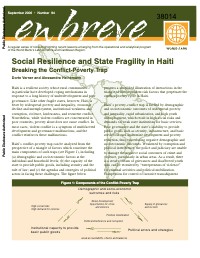
Haiti’s conflict-poverty trap can be analyzed from the
perspective of a triangle of factors which constitute the
main components of such traps (see Figure 1), including
(a) demographic and socioeconomic factors at the
individual and household levels; (b) the capacity of the
state to provide public goods, including security and the
rule of law; and (c) the agendas and strategies of political
actors in facing these challenges. The figure below
presents a simplified illustration of interactions in the
triangle of interdependent risk factors that perpetuate the
conflict-poverty cycle in Haiti.
Haiti’s poverty-conflict trap is fuelled by demographic
and socioeconomic outcomes of widespread poverty
and inequality, rapid urbanization, and high youth
unemployment, which result in high social risks and
demands on weak state institutions for basic services.
Poor governance and the state’s inability to provide
public goods such as security, infrastructure, and basic
services in turn undermine development and poverty
reduction, thus exacerbating negative demographic and
socioeconomic outcomes. Weakened by corruption and
political interference, the police and judiciary are unable
to manage the negative social outcomes of crime and
violence, particularly in urban areas. As a result, there
is a steady stream of grievances and disaffected youth
who can be recruited by “entrepreneurs of violence”
for criminal activities and political mobilization.
Competition for control of lucrative transshipment
Table 1: Rural Infrastructure Coverage Rates
4
Social Resilience and State Fragility in Haiti
Breaking the Conflict-Poverty Trap
Dorte Verner and Alessandra Heinemann
Figure 1: Components of the Conflict-Poverty Trap
Demographic and socio-economic
outcomes and risks
High social risks
High demand for services
Institutional capacity to provide
basic public goods
Political actors and strategies
Supply of grievances
and recruits
Slows Development
Opportunites for crime
and violence
Political mobilization
Political interference and corruption
weak accountability, checks and balances38014
Public Disclosure Authorized
Public Disclosure Authorized
Public Disclosure Authorized
Public Disclosure Authorized
Public Disclosure Authorized
Public Disclosure Authorized
Public Disclosure Authorized
Public Disclosure Authorized
� • September 2006 • Number 94
routes for the illegal drugs trade further compounds
these problems. Institutions cannot provide the checks
and balances necessary for the peaceful resolution of
conflicting interests, and instead some political actors
resort to illegal and violent methods. The weakness
of accountability mechanisms within state institutions
creates opportunities for political interference and
corruption, further weakening those institutions and
thereby perpetuating the conflict-poverty cycle.
Demographic and Socioeconomic Outcomes and Risks
Haiti is affected by high rates inequality and extensive
poverty, although non-income poverty has declined
in recent years. Haiti’s income distribution is among
the world’s most inequitable with a Gini coefficient of
0.66. Nearly half of Haiti’s households are trapped in
absolute poverty and live on less than a dollar a day.
Social indicators such as literacy, life expectancy, infant
mortality, and child malnutrition show that poverty
is extensive. About 40 percent of people cannot read
and write; some 20 percent of children suffer from
malnutrition; nearly half the population has no access
to healthcare; and more than four-fifths have no clean
drinking water. However, indicators suggest that non-
income poverty has declined in recent years. Access
to assets such as education, infrastructure, and basic
services is highly unequal and strongly associated with
poverty.
Especially rural areas have been long neglected
in terms of the provision of basic public goods,
which in turn fuels migration. Haiti’s enormous
social and economic inequalities reflect a history of
development neglect of secondary cities and rural
areas since independence. The result is a significantly
underdeveloped and impoverished rural sector where
basic public goods—notably physical infrastructure,
law enforcement, judicial institutions, basic services,
environmental protection, and regulatory frameworks—
are almost entirely absent. The smallholding peasant
economy is economically and technologically stagnant
and environmentally unsustainable. In response, people
are increasingly moving to the cities.
The combination of high youth unemployment, rapid
urbanization and economic stagnation creates an
explosive social situation in the metropolitan area.
Unemployment and underemployment are pervasive
among the young. Remittances from relatives living
abroad allow a large group of people to avoid taking
the lowest paid work in trade or other sectors, or to
become self-employed, but instead to remain idle and
near the poverty line. This pool of unemployed and
disaffected youth totals several hundred thousands in the
capital alone, while some 75,000 new migrants continue
to enter the metropolitan area every year. Data show
that metropolitan residents, although they have higher
material living conditions than those in rural areas, live
in fear of crime and violence. In conjunction with state
fragility and political tensions, these circumstances
create an explosive social situation unmitigated by the
institutions responsible for providing security and rule of
law.
Education is key to reducing poverty and inequality,
but access and quality remain poor. Educational
attainment in Haiti has increased over the last century,
more so in urban than rural areas, but the quality of
education remains alarmingly low. There are substantial
differences in school attendance across regions, such that
children and youths in the poorest regions fall behind
their peers in richer areas. Moreover, the children of
poor households have less education than children from
nonpoor households. For most Haitians, education is the
key strategy for alleviating poverty; it is also associated
with the reduction of inequalities. Improvements in
educational achievement indirectly mitigate the risks of
crime and conflict by enhancing opportunities. Increasing
investments in education will be crucial to reducing
poverty and inequality, as well as mitigating crime and
conflict over the longer term.
The non-state sector provides many basic services
and development efforts should focus on improving,
coordinating and regulating these public-private
partnerships. State provision of infrastructure and
basic services is limited outside Port-au-Prince and
other urban centers. In response, private providers have
made the difference between no education and some
kind of schooling for large parts of the population. The
same is true of health and other services. In rural areas
especially, the non-state sector has provided a crucial
safety net by offering access to services to a population
mostly unserved by the state. The cost of these essential
services still restricts access by substantial numbers of
the poor. Given the state’s limited resources and capacity
September 2006 • Number 94 • 3
to provide services directly, development efforts should
focus on improving the policy guidelines, coordination
mechanisms, and regulatory frameworks for public-
private partnerships.
Economic growth alone is unlikely to alleviate poverty
or mitigate conflict in the short-term, therefore targeted
interventions are necessary. Over the medium to long
term, broad-based growth is needed to alleviate the high
levels of poverty in Haiti. Economic growth is also
crucial to reducing the unemployment that contributes
to crime and violence in urban areas. Simulations of
uniform growth in all sectors, however, reveal that the
immediate impact of modest and even strong annual
growth rates on poverty reduction will be relatively small
due to the high rates of inequality. Hence growth alone
will not alleviate poverty or mitigate conflict, particularly
in the short run. Targeted interventions are thus needed to
reduce poverty, attenuate violence and protect vulnerable
groups. Strategic interventions to reduce poverty should
aim to strengthen key assets of the poor and should
set regional priorities in Haiti by taking account of
geographic variations in poverty.
Institutional Capacity to Provide Basic Public Goods
Core state institutions struggle to provide basic
conditions for security and development, in part due to
financial constraints and volatile aid flows. The Haitian
state continues to struggle to provide its citizens with
minimum public goods. With only a limited capacity
to establish security, provide basic infrastructure, and
supply services, the state has failed to create enabling
conditions for economic growth and poverty reduction,
or to prevent growing social tensions from challenging
stability. Significant financial constraints limit the state’s
capacity to be a driver of development and to respond
to social risks. In 2005, central government revenues
were only 9 percent of GDP. The public sector has been
further weakened by the volatility of aid flows—a result
of political crises, corruption, and insecurity—and the
channeling of assistance through the private sector and
NGOs.
The state’s territorial reach and local-level participation
in policy-making are very limited. Especially in rural
areas, a large part of the population has practically no
access to public services. Constitutional provisions for
political-administrative decentralization have not been
implemented. As a result there is limited local partici-
pation in policy-making and deficient communication
between the local and central levels for development
planning. This explains the reliance on private and civil
society service “providers”.
The police and the judiciary remain plagued by
weaknesses which must be addressed to create an
environment conducive to development. Efforts to
establish Haiti’s first civilian police force in the context
of peace-building in the 1990s were initially deemed
largely successful. However, increased politicization
and the weakness of accountability mechanisms within
the Haitian National Police created a climate in which
corruption and police links to criminal networks and
drug trafficking could be exploited in later years.
The judiciary is similarly weakened by corruption
and political interference, circumstances that have
undermined its independence. Strengthening the police
and judiciary are not only crucial to ensuring security
and justice; they are also necessary for the creation of an
enabling environment for investment, economic growth,
and development. Before embarking on large-scale
institutional capacity building programs, the government
and donors should establish mechanisms to prevent the
recurrence of practices that have undermined previous
reform efforts.
Unconsolidated democratic institutions and
“entrepreneurs of violence” have undermined political
leadership. Fourteen years of democratic transition in
Haiti have not led to stable governance. Within a year
of the 1990 elections, democracy was brutally repressed
by the army and its supporters, using armed paramilitary
groups that have been a feature of Haitian politics since
Duvalier’s macoutes. From President Aristide’s return in
1994, democratic consolidation was undermined by deep
conflicts among former democratic allies. The result
was a political stalemate that lasted until his departure
in 2004 and that undermined economic growth and state
building. Moreover, the stalemate transformed important
parts of the democratic movement — elements within
the urban popular organizations — into violent
government enforcers and criminal gangs that struggled
for control of territory and state favors. Their area
of operation and influence is in the urban slums and
“popular areas”, which provide an abundant pool of
potential recruits.
� • September 2006 • Number 94
Rural Haiti has remained relatively peaceful and
socially cohesive. The ability of communities and
households to work and live together by establishing
bonds of mutual trust, as well as to penalize wrongdoing,
are essential to maintaining people’s livelihoods,
security, and welfare, especially in fragile states. Social
capital indicators suggest that robust cohesion at the
community level has been crucial in preventing Haiti’s
institutional-political crisis from deteriorating into
widespread social collapse or civil war. But there are
wide urban-rural differences, and people in rural areas
feel much safer in their daily lives than city dwellers.
As the population shifts from rural to urban areas, the
robust social cohesion that has characterized rural areas
becomes less effective in mitigating social dislocation.
Restoring state capacities and reducing urban violence
are crucial to breaking Haiti’s conflict-poverty
trap. Development, poverty reduction and conflict
prevention will not be possible unless attention is paid to
strengthening the state’s capacity to provide basic public
goods, including security and the rule of law. This is
especially crucial in view of Haiti’s very limited central
government revenue base, which gives the state little
leeway even in comparison to the average among low-
income countries. Its financial and managerial resources
must be used with an exceptionally strong sense of
priorities. Violence and insecurity in the Port-au-Prince
slums in particular has undermined the political process,
fuelled conflict, and negatively affected development and
reconstruction efforts. Joint multisectoral interventions
in key urban areas that combine security and poverty
reduction objectives will be essential for creating
the conditions necessary for broad-based national
development strategies.
Political Actors and Strategies
Good leadership is central to breaking the conflict-
poverty trap and donors should reward good
governance. The most important component to achieve
a turnaround in Haiti is one that cannot be provided by
donors but only by Haitians themselves: good leadership.
Donors can support good leadership supporting the
‘demand’ for good governance and by establishing
incentives that reward good governance and penalize
the opposite. Because of the centrality of corruption in
undermining good leadership, transparency in public
finances should be a foundation for the Bank and
other donors’ assistance to the newly elected Haitian
government.
Conclusion: Breaking the Conflict-Poverty Trap
Haiti’s social resilience and social capital, its vibrant
cultural life and improvements in social indicators are
keystones to draw upon in breaking the conflict-poverty
trap. Haiti’s deep and widespread poverty results
from a long history of failure to establish even basic
enabling conditions for broad-based social and economic
development. The state has struggled to provide basic
services to the population and has been dominated
by a small elite that has made limited investments in
infrastructure and basic services.
Among the triangle of risk factors in the poverty-conflict
trap, institutional capacity-building is a key entry
point for breaking the cycle; improving demographic
and socioeconomic outcomes and supporting political
dialogue remain longer-term objectives. Institutional
reform itself, however, requires a long-term engagement.
Development, poverty reduction and conflict prevention
will not be possible without a focus on:
Strengthening the state’s capacity to provide basic
public goods, including security and the rule of law,
while using its financial and managerial resources
with an exceptionally strong sense of priority;
Reducing violence and improving security conditions
though multisectoral interventions in key urban areas
(including Cité Soleil) that addresses both security
and poverty reduction objectives;
Good leadership in Haiti, and donor support of good
leadership by establishing incentives that reward
good governance and ensure transparency in public
finances; and
Restoring core state functions – the provision of
public goods of security and rule of law, infrastructure
and basic services – while building on the existing
International Cooperation Framework and prioritizing
resources and monitoring progress, so that both
donors and the government can be held accountable
for results.
•
•
•
•
About the Authors
Dorte Verner is a Senior Economist and Alessandra
Heinemann is a Junior Professional with the Social
Development Group of the Latin America and the
Caribbean Region of the World Bank.
“en breve” is produced by the Knowledge Team of the Operations Services Department of the
Latin America and the Caribbean Region of the World Bank - http://www.worldbank.org/lac