Full Document Text
Extracted text from the original document for search indexing.
Home ▶ Research & Analysis
KEY TAKEAWAYS
Establishment of the Kenya-led security mission and transitional government are
important milestones.
Broadening multinational support is critical to building on these successes.
More robust U.S. engagement can be achieved through existing U.S. programs and
coordination with Haiti’s diaspora.
Thursday, September 5, 2024/ READ TIME: 9 minutes
BY: Georges Fauriol
Search
Share This Print the Page
Four Ways the U.S.Four Ways the U.S.
Can HelpCan Help
Advance Haiti’sAdvance Haiti’s
ProgressProgress
Lire en français
Since Haiti reached a political agreement in early April to push ahead with an “orderly
transition," much progress has been made. Mediated by the Caribbean Community
(CARICOM), that deal has a February 2026 timetable for an elected government and
parliament. Although politically and administratively wobbly, a transitional governance
structure is in place, led by a Transition Presidential Council (TPC) and Prime Minister
Garry Conille. A Kenyan-led Multinational Security Support mission (MSS) is now
active in the country and working to stabilize the security situation. Working with
Haiti’s political and civil society leadership, the country’s diaspora and key
international actors, the U.S. can help build on these milestones and pave a
sustainable path out of Haiti’s long-running crises.
The United States signaled its commitment to that endeavor this week, with Secretary
of State Antony Blinken visiting the country to assess the work of the MSS. Amid a
host of global challenges that Washington is tangling with, Blinken’s visit is the first by
a U.S. secretary of state in nearly a decade.
Conille, the new prime minister, is a visible, dynamic and a reassuring personality in
the wake of the ultimately abysmal tenure of his predecessor, Ariel Henry. Less
reassuring are the political tensions within the TPC. Some of this is the result of it
being composed of Haiti’s diverse, if not fractured, political community, and
operational tensions with Conille, in addition to the challenge of delivering clear,
timely and sustained policy messages to the average Haitian citizen. At this point,
none of these political concerns are insurmountable — in part due to the deployment
of the MSS.
For most Haitians, these developments suggest a more hopeful shift regarding their
immediate future — moving from generalized mayhem to a sense that someone
cares. However, the daily reality for many in the Port-au-Prince region, in particular,
has not changed that much and some of the initial joint Haitian National Police- (HNP)
MSS operations have had the unnerving result of highlighting the disjointed character
of the international response to Haiti’s security crisis.
Part of the problem here is one of perception and confused messaging. The issue is
not just that the Kenyan contingent at its fullest (1,000) will be insufficient to address
the full range of security challenges, but that the MSS is perceived by too many as
replicating previous U.N. peacekeeping missions. Although the U.N. Security Council
approved the MSS in October 2023 (and needs to renewed it by October 2), it is not a
conventional U.N. peacekeeping operation. Instead, it is designed primarily to support
the depleted capacity of the HNP as it eventually moves toward an effective law
enforcement arm of the government. Beyond clarity about its mission, the MSS also
needs to devise and synchronize logistical, intelligence, medical and other basic
military operational support functions, as well as the legal/human rights monitoring
capacity. On top of that, is the often-delicate management of relations with the host
government and local community relations.
For most Haitians, these developments
suggest a more hopeful shift regarding
their immediate future — moving from
generalized mayhem to a sense that
someone cares.”
“
Haitian Civil Society Is Ready to get to Work
Many of these challenges can be addressed by Haiti’s transitional government. And
contrary to the public perception of Haiti as a lost cause, the country retains a robust
civil society community likely to play key roles in the transition process and follow-on
consolidation. For example, the recent formation of a monitoring committee (Comité
de Pilotage) for the National Conference — the latter a key component of the April
political accord — is encouraging. It represents the first step toward the key
milestones needed to achieve a democratic transition in February 2026: adopting
consensus and operational language framing revisions to the 1987 constitution,
redefining the societal compact between the state and civil society and political
parties, and identifying key reforms to the nation’s judicial system.
Likewise, a civil society-led undertaking, the Groupe d’Assistance à la Transition
(GAT), was launched recently in response to requests from the TPC and Conille. They
both face the practical implications of a complex decision-making agenda while the
transition clock is ticking. The GAT’s mission includes mobilizing the participation of
social, economic and political stakeholders, as well as providing a potential
interlocutor to the international community’s engagement in transition-related efforts.
Another encouraging move was Conille leading a government delegation to the
northern port city of Cap-Haitian the last week of August, along with a large group of
diplomatic representatives from the U.S., Canada, France, Spain, Mexico, Chile,
Switzerland, the U.N. and the EU. Not only was he reaching out beyond Port-au-Prince
but he used the opportunity to confirm his governance priorities: addressing the
security and humanitarian crises, strengthening the judiciary, reenergizing the
economy, and moving ahead with a constitutional reform and national elections.
Critically, he did so by underscoring the key role that international partners will have
to play to achieve these goals. One can interpret this as a direct appeal to
But Haiti Still Needs a lot of Help from Its Friends
Washington and other key capitals that the reversal of Haiti’s downward trajectory can
only be sustained with more energetic international support.
Even amid a host of competing global crises, the upcoming U.N. General Assembly
provides a useful multilateral platform to focus on Haiti. But getting that focus requires
additional actions by the U.S. government. Although pre-occupied with other
domestic and foreign policy challenges, Washington should be reassured by the fact
that the U.S. has played an important role in advances made so far, including the
deployment of the MSS and CARICOM’s successful mediation of the April 2024
Haitian political agreement and ensuing establishment of the TPC. But to be
sustained, these achievements now require a second act.
Over the next 90 days, Washington’s diverse decision-making centers and networks
need to pursue specific actions:
1. Keep up with security challenges. While the Kenyan MSS is being deployed, there
remains a lack of clarity as to how and when other contingents will deploy. Although the
U.S. does not have to be the sole funder, it is nonetheless the chief fundraiser and
needs to do more diplomatic heavy lifting to get others, especially in the hemisphere, to
ante up. Blinken’s visit should help in this regard. Supporting the MSS can go beyond
funding, including training, logistical support and medical services. The painful reality on
the ground is that the longer the currently limited Kenyan MSS deployment appears to
flounder, the more Haiti’s gangs will expand their violence geographically and be
emboldened to assume they can graduate to a political role in national politics.
2. Economic recovery and infrastructure resilience. Two existing U.S. Haiti-related
initiatives could make a significant difference, but require action:
Provide employment: The most immediate are theHaitian Hemispheric Opportunity
through Partnership Encouragement (HOPE) and the Haiti Economic Lift Program
(HELP) acts, which allow U.S. duty-free access for apparel and textile products
What Washington Can Do
produced in Haiti. HOPE/HELP is due to expire September 2025, and its uncertain
prospects imply that long-term production contracts are already being diverted away
from Haiti. For a program that has represented over 80% of Haiti’s total exports, its
demise would be catastrophic.
Ensure Longevity of Assistance: The other longer term U.S. policy initiative relates to
Haiti’s inclusion under the Global Fragility Act (GFA), renamed the Strategy to
Prevent Conflict and Promote Stability. Its virtue lies in its 10-year timeframe, unified
conceptual approach and locally led assistance vision. Significantly, it is designed to
go beyond addressing insecurity by building ways to mitigate future crises through
constructing institutional resiliency by empowering a cross-section of Haitian public,
private, and civil society institutions. Although some preparatory work is underway,
operationalizing the GFA now would merge with a critical need in Haiti today —
ensuring that key institutions remain viable and capable of contributing to the
rebuilding of a resilient society.
This support would be timely for Haiti’s struggling and overwhelmed transitional
governance apparatus. Another example could be to provide direct support to Haiti’s
few institutions of higher learning, whose student body constituency is disappearing
due to insecurity — affecting not only the financial viability of those institutions but
also the ability to generate home-grown policy solutions to Haiti’s crises. This will be
a factor in reversing the emigration of Haiti’s talent pool.
3. Mobilize the diaspora. During Conille’s visit to Washington in July, he sought to
energize the Haitian diaspora toward a more active role in restoring Haiti’s governance,
security and development. In doing so, he highlighted the diaspora’s potential as an
asset to U.S. efforts to address Haiti’s crises. But unlike other established diaspora
communities, Haiti’s lacks a unified voice and strategic focus. That needs to change
quickly. Whether it is encouraged through Haitians diaspora initiatives, lessons learned
from other Caribbean diaspora policy efforts, an extra push from Haiti-related U.S.
advocacy groups, or even Capitol Hill’s limited Haiti-related constituency, the time is
now to translate initial success into sustainable initiatives capable of making real
change.
4. Unify and clarify U.S. strategy. In fact, the near-term successes of U.S. policies on Haiti
are linked to a global agenda of relationships: Washington’s close-in Caribbean context;
key Latin American actors; support from traditional Haiti-policy allies like Canada,
France and the EU along with other supporters like Japan and South Korea; multilateral
donor diplomacy, particularly at the World Bank and the Inter-American Development
Bank; as well as diplomatic forums like the U.N. and Organization of American States.
These are critical to the international community’s engagement in Haiti and their ability
to row in the same direction will be key to success. Many look to the U.S. to help
provide a unifying strategy.
Cumulatively, the above actions can clarify the various strands of U.S. strategy. The
operating term here is “clarify”; the challenge is not so much the absence of a strategy
as its disaggregated character. This points to the expanding demands that U.S.
engagement toward Haiti is making on layers of U.S. government capabilities and
resources, let alone the global complexities of productively managing the diplomacy of
U.S. Haiti policy.
On the outer edges of all the work to address Haiti’s crisis — exemplified by Kenya’s
engagement — is the need to conceptualize the global context of Haiti’s crisis and
how the U.S. cultivates a diverse environment increasingly being characterized as the
Global South. Much of the needed energy can feed on the measurable achievements
of the last 90 days, as well as a necessary engagement of international civil society
networks including Haiti’s own U.S.-based diaspora. To be sustainable, this requires
follow-on actions.
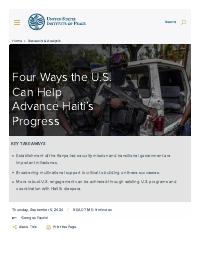
PHOTO: The Haitian police patrolling the mostly empty streets of Pétionville, Haiti on Monday, Oct. 18,
2021. (Adriana Zehbrauskas/The New York Times)
The views expressed in this publication are those of the author(s).
PUBLICATION TYPE: Analysis
How to Break Gangs’ Grip on Haiti
Ki Sa Siksè Politik Etazini ta Dwe Sanble an Ayiti?
RELATED RESEARCH & ANALYSIS
À quoi ressemble le succès de la politique américaine en Haïti?
What Does U.S. Policy Success Look Like in Haiti?
View All Research & Analysis
COUNTRIES
Haiti
USIP has a variety of newsletters and announcements with the latest analysis, publications
and events.
STAY INFORMED
2301 Constitution Avenue NW, Washington, DC 20037
Tel: +1.202.457.1700
About USIP
Countries & Regions
Research & Analysis
Gandhi-King Global Academy
Legal and Privacy Information | FOIA InquiriesThe United States Institute of Peace
Sign up!
Connect Press Projects
The Olive Branch Blog