
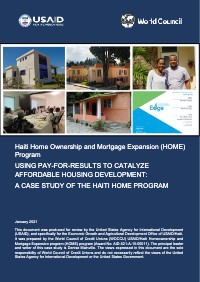
Using Pay-for-Results to Catalyze Affordable Housing Development: A Case Study of the Haiti HOME Program
- PfR can be effectively deployed to achieve development goals in challenging environments.
- HOME catalyzed the construction and sale of Haiti’s first commercially driven affordable housing.
- The program led to the establishment of Haiti’s first mortgage instrument tailored to low- and middle-income buyers.
- HOME leveraged USD 25.9 million in private sector investment using less than USD 3 million in financial incentives.
- The program stimulated entrepreneurial innovation, motivating private sector partners to leverage their own resources.
The Haiti Home Ownership and Mortgage Expansion (HOME) program, a five-year, USD 10 million USAID-funded initiative implemented by the World Council of Credit Unions (WOCCU), aimed to catalyze the development of an affordable housing market in Haiti using a Pay-for-Results (PfR) model. This case study leverages the experience of Haiti HOME to showcase the potential of PfR in achieving meaningful development outcomes and the challenges inherent in its design and implementation. The program incentivized private sector investment in affordable housing supply and supported property developers in building capacity for international building best practices. On the demand side, it developed Haiti’s first credit union-issued mortgage product, targeting lower-income households underserved by commercial banks.
How to cite
United States Agency for International Development (USAID), 2021, Using Pay-for-Results to Catalyze Affordable Housing Development: A Case Study of the Haiti HOME Program, accessed via HaitiDocs, https://www.haitidocs.org/doc/usaid-2021-using-pay-results-catalyze