
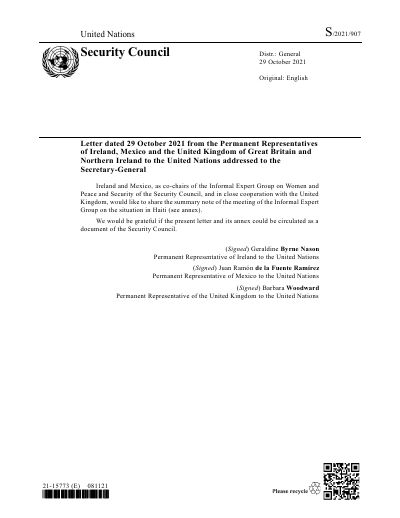
S/2021/907: Informal Expert Group on Women and Peace and Security, summary of the meeting on Haiti of 29 September 2021
Summary — The Security Council's Informal Expert Group on Women and Peace and Security met on Haiti on 29 September 2021, two months after the assassination of the President. BINUH head Helen La Lime briefed it, UN-Women set out recommendations, and members asked about gender considerations in the political agreement then under negotiation.
Key Findings
- The Informal Expert Group on Women and Peace and Security convened on Haiti on 29 September 2021, co-chaired by Ireland and Mexico in cooperation with the United Kingdom.
- Members were briefed by Helen La Lime, Special Representative of the Secretary-General and Head of BINUH, with representatives of the United Nations country team.
- UN-Women closed the meeting with an overview of its key recommendations.
- Council members asked about gender considerations in the political agreement then under negotiation and about the obstacles to women's participation.
- It reaches the Council as a document circulated by the three permanent representatives. The Secretariat did not author it.
Full Document Text
Extracted text from the original document for search indexing.
S/2021/907
United Nations
Security Council
Distr.: General
29 October 2021
Original: English
Letter dated 29 October 2021 from the Permanent Representatives
of Ireland, Mexico and the United Kingdom of Great Britain and
Northern Ireland to the United Nations addressed to the
Secretary-General
Ireland and Mexico, as co-chairs of the Informal Expert Group on Women and
Peace and Security of the Security Council, and in close cooperation with the United
Kingdom, would like to share the summary note of the meeting of the Informal Expert
Group on the situation in Haiti (see annex).
We would be grateful if the present letter and its annex could be circulated as a
document of the Security Council.
(Signed) Geraldine Byrne Nason
Permanent Representative of Ireland to the United Nations
(Signed) Juan Ramón de la Fuente Ramírez
Permanent Representative of Mexico to the United Nations
(Signed) Barbara Woodward
Permanent Representative of the United Kingdom to the United Nations
21-15773 (E)
081121
*2115773*
S/2021/907
Annex to the letter dated 29 October 2021 from the Permanent
Representatives of Ireland, Mexico and the United Kingdom of
Great Britain and Northern Ireland to the United Nations
addressed to the Secretary-General
Informal Expert Group on Women and Peace and Security of the
Security Council
Summary of the meeting on Haiti held on 29 September 2021
On 29 September 2021, the Informal Expert Group on Women and Peace and
Security convened a meeting on the situation in Haiti. The members were briefed by
the Special Representative of the Secretary-General for Haiti and Head of the United
Nations Integrated Office in Haiti (BINUH), Helen La Lime, accompanied by
representatives of the United Nations country team. The meeting concluded with an
overview of key recommendations provided by the United Nations Entity for Gender
Equality and the Empowerment of Women (UN-Women).
Questions from Council members
Members of the Security Council asked questions about gender considerations
in the recent political agreement; challenges for women’s participation in politics and
steps taken to support women candidates; violence against women human rights
defenders; plans for the adoption of a national action plan on Council resolution 1325
(2000); gender components in BINUH programmes on disarmament, demobilization
and reintegration; the mission’s engagement with women’s organizations; Haiti’s new
penal code; women’s access to justice and services for survivors of sexual and genderbased violence; the high rates of pretrial detention for women; sexual exploitation
and abuse committed by peacekeepers; gendered impacts of climate -related security
risks and lessons learned from the 2010 earthquake; women’s leadership in
humanitarian efforts, disaster risk reduction, and climate resilience and recovery;
women’s access to menstrual products during emergencies; actions targeted towards
migrant women; gender gaps in the Haitian vaccination campaign; women’s
participation in the formal and informal economy; access to funding for women’s
organizations; and the budget of the Ministry of Women’s Affairs and Rights.
Main points raised in the meeting
• Women are extremely marginalized in politics and public life. The
representation of women in the most recent Haitian Parliament was among the
lowest in the world, with less than 3 per cent of elected parliamentarians.
Violence against women in politics, including during elections, is rampant, and
women leaders are often subject to threats and smear campaigns. The violent
political climate and prevailing misogyny within political parties limit women ’s
participation in public affairs and campaign funding for women candidates.
• A project of UN-Women and the United Nations Development Programme,
supported by the Peacebuilding Fund, is building capacity in the Provisional
Electoral Council, the Haitian National Police and women’s groups to prevent,
mediate and manage electoral conflicts and violence. With the support of the
Government of Canada, UN-Women is building the capacity of up to 80
potential women candidates running in the upcoming elections.
• The Haitian Women National Forum for Peace and the National Forum on
Women, Peace and Political Participation have stressed the importance of
developing a national action plan on women and peace and security. One of their
2/5
21-15773
S/2021/907
most urgent priorities is the need to strengthen the capacity of the State to ensure
security and respond to all types of violence perpetrated against women.
• There is political willingness to enhance women’s participation, and in his
governance pact of 11 September 2021, the Prime Minister reiterates the
requirement for a minimum 30 per cent quota of women in all institutions.
However, the current draft of the constitution does not address gender issues
adequately. The newly appointed Supreme Court does not include women.
• Opportunistic violence against women and girls, including gang violence, is a
constant threat. Over the course of their lives, one out of every three women in
Haiti will suffer violence, and at least 12 per cent of girls under the age of 18
will be raped. Furthermore, in the past 12 months, 7,990 cases of gender-based
violence were reported by health facilities in the country, 26 per cent of which
involved children. The number of rape cases registered by the police and the
number of cases of sexual violence registered by service providers differ
significantly. Reasons for this discrepancy include a lack of trust in the judicial
system, and informal arrangements between the perpetrator and the victim.
BINUH has supported the Government in developing an anti -gang strategy, and
the Spotlight Initiative has provided assistance to more than 6,000 wo men and
girl survivors of violence. While there has been an increase in funding for sexual
and gender-based violence services and women’s health, it remains an
underfunded area, and the gap in services remains high in rural areas. Only 10.7
per cent of police officers are women.
• The United Nations, with the support of a dedicated trust fund, provides
assistance to 31 victims and 37 children born out of sexual exploitation and
abuse committed by former peacekeepers, from 17 different Member States. In
addition, the Prevention of Sexual Exploitation and Abuse network is raising
awareness within communities. The Special Representative of the Secretary General for Haiti urged Member States to give their full support to the survivors
and their children to resolve pending paternity and child support claims. The
pretrial detention rate for women stands at 90 per cent, among the highest in the
world. Through local organizations supported by the Peacebuilding Fund, 60 per
cent of women in prolonged pretrial detention are now being legally assisted.
UN-Women trained prison staff on the Bangkok Rules and is raising awareness
among women detainees of their rights.
• The Special Representative of the Secretary-General called upon donors to
respond to the August humanitarian flash appeal for $187.3 million. Lessons
learned from the 2010 earthquake include the importance of supporting the
national economy, working closely with civil society, and national ownership
and coordination. Local and national authorities, such as the Ministry of
Women’s Affairs and Rights, must be strengthened.
• According to a rapid gender analysis conducted by UN-Women and CARE,
women and girls are the most affected of the 800,000 survivors of the earthquake
in August 2021 and are exposed to higher levels of domestic violence owing to
open-space living, a higher loss of revenue and a higher risk of negative coping
strategies.
• According to the rapid assessment of reproductive health and gender-based
violence led by the United Nations Population Fund, 22,000 women are
expected to give birth in the earthquake zone, and 4,000 of them will have
complications. Over 50 per cent of existing safe spaces are no longer safe after
the earthquake, which necessitates the setting up of mobile spaces for survivors.
Haiti is the country with the highest maternal mortality rate in the Western
21-15773
3/5
S/2021/907
hemisphere, with an average of three women dying per day of causes related to
childbirth.
• More than 900 schools have been destroyed or damaged by the eart hquake. The
United Nations Children’s Fund (UNICEF) and other agencies are supporting
the Ministry of Education with an integrated package, including to prevent
school dropouts and the abuse of girls.
• UNICEF issued a statement on 23 September 2021 regarding the migrant crisis
in which it urged the authorities to refrain from any use of force at borders, to
keep families together and to properly assess the protection needs of migrants
before any decision on their return was made. Its early estimates indi cated that
two thirds of migrant returnees were women and children. UNICEF and the
International Organization for Migration are providing protection and
psychosocial support to children arriving from Mexico, the United States of
America and other countries at two airports and the port of Cap-Haïtien.
• The Women’s Peace and Humanitarian Fund has supported 28 women’s rights
organizations in Haiti in implementing programmes ranging from helping
internally displaced women affected by gang-violence to reaching disabled
women affected by gender-based violence. The Fund approved a new allocation
that will result in the launch of a new call for proposals to support women’s
organizations in their response to the earthquake.
• High levels of poverty, a lack of security and limited access to basic services,
including education for girls, continue to severely affect women’s well -being
and their socioeconomic standing. Nevertheless, women play a major role in the
formal and informal economies. They make up 48 per cen t of the economically
active population and 82 per cent of the business sector. The garment and
apparel sector, which represents 90 per cent of the country’s manufacturing
exports and in which 70 per cent of the workforce are women, was the hardest
hit by the economic fallout of the coronavirus disease (COVID -19) pandemic.
Women also represent a disproportionate share of the informal economy centred
on subsistence agriculture, open-air markets and communal kitchens, in which
the unemployment rate of women has also increased. A $75 million World Bank
initiative provides immediate support to poor and vulnerable households
through regular cash transfers and measures to improve health, nutrition, and
access to finance, and builds the capacity of the Ministry of Social Affairs and
Labour to improve the management and governance of social protection
programs. UN-Women provides support to rural women in the south affected by
the earthquake through an economic empowerment programme financed by the
Government of Norway.
• As at 31 August 2021, women make up 38.1 per cent of staff overall, 39.4 per
cent of national staff, 34.1 per cent of international staff and 33 per cent of
uniformed personnel of BINUH. Of the 21 United Nations entities in Haiti, only
two are led by women. The Resident and Humanitarian Coordinator encouraged
Member States to push, in United Nations agency boards, for stronger
representation of women in United Nations leadership positions.
Recommendations
The following recommendations were made by UN-Women, as the secretariat
of the Informal Expert Group: 1
__________________
1
4/5
These recommendations are suggestions from United Nations participants in this meeting or the
background note prepared by the secretariat of the Informal Expert Group ahead of the meeting,
and not recommendations from the Informal Expert Group as a whole or Council members.
21-15773
S/2021/907
(a) In view of the upcoming negotiations on the mandate of BINUH, the
Security Council should retain all existing references to women and peace and
security in both the preamble and operative paragraphs of Council resolutions 2476
(2019) and 2547 (2020), and should consider adding the following:
(i) Calls for the full participation of women at all levels of the process leading
to presidential and parliamentary elections and requests BINUH to support the
Government of Haiti in strengthening the participation of women in this process
as voters, candidates and administrators;
(ii) Requests BINUH to work with United Nations agencies to support,
engage, and consult with women’s civil society organizations in all their
diversity, at all levels and in all areas of its work;
(iii) Calls upon the United Nations and other internation al partners to support
the Government of Haiti in the development and implementation of a national
action plan on women and peace and security;
(iv) Calls upon all Member States to provide funding for the trust fund in
support of victims of sexual exploitation and abuse; welcomes the efforts taken
by BINUH to address sexual exploitation and abuse and to improve support to
survivors; and calls upon troop- and police-contributing countries to hold
perpetrators of sexual exploitation and abuse to account and to facilitate the
resolution of paternity and child support claims.
(b) In addition, the Co-Chairs of the Informal Expert Group and other Council
members should do the following:
(i) Urge that all humanitarian efforts in response to the earthquake be ba sed
on gender analysis, be gender-responsive, mainstream protection activities
across all sectors and support the Government of Haiti in strengthening the
capacities of State institutions in that regard;
(ii) Urge that women’s organizations be included in humanitarian and disaster
risk coordination mechanisms at the national, departmental and local levels, and
support investments in the capacity and resources of women’s organizations in
preventing and responding to disasters;
(iii) Provide direct financial support to women-led local peacebuilding
initiatives, including through long-term and flexible funding for civil society
organizations, and support coalition-building among women’s networks and the
mobilization of women as peace mediators at the commun ity level;
(iv) Strengthen efforts to enhance women’s economic security and rights,
including access to finance and other opportunities to rebuild their livelihoods;
(v) Continue to support the capacity of the State to respond to all types of
violence against women and girls;
(vi) In the lead-up to the postponed elections, Council members and other
international partners could scale up investment in women’s political leadership
through capacity-building for women leaders, the prevention of electoral
violence against women, and a national campaign to promote women’s political
leadership.
The Co-Chairs thanked the Special Representative of the Secretary-General for
Haiti and all participants, and committed to following up on the important issues
raised at the meeting.
21-15773
5/5
How to cite
United Nations Security Council, S/2021/907: Informal Expert Group on Women and Peace and Security, summary of the meeting on Haiti of 29 September 2021, https://docs.un.org/en/S/2021/907
- Rights holder
- United Nations Security Council