
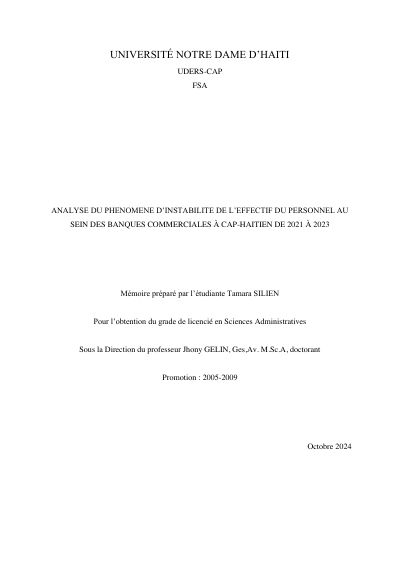
Analysis of Staff Instability in Commercial Banks in Cap-Haïtien, 2021 to 2023
- The study sets out to identify the factors behind staff instability in commercial banks in Cap-Haïtien from 2021 to 2023.
- Interviews with current and former bank employees point to job dissatisfaction as the main driver of resignations.
- Participants describe a rigid hierarchy, stress and little support from management, which weaken their sense of security.
- Participants also report limited chances of advancement and a feeling of being undervalued.
- The author finds that the American humanitarian program and insecurity are not the main causes and that poor human resource management is the underlying cause.
- The thesis recommends salary adjustments, benefits and rewards, evaluation and continuing training, and open communication between employees and management.
The thesis asks what determines staff instability in the commercial banks of Cap-Haïtien between 2021 and 2023. It reviews the work of three authors on the subject and interviews current and former bank employees by WhatsApp, selected by purposive sampling.
The author concludes that job dissatisfaction drives resignations: participants cite pay, recognition, job security, career advancement and a rigid hierarchy with weak support from management. She finds that the American humanitarian immigration programs and insecurity are not the main causes and are an opportunity for frustrated employees to leave, and that the basic cause is poor human resource management. The thesis recommends salary adjustments, benefits and rewards, evaluation and continuing training, and open communication between staff and management.
How to cite
Université Notre-Dame d'Haïti (UDERS-CAP), 2024, Analysis of Staff Instability in Commercial Banks in Cap-Haïtien, 2021 to 2023, https://lescientifique.org/wp-content/uploads/2025/07/Version-finale-Memoire-de-Tamara-Silien.pdf
- Rights holder
- Université Notre-Dame d'Haïti (UDERS-CAP)