Full Description
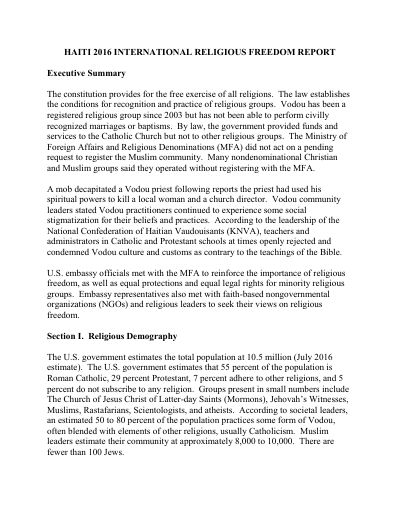
The Haiti chapter of the United States Department of State's International Religious Freedom Report for 2016, prepared by the Bureau of Democracy, Human Rights, and Labor and submitted to Congress under the International Religious Freedom Act of 1998.
It sets out the legal framework: the constitution provides for the free exercise of all religions and protects against compelled membership of a religious group. The Ministry of Foreign Affairs and Religious Denominations administers the laws on religious groups, and its Bureau of Worship registers religious buildings, clergy and missionaries. Registration confers standing in legal disputes, tax-exempt status and customs exemption, and civil recognition of marriage and baptismal certificates. An 1860 concordat with the Holy See remains in force, under which the Vatican approves and selects a set number of bishops with the government's consent and the state pays Catholic priests a monthly stipend.
On government practice, the report records that Vodou, registered since 2003, still could not have its marriage and baptism ceremonies recognised; that the ministry neither acted on nor explained its inaction over a pending application to register Islam, so Muslims had to obtain civil marriage licences while Christian clergy could conduct recognised ceremonies; that the state continued to fund the upkeep of Catholic churches and some Catholic schools while the Protestant Federation said in May the same support remained unavailable to other groups; and that limited institutional capacity restricted religious services for Muslim prisoners, particularly outside Port-au-Prince.
On societal respect, it reports that a mob decapitated a Vodou houngan in the town of Toman in May, in the belief that he had caused two deaths, and that no one was charged. Vodou leaders reported continued social stigmatisation, and the National Confederation of Haitian Vaudouisants said teachers and administrators in Catholic and Protestant schools at times openly condemned Vodou culture as contrary to the Bible.
The final section records United States policy: embassy officials met the minister of foreign affairs and religious denominations to press for equal treatment and for registration of groups that had completed the procedure, and met faith-based non-governmental organisations and Protestant, Catholic and Vodou leaders.
Full Document Text
Extracted text from the original document for search indexing.
HAITI 2016 INTERNATIONAL RELIGIOUS FREEDOM REPORT
Executive Summary
The constitution provides for the free exercise of all religions. The law establishes
the conditions for recognition and practice of religious groups. Vodou has been a
registered religious group since 2003 but has not been able to perform civilly
recognized marriages or baptisms. By law, the government provided funds and
services to the Catholic Church but not to other religious groups. The Ministry of
Foreign Affairs and Religious Denominations (MFA) did not act on a pending
request to register the Muslim community. Many nondenominational Christian
and Muslim groups said they operated without registering with the MFA.
A mob decapitated a Vodou priest following reports the priest had used his
spiritual powers to kill a local woman and a church director. Vodou community
leaders stated Vodou practitioners continued to experience some social
stigmatization for their beliefs and practices. According to the leadership of the
National Confederation of Haitian Vaudouisants (KNVA), teachers and
administrators in Catholic and Protestant schools at times openly rejected and
condemned Vodou culture and customs as contrary to the teachings of the Bible.
U.S. embassy officials met with the MFA to reinforce the importance of religious
freedom, as well as equal protections and equal legal rights for minority religious
groups. Embassy representatives also met with faith-based nongovernmental
organizations (NGOs) and religious leaders to seek their views on religious
freedom.
Section I. Religious Demography
The U.S. government estimates the total population at 10.5 million (July 2016
estimate). The U.S. government estimates that 55 percent of the population is
Roman Catholic, 29 percent Protestant, 7 percent adhere to other religions, and 5
percent do not subscribe to any religion. Groups present in small numbers include
The Church of Jesus Christ of Latter-day Saints (Mormons), Jehovah’s Witnesses,
Muslims, Rastafarians, Scientologists, and atheists. According to societal leaders,
an estimated 50 to 80 percent of the population practices some form of Vodou,
often blended with elements of other religions, usually Catholicism. Muslim
leaders estimate their community at approximately 8,000 to 10,000. There are
fewer than 100 Jews.
�HAITI
2
Section II. Status of Government Respect for Religious Freedom
Legal Framework
The constitution provides for the free exercise of all religions and establishes laws
to regulate the registration and operation of religious groups. The constitution
protects against being compelled to belong to a religious group contrary to one’s
belief. The MFA is responsible for monitoring and administering laws relating to
religious groups, while the Bureau of Worship, an office within the ministry, is
responsible for registering churches and other religious buildings, clergy, and
missionaries of various religious denominations.
An 1860 concordat between the Holy See and the state remains in effect and gives
the Vatican power to approve and select a specific number of bishops in the
country with the consent of the government. Under the concordat, the government
provides a monthly stipend to Catholic priests. Catholic and Episcopalian bishops
have official license plates and carry diplomatic passports.
All religious groups are legally required to register with the MFA. Registration
affords religious groups standing in legal disputes, provides tax-exempt status, and
extends civil recognition to documents such as marriage and baptismal certificates,
which are issued in a similar way to birth certificates. The government does not
tax registered religious groups and exempts their imports from customs duties.
Requirements for registration include information on qualifications of the group’s
leader, a membership directory, and a list of the group’s social projects.
Registered religious groups must submit annual updates of their membership,
projects, and leadership to the MFA. Foreign missionaries are required to submit
registration paperwork to operate privately funded clinics, schools, and
orphanages.
The country is a party to the International Covenant on Civil and Political Rights.
Government Practices
Although Vodou was registered in 2003, the government continued not to
recognize Vodou marriage and baptism ceremonies. The MFA continued to accept
applications requesting such recognition.
The MFA did not act on a pending request for registration of Islam as a religious
group or communicate an explanation for the inaction to the National Council of
International Religious Freedom Report for 2016
United States Department of State • Bureau of Democracy, Human Rights, and Labor
�HAITI
3
Muslims. Muslims were required to obtain civil marriage licenses while Christian
clergy were able to conduct government-recognized ceremonies.
The government continued to provide financial support for the maintenance of
Catholic churches and some Catholic schools. Despite ongoing negotiations
between the Protestant Federation and the MFA, the Protestant Federation said in
May that the system of financial support was still unavailable to other religious
groups.
Muslims and many nondenominational Christian groups stated they operated freely
without formal registration.
Government sources stated their continued limited institutional capacity restricted
their ability to provide the full range of religious services for prisoners requested
by Muslims, particularly in facilities outside of Port-au-Prince. Volunteers
provided religious services in some prisons, and prisoners were unhindered from
exercising their religious beliefs.
Protestant and Catholic clergy continued to report good working relationships with
the government. The Catholic Church and Protestant groups operated schools and
provided numerous social services.
Section III. Status of Societal Respect for Religious Freedom
According to media reports, a mob decapitated a Vodou houngan – a male Vodou
priest – in the town of Toman in May. Members of the community reportedly
believed the houngan had used his spiritual powers to cause the death of a local
woman and a former director of a local church. No one was charged in the case.
According to the MFA, while many Christians were tolerant of Vodouism, others
rejected it as incompatible with their beliefs. Vodou community leaders stated
Vodou practitioners continued to experience some social stigmatization for their
beliefs and practices. The KNVA leadership stated that in Catholic and Protestant
schools, teachers and administrators at times openly rejected and condemned
Vodou culture and customs as contrary to the teachings of the Bible.
Section IV. U.S. Government Policy
U.S. embassy representatives met regularly with government officials, including
the minister of foreign affairs and religious denominations, to advocate for fair and
International Religious Freedom Report for 2016
United States Department of State • Bureau of Democracy, Human Rights, and Labor
�HAITI
equal treatment for all religious groups as well as to advocate for registration of
religious groups that have completed the requisite registration procedures.
Embassy officials met with faith-based NGOs and religious leaders in the
Protestant, Catholic, and Vodou communities to discuss their views on religious
freedom, clergy, and marriage recognition, as well as on the registration of
religious minority clergy. In meetings with religious leaders, embassy officials
stressed the importance of religious freedom and tolerance and discussed the
influential role of religion in society.
International Religious Freedom Report for 2016
United States Department of State • Bureau of Democracy, Human Rights, and Labor
4
�