Deskripsyon Konple
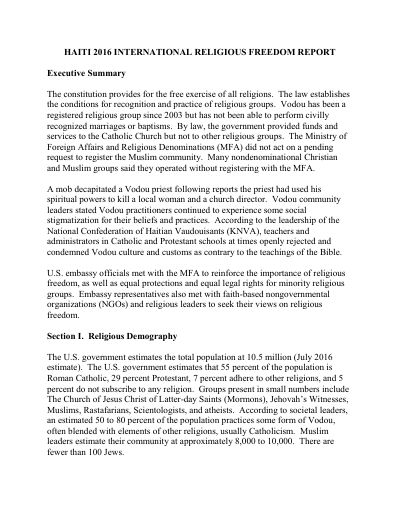
Chapit Ayiti nan rapò Depatman Deta Etazini an sou libète relijyon nan mond lan pou 2016, Biwo demokrasi, dwa moun ak travay la prepare epi voye bay Kongrè a dapre lwa International Religious Freedom Act 1998 la.
Li prezante kad legal la: konstitisyon an bay tout relijyon dwa pratike lib epi li pwoteje moun kont obligasyon pou yo antre nan yon gwoup relijye. Ministè Afè Etranjè ak Kilt yo jere lwa sou gwoup relijye yo, epi Biwo Kilt li a anrejistre kay relijye, klèje ak misyonè. Anrejistreman an bay dwa pou ale nan tribinal, egzansyon taks ak ladwàn, epi rekonesans sivil pou sètifika maryaj ak batèm. Konkòda 1860 la ak Sen Syèj la toujou an vigè: Vatikan an apwouve epi chwazi yon kantite evèk fiks ak akò gouvènman an, epi leta peye prèt katolik yo yon alokasyon chak mwa.
Sou pratik gouvènman an, rapò a note vodou, ki anrejistre depi 2003, toujou pa t gen maryaj ak batèm li yo rekonèt; ministè a pa t deside ni esplike silans li sou yon demann pou anrejistre Islam, kidonk mizilman yo te oblije pran lisans maryaj sivil pandan klèje kretyen yo te ka fè seremoni leta rekonèt; leta te kontinye finanse antretyen legliz katolik ak kèk lekòl katolik, epi Federasyon pwotestan an te di nan mwa me sipò sa a te toujou fèmen pou lòt gwoup; epi mank mwayen enstitisyonèl te limite sèvis relijye pou prizonye mizilman, sitou andeyò Pòtoprens.
Sou respè nan sosyete a, li rapòte yon foul moun te koupe tèt yon oungan nan bouk Toman nan mwa me, paske yo te kwè li te lakòz de lanmò, epi pèsonn pa t akize. Responsab vodou yo pale de yon stigmatizasyon sosyal ki kontinye, epi Konfederasyon nasyonal vodouyizan ayisyen yo di pwofesè ak direktè nan lekòl katolik ak pwotestan pafwa kondane kilti vodou an piblikman kòm yon bagay ki kontrè ak Bib la.
Dènye seksyon an dekri politik Etazini: responsab anbasad la te rankontre minis Afè Etranjè ak Kilt yo pou mande tretman egal ak anrejistreman pou gwoup ki fin ranpli pwosedi a, epi yo te rankontre òganizasyon non gouvènmantal relijye ak responsab pwotestan, katolik ak vodou.
Teks Konple Dokiman an
Teks ki soti nan dokiman orijinal la pou endeksasyon.
HAITI 2016 INTERNATIONAL RELIGIOUS FREEDOM REPORT
Executive Summary
The constitution provides for the free exercise of all religions. The law establishes
the conditions for recognition and practice of religious groups. Vodou has been a
registered religious group since 2003 but has not been able to perform civilly
recognized marriages or baptisms. By law, the government provided funds and
services to the Catholic Church but not to other religious groups. The Ministry of
Foreign Affairs and Religious Denominations (MFA) did not act on a pending
request to register the Muslim community. Many nondenominational Christian
and Muslim groups said they operated without registering with the MFA.
A mob decapitated a Vodou priest following reports the priest had used his
spiritual powers to kill a local woman and a church director. Vodou community
leaders stated Vodou practitioners continued to experience some social
stigmatization for their beliefs and practices. According to the leadership of the
National Confederation of Haitian Vaudouisants (KNVA), teachers and
administrators in Catholic and Protestant schools at times openly rejected and
condemned Vodou culture and customs as contrary to the teachings of the Bible.
U.S. embassy officials met with the MFA to reinforce the importance of religious
freedom, as well as equal protections and equal legal rights for minority religious
groups. Embassy representatives also met with faith-based nongovernmental
organizations (NGOs) and religious leaders to seek their views on religious
freedom.
Section I. Religious Demography
The U.S. government estimates the total population at 10.5 million (July 2016
estimate). The U.S. government estimates that 55 percent of the population is
Roman Catholic, 29 percent Protestant, 7 percent adhere to other religions, and 5
percent do not subscribe to any religion. Groups present in small numbers include
The Church of Jesus Christ of Latter-day Saints (Mormons), Jehovah’s Witnesses,
Muslims, Rastafarians, Scientologists, and atheists. According to societal leaders,
an estimated 50 to 80 percent of the population practices some form of Vodou,
often blended with elements of other religions, usually Catholicism. Muslim
leaders estimate their community at approximately 8,000 to 10,000. There are
fewer than 100 Jews.
�HAITI
2
Section II. Status of Government Respect for Religious Freedom
Legal Framework
The constitution provides for the free exercise of all religions and establishes laws
to regulate the registration and operation of religious groups. The constitution
protects against being compelled to belong to a religious group contrary to one’s
belief. The MFA is responsible for monitoring and administering laws relating to
religious groups, while the Bureau of Worship, an office within the ministry, is
responsible for registering churches and other religious buildings, clergy, and
missionaries of various religious denominations.
An 1860 concordat between the Holy See and the state remains in effect and gives
the Vatican power to approve and select a specific number of bishops in the
country with the consent of the government. Under the concordat, the government
provides a monthly stipend to Catholic priests. Catholic and Episcopalian bishops
have official license plates and carry diplomatic passports.
All religious groups are legally required to register with the MFA. Registration
affords religious groups standing in legal disputes, provides tax-exempt status, and
extends civil recognition to documents such as marriage and baptismal certificates,
which are issued in a similar way to birth certificates. The government does not
tax registered religious groups and exempts their imports from customs duties.
Requirements for registration include information on qualifications of the group’s
leader, a membership directory, and a list of the group’s social projects.
Registered religious groups must submit annual updates of their membership,
projects, and leadership to the MFA. Foreign missionaries are required to submit
registration paperwork to operate privately funded clinics, schools, and
orphanages.
The country is a party to the International Covenant on Civil and Political Rights.
Government Practices
Although Vodou was registered in 2003, the government continued not to
recognize Vodou marriage and baptism ceremonies. The MFA continued to accept
applications requesting such recognition.
The MFA did not act on a pending request for registration of Islam as a religious
group or communicate an explanation for the inaction to the National Council of
International Religious Freedom Report for 2016
United States Department of State • Bureau of Democracy, Human Rights, and Labor
�HAITI
3
Muslims. Muslims were required to obtain civil marriage licenses while Christian
clergy were able to conduct government-recognized ceremonies.
The government continued to provide financial support for the maintenance of
Catholic churches and some Catholic schools. Despite ongoing negotiations
between the Protestant Federation and the MFA, the Protestant Federation said in
May that the system of financial support was still unavailable to other religious
groups.
Muslims and many nondenominational Christian groups stated they operated freely
without formal registration.
Government sources stated their continued limited institutional capacity restricted
their ability to provide the full range of religious services for prisoners requested
by Muslims, particularly in facilities outside of Port-au-Prince. Volunteers
provided religious services in some prisons, and prisoners were unhindered from
exercising their religious beliefs.
Protestant and Catholic clergy continued to report good working relationships with
the government. The Catholic Church and Protestant groups operated schools and
provided numerous social services.
Section III. Status of Societal Respect for Religious Freedom
According to media reports, a mob decapitated a Vodou houngan – a male Vodou
priest – in the town of Toman in May. Members of the community reportedly
believed the houngan had used his spiritual powers to cause the death of a local
woman and a former director of a local church. No one was charged in the case.
According to the MFA, while many Christians were tolerant of Vodouism, others
rejected it as incompatible with their beliefs. Vodou community leaders stated
Vodou practitioners continued to experience some social stigmatization for their
beliefs and practices. The KNVA leadership stated that in Catholic and Protestant
schools, teachers and administrators at times openly rejected and condemned
Vodou culture and customs as contrary to the teachings of the Bible.
Section IV. U.S. Government Policy
U.S. embassy representatives met regularly with government officials, including
the minister of foreign affairs and religious denominations, to advocate for fair and
International Religious Freedom Report for 2016
United States Department of State • Bureau of Democracy, Human Rights, and Labor
�HAITI
equal treatment for all religious groups as well as to advocate for registration of
religious groups that have completed the requisite registration procedures.
Embassy officials met with faith-based NGOs and religious leaders in the
Protestant, Catholic, and Vodou communities to discuss their views on religious
freedom, clergy, and marriage recognition, as well as on the registration of
religious minority clergy. In meetings with religious leaders, embassy officials
stressed the importance of religious freedom and tolerance and discussed the
influential role of religion in society.
International Religious Freedom Report for 2016
United States Department of State • Bureau of Democracy, Human Rights, and Labor
4
�