
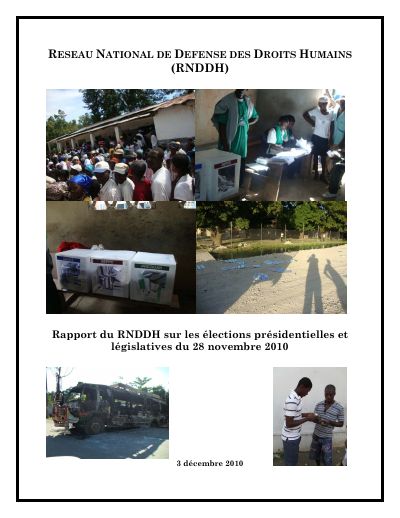
RNDDH report on the presidential and legislative elections of November 28, 2010
- The RNDDH counted 107 polling centers vandalized or burned, and says the real number is higher.
- The report states that the electoral list was not updated after the January 12, 2010 earthquake.
- The RNDDH concludes that the INITE platform was the main author of massive fraud and systematic violence.
- The RNDDH believes the fraud and violence were premeditated by the executive branch.
- It recommends repeating the vote in sabotaged areas before the second round.
The RNDDH deployed national and international observers across the country for the partial presidential and legislative elections of November 28, 2010 and published its observations on December 3, 2010. The report describes the sociopolitical context before the vote, including the reshuffled CEP, the earthquake of January 12, 2010, the cholera epidemic and problems with the electoral list. It then lists irregularities on voting day, such as late opening, late delivery of materials, lack of ballot secrecy, absence of guides for voters, the failure of the Centre d'Opération et de Vérification and insecurity.
A department-by-department account details fraud, ballot-box stuffing and violence, and the report also assesses observers, electoral staff and the role of the international community. The RNDDH counts 107 polling centers vandalized or burned and concludes that the INITE platform was the main author of massive fraud and systematic violence. It recommends securing polling centers, repeating the vote where it was sabotaged before the second round, investigating and punishing those responsible, and applying the electoral law.
How to cite
National Human Rights Defense Network (RNDDH), RNDDH report on the presidential and legislative elections of November 28, 2010, https://web.rnddh.org/wp-content/uploads/2012/04/Rapport-Elections-2010.pdf
- Rights holder
- Réseau National de Défense des Droits Humains (RNDDH)