
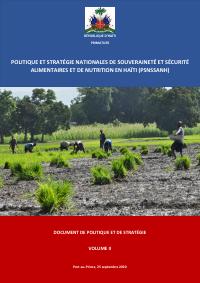
National Food Sovereignty, Food Security and Nutrition Policy and Strategy (PSNSSANH), Volume II: Policy and Strategy
- Carries the strategy behind Volume I's policy across 276 pages, with each of the four axes broken into pillars, and the pages marked DRAFT.
- Distributes the 35 measures and 25 national programs by ministry in Annex III with a figure for each, for a grand total of 45 billion.
- Concentrates the cost in two ministries: MTPTC at 25 billion, including 22 billion for road network extension and maintenance and 1.5 billion for irrigation perimeters, and MENFP at 11 billion, almost entirely the school canteen program based exclusively on local produce.
- Allocates 3.663 billion to MARNDR across sixteen programs, 2.7 billion to MAST for local food vouchers for the ultra-poor, and 1.112 billion to MSPP including 1 billion for the nutrition program.
- Sets out the context analysis as three acts, a deep crisis of agricultural production, urban migration and the impoverishment of the diet, and the lack of basic services with high malnutrition prevalence.
- Includes the draft legal text creating ONASAN, the national food and nutrition security office intended to be the implementing structure under MARNDR supervision.
Volume II of Haiti's national policy and strategy on food sovereignty, food security and nutrition, issued by the Prime Minister's office on September 25, 2020. Volume I states the policy in 36 pages; this is the 276-page working document behind it, and the pages carry a DRAFT marking, so it should be cited as the strategy document and not as an adopted instrument.
The structure is the same four axes, political, operational, institutional and cross-cutting, but here each pillar is written out: trade policy and the tariff profile, budget policy, the legal framework, and a preparedness system for food and nutrition emergencies under Axis 1; then production, processing and marketing, access to staple foods, the basic services nutrition depends on, and road and maritime infrastructure under Axis 2. The context analysis is set out as three acts, a deep crisis of agricultural production, urban migration and the impoverishment of the diet, and the lack of basic services with high malnutrition prevalence, followed by the causal relations of the vicious circle of food dependence, hunger and malnutrition.
What this volume adds beyond Volume I is the costing and the assignment. Annex III distributes the 35 measures and 25 national programs across ministries with a figure for each, reaching a grand total of 45 billion: MTPTC carries 25 billion, of which 22 billion for road network extension and maintenance and 1.5 billion for irrigation perimeters; MENFP 11 billion, almost all of it the school canteen program based exclusively on local produce; MARNDR 3.663 billion across sixteen programs; MAST 2.7 billion for local food vouchers for the ultra-poor; MSPP 1.112 billion; MEF 296 millions; MPCE, MICT and BRH smaller amounts. Reading the annex is the fastest way to see which ministry the strategy actually depends on.
How to cite
Office of the Prime Minister of Haiti, 2020, National Food Sovereignty, Food Security and Nutrition Policy and Strategy (PSNSSANH), Volume II: Policy and Strategy, http://agriculture.gouv.ht/wp-content/uploads/2026/07/PSNSSANH_Volume-2-octobre-2020.pdf